
www.industryemea.com
06
'26
Written on Modified on
Refractometers improve electrolyzer performance monitoring
Vaisala technology supports German partners in developing efficient green hydrogen electrolyzers through precise electrolyte measurement.
www.vaisala.com
The green hydrogen sector, within the broader clean energy and industrial electrochemistry industries, is advancing rapidly as part of global decarbonisation efforts. Hydrogen produced through water electrolysis using renewable energy offers a low-carbon alternative to fossil-based production routes.
A German engineering consortium—comprising iChemAnalytics GmbH, Dr.-Ing. Max Schlötter GmbH & Co. KG, and WHW Hillebrand—is developing a fully automated test bench for alkaline electrolyzers. The objective is to improve component durability, optimize electrode coatings, and enhance process efficiency under industrial operating conditions.
A key technical challenge lies in maintaining stable and measurable electrolyte conditions. Alkaline electrolyzers operate with highly concentrated potassium hydroxide (KOH) solutions, typically between 15% and 30%, which are chemically aggressive and sensitive to process variations. Fluctuations in electrolyte concentration directly affect cell voltage, reaction efficiency, and component lifespan.
Monitoring challenge in aggressive process conditions
During electrolysis, the concentration of KOH changes dynamically across the membrane separating the electrodes. These variations influence ion transport, phase boundary reactions, and degradation mechanisms within the cell.
Accurate, real-time monitoring of electrolyte concentration is therefore essential for controlling the process and evaluating new materials. However, the operating environment presents significant constraints: temperatures up to 80°C, pressures up to 5 bar, and continuous exposure to corrosive alkaline media.
Conventional laboratory analysis was not suitable due to delayed results, which prevent real-time process control. Alternative inline measurement technologies were limited in their ability to withstand such harsh conditions.
Selection of inline refractometry
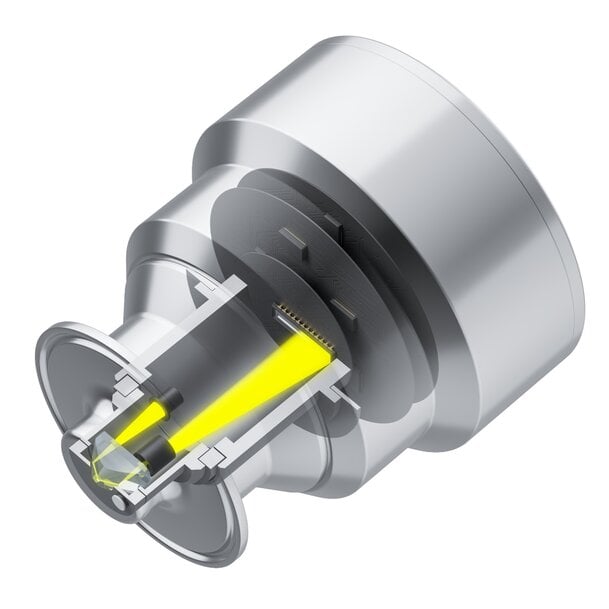
Following a global evaluation of available technologies, the project team selected inline refractometry as the most viable solution. Two Vaisala PR53AC inline refractometers were installed on the test bench to measure KOH concentration continuously on both sides of the membrane.
The decision was based on several technical factors:
- Capability to operate reliably in high-concentration KOH solutions
- Resistance to aggressive chemical environments
- Compatibility with inline installation and industrial process control systems
- Real-time measurement enabling continuous monitoring
The devices were delivered factory-calibrated and integrated into the system via standard 4–20 mA outputs connected to the PLC, enabling immediate deployment within the automated test bench.
Technology principle and operational advantages
The refractometers operate by measuring the critical angle of light refraction within the process medium. This optical parameter correlates directly with the concentration of dissolved substances, such as KOH.
Unlike alternative measurement methods, refractometry is not affected by bubbles, suspended particles, or fluid coloration. This ensures stable readings in dynamic electrolysis environments. In addition, optional automatic prism cleaning prevents fouling or scaling, maintaining measurement accuracy over long operating periods.
These characteristics are particularly relevant for electrolysis systems, where process stability and uptime are critical for both testing and industrial deployment.
Deployment and testing progress
The implementation of inline refractometry has enabled continuous monitoring and control of electrolyte conditions within the test bench. This has supported accelerated testing of electrode coatings and system configurations under varying temperatures and operating parameters.
Initial results from a four-week trial were presented at the ZVO Oberflächentage 2025 conference in Berlin, demonstrating stable performance and improved evaluation of new coating materials.
Results and technical impact
Although no quantitative performance metrics were disclosed, the integration of inline refractometry provides clear operational benefits:
Technology principle and operational advantages
The refractometers operate by measuring the critical angle of light refraction within the process medium. This optical parameter correlates directly with the concentration of dissolved substances, such as KOH.
Unlike alternative measurement methods, refractometry is not affected by bubbles, suspended particles, or fluid coloration. This ensures stable readings in dynamic electrolysis environments. In addition, optional automatic prism cleaning prevents fouling or scaling, maintaining measurement accuracy over long operating periods.
These characteristics are particularly relevant for electrolysis systems, where process stability and uptime are critical for both testing and industrial deployment.
Deployment and testing progress
The implementation of inline refractometry has enabled continuous monitoring and control of electrolyte conditions within the test bench. This has supported accelerated testing of electrode coatings and system configurations under varying temperatures and operating parameters.
Initial results from a four-week trial were presented at the ZVO Oberflächentage 2025 conference in Berlin, demonstrating stable performance and improved evaluation of new coating materials.
Results and technical impact
Although no quantitative performance metrics were disclosed, the integration of inline refractometry provides clear operational benefits:
- Enables real-time control of electrolyte concentration
- Improves reproducibility of electrochemical testing conditions
- Supports evaluation of long-life electrode coatings (target >80,000 hours)
- Enhances process stability and system efficiency
By ensuring accurate monitoring of KOH concentration, the system reduces variability in electrolysis performance and allows more precise optimization of materials and operating conditions.
Outlook: Supporting electrolyzer optimization
The automated test bench, supported by continuous electrolyte monitoring, provides a platform for developing high-performance electrolyzer components. As new coatings and materials are validated, the ability to control electrolyte balance will remain critical for scaling up green hydrogen technologies.
This case illustrates how advanced measurement technologies contribute to improving electrolysis systems and support the broader transition toward low-carbon energy infrastructure.
Edited by an industrial journalist, Lekshman Ramdas, with AI assistance.
www.vaisala.com
Outlook: Supporting electrolyzer optimization
The automated test bench, supported by continuous electrolyte monitoring, provides a platform for developing high-performance electrolyzer components. As new coatings and materials are validated, the ability to control electrolyte balance will remain critical for scaling up green hydrogen technologies.
This case illustrates how advanced measurement technologies contribute to improving electrolysis systems and support the broader transition toward low-carbon energy infrastructure.
Edited by an industrial journalist, Lekshman Ramdas, with AI assistance.
www.vaisala.com
