
Understanding Modern Remote I/O Systems in Industrial Automation
How Antaira Technologies supports high-performance distributed I/O with resilient industrial networking.
www.antaira.com
What Remote I/O Is and Why It Has Become an Industry Standard
In industrial automation, remote input/output (I/O)—also known as distributed I/O—refers to a system in which sensors and actuators are connected to an I/O module located near the field equipment rather than directly in the PLC cabinet. This architecture allows a controller, whether a PLC, DCS, RTU or industrial PC, to remain in a protected environment while field devices operate in areas affected by heat, vibration, moisture or chemical exposure.
Remote I/O modules collect data such as temperature, pressure, vibration, flow and light intensity and relay it over high-speed industrial Ethernet protocols including EtherNet/IP, PROFINET, Modbus TCP, Profibus or Sercos-based networks. An adapter module installed in the PLC rack ensures the remote I/O network communicates seamlessly with the controller’s backplane.
Why Remote I/O Systems Are Preferred Over Centralised Wiring
Remote I/O has dominated modern industrial design for more than two decades because it streamlines wiring, supports modular equipment design and adapts to diverse factory layouts. By positioning I/O modules close to the instrumentation, only short local cable runs are required, while the controller communicates over a single network link to multiple modules. This reduces wiring complexity, accelerates installation and makes system expansion more straightforward.
Channel-level diagnostics allow technicians to detect wire breaks, short circuits or voltage anomalies directly from PLC tags or HMIs, eliminating extensive manual troubleshooting. The architecture also allows I/O modules to be replaced quickly without rewiring entire bundles of field cables, which is particularly valuable in plants with continuous production cycles.
Key Challenges and What Users Must Consider
Despite its advantages, remote I/O introduces challenges that must be planned for. The entire architecture relies on stable communication between the PLC and remote modules. If this link is interrupted, both data collection and actuation can be affected unless redundancy protocols are implemented.
Configuration complexity can increase as systems expand, since each added module must be mapped and integrated. Cybersecurity is another essential consideration: without proper network segmentation using VLANs or firewalls, IP-based I/O systems may be exposed to broader plant networks or external threats. Latency can also pose problems in high-speed motion or safety-critical applications when using non-deterministic protocols such as EtherNet/IP or Modbus TCP.
Why Ethernet Switches Are Critical to Remote I/O Performance
Remote I/O networks depend heavily on managed industrial Ethernet switches to maintain speed, reliability and determinism. Switches ensure predictable packet flow between PLCs and distributed modules through bandwidth management, redundancy mechanisms, Quality of Service (QoS), IGMP snooping, diagnostics and security controls. Without these tools, remote I/O systems may experience jitter, congestion or communication loss—especially over long distances.
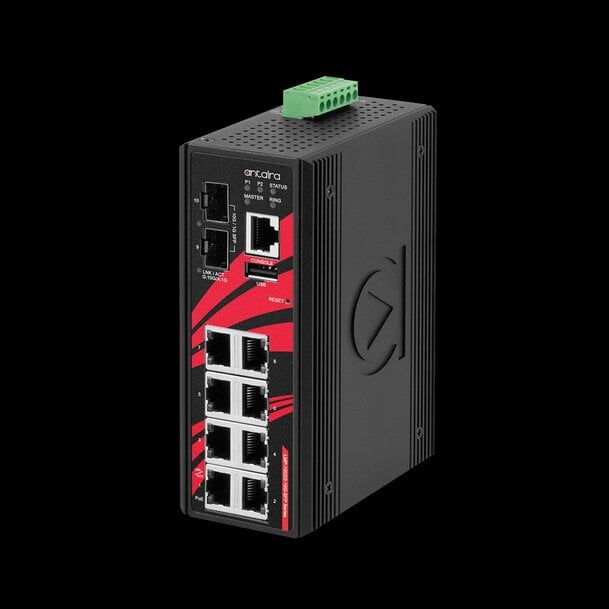
Antaira’s industrial Ethernet switches are engineered for these demanding environments. Many models support IEEE-compliant Power over Ethernet (PoE), allowing data and power to be delivered through a single cable to remote devices. This reduces infrastructure requirements and simplifies both installation and ongoing maintenance. In distributed architectures built on industrial Ethernet, the switch becomes the high-speed backbone that keeps remote I/O data moving safely and efficiently.
How Industrial Networking Expertise Enhances Remote I/O Deployments
The success of a remote I/O system depends not only on the I/O modules and PLCs but also on the resilience of the industrial network connecting them. With ruggedised switches, advanced management features and support for real-time automation protocols, Antaira Technologies continues to strengthen remote I/O deployments across manufacturing, energy, transportation and process industries.
Article by Henry Martel, Field Applications Engineer, Antaira Technologies, LLC
www.antaira.com
