
www.industryemea.com
18
'25
Written on Modified on
Saxony Establishes Coordinated Quantum Technology Research Network
Quantum Saxony, coordinated by leading Saxon research institutions including Fraunhofer IPMS, aims to accelerate the industrial transfer of quantum technologies in computing, communication, materials and sensing.
www.fraunhofer.de
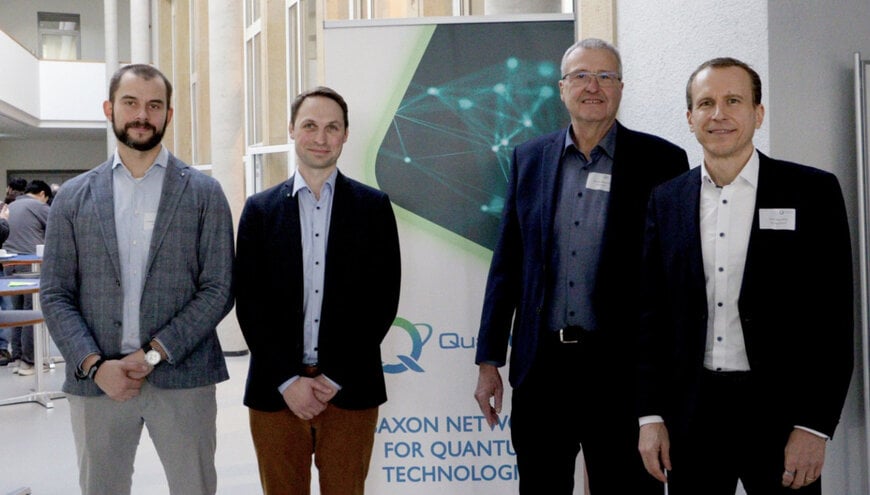
The Free State of Saxony has launched SAX-QT “Quantum Saxony,” a coordinated research network designed to consolidate regional expertise in quantum technologies and accelerate their transfer into industrial applications across Europe.
Strategic relevance of quantum technologies
Quantum sciences are increasingly recognized as enabling technologies for secure communication, high-performance computing, advanced materials and ultra-precise sensing. To address both scientific and economic requirements, Saxony has established Quantum Saxony as a structured collaboration between universities, non-university research institutes and industry. The network is coordinated by Zittau/Görlitz University of Applied Sciences, Fraunhofer Institutes for Photonic Microsystems (IPMS) and for Machine Tools and Forming Technology (IWU), and the Leibniz Institute for Solid State and Materials Research IFW Dresden.
The objective is to systematically pool expertise, further develop application-oriented research, and position Saxony as an internationally visible quantum technology hub aligned with European initiatives.
Public funding and European integration
The European Union and the Free State of Saxony are supporting the establishment phase of the network with €3 million in ERDF funding until the end of 2027. This setup period is intended to create a sustainable organizational structure with long-term national and international visibility. A key focus is close integration with European pilot lines, enabling coordinated technology development and faster industrial validation.
At the network’s launch event on 17 December 2025, Saxon State Minister for Science Sebastian Gemkow highlighted quantum technologies as a strategically important research field within Saxony’s scientific policy framework and Germany’s High-Tech Agenda. The network is positioned at the intersection of national, European and global quantum technology strategies, reflecting the growing economic relevance of the field.
Open platform for research, industry and skills development
Quantum Saxony is designed as an open platform that continuously integrates additional partners from academia, industry, start-ups and associations. By linking disciplines ranging from materials science and micro- and nanoelectronics to software development, the network aims to support end-to-end innovation pathways from fundamental research to industrial application.
In parallel, the network addresses workforce development through targeted education and continuing training programs. These initiatives are intended to qualify young specialists for careers in quantum research and technology-driven industries, supporting the long-term availability of skilled personnel.
Fraunhofer IPMS as a technology transfer interface
Fraunhofer IPMS plays a central coordinating role within SAX-QT, contributing expertise at the interface of microelectronics, semiconductor manufacturing and quantum technologies. With long-standing experience in application-oriented research and industrial collaboration, IPMS supports accelerated technology transfer from laboratory research to industrial-scale production.
An industry-grade cleanroom infrastructure enables testing of quantum materials and components under realistic manufacturing conditions, including pilot production at wafer level. This capability supports validation, scalability and early industrial adoption, particularly for start-ups and small and medium-sized enterprises.
Within Quantum Saxony, Fraunhofer IPMS collaborates with national and international partners such as Infineon, GlobalFoundries, RWTH Aachen University, imec, CEA-LETI, VTT and Forschungszentrum Jülich. These partnerships are intended to create measurable synergies across the innovation chain, from basic research and technology development to industrial deployment.
www.ipms.fraunhofer.com
