
www.industryemea.com
05
'26
Written on Modified on
Delta wireless charging powers autonomous intralogistics vehicles
Delta MOOVair systems enable Neumaier’s AGVs and forklifts to operate continuously without charging breaks.
www.delta-emea.com
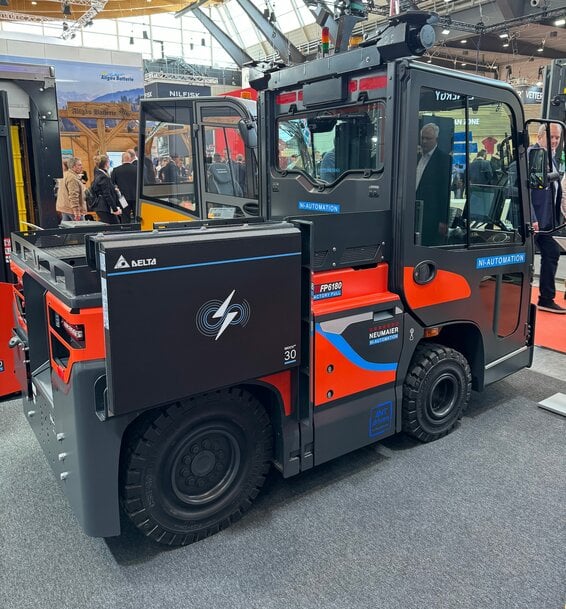
Moovair 30: Delta’s MOOVair 30 - a 30 kW wireless charging system for 80-volt operation
Inductive battery charging technology for autonomous tugger trains and counterbalanced forklifts – suitable for indoor and outdoor use.
In highly automated production environments, every second counts. Material flows are tightly synchronized, vehicles operate in perfect coordination, and downtime means not only lost time but also production risks. Especially in intralogistics - the heart of any manufacturing operation - a single interruption in the transport chain can bring entire processes to a standstill.
But what if charging breaks for tugger trains and forklifts simply disappeared?
That was the question posed by Neumaier Industry GmbH & Co. KG, a leading medium-sized provider of customized intralogistics solutions based in Hofstetten in the Black Forest. The company specializes in tugger train systems based on automated guided vehicles (AGVs), particularly for outdoor applications. Its portfolio ranges from automated tugger trains, forklifts, undercarriage shuttles, and low-/high-lift trucks to fully automated very-narrow-aisle solutions, conveyor systems, and logistics software. Neumaier develops tailored automation concepts for a wide variety of industries — serving sectors from automotive to leisure.
Neumaier was looking for a charging infrastructure that would enable 24/7 operation without manual intervention, operate maintenance-free, and remain reliable even under the harshest outdoor conditions. The biggest technical challenge is - the required 80-volt power supply, for which only a few industrial-grade systems exist on the market.
The Search for the Right Technology
Neumaier wanted a solution that would integrate seamlessly into highly automated logistics processes. Cable-based charging methods requiring manual plugging and unplugging were not an option — too error-prone and too maintenance-intensive. The focus quickly shifted to inductive charging, which is increasingly becoming the standard in modern intralogistics.
• Wireless systems offer several advantages:
• No exposed contacts
• No mechanical wear
• High protection against dust, water, and extreme temperatures
• Support for “opportunity charging” — short intermediate charges during operation
With Delta, Neumaier found the right partner. The global leader in power supplies, thermal management systems, and IoT-based automation solutions offers MOOVair, a portfolio of wireless charging systems from 1 kW to 30 kW - developed in Germany and manufactured in highly automated facilities in Slovakia.
In addition to EU conformity, short delivery routes, and local technical support, Delta’s key advantage was its ability to deliver an efficient, robust, and standards-compliant 80-volt solution.
As part of two customer projects - an autonomous outdoor tugger train and autonomous outdoor counterbalanced forklifts - Neumaier and Delta faced the challenge of integrating an efficient, robust, and maintenance-free charging system for continuous 24/7 operation.
Project 1: Autonomous Outdoor Tugger Train “Factory Train FT630”
For the conversion of a manual Linde P180 tractor into an autonomous outdoor tugger train with fully automated loading/unloading of tugger trailers and automatic battery charging, Neumaier relied on Delta’s MOOVair 30 - a 30 kW wireless charging system for 80-volt operation.
The system delivers up to 300 amperes and achieves 95% efficiency over a distance of up to 150 mm, even when the vehicle is slightly misaligned. The wireless energy transfer eliminates contact wear, significantly reduces maintenance, and enables fast, frequent intermediate charges without interrupting operation.
With its IP69 protection rating, the system is ideal for outdoor use, while Ethernet and CAN bus interfaces allow easy integration into existing fleet management systems. Another advantage: multiple vehicles can share one charging unit, saving space and reducing investment costs.
Inductive battery charging technology for autonomous tugger trains and counterbalanced forklifts – suitable for indoor and outdoor use.
In highly automated production environments, every second counts. Material flows are tightly synchronized, vehicles operate in perfect coordination, and downtime means not only lost time but also production risks. Especially in intralogistics - the heart of any manufacturing operation - a single interruption in the transport chain can bring entire processes to a standstill.
But what if charging breaks for tugger trains and forklifts simply disappeared?
That was the question posed by Neumaier Industry GmbH & Co. KG, a leading medium-sized provider of customized intralogistics solutions based in Hofstetten in the Black Forest. The company specializes in tugger train systems based on automated guided vehicles (AGVs), particularly for outdoor applications. Its portfolio ranges from automated tugger trains, forklifts, undercarriage shuttles, and low-/high-lift trucks to fully automated very-narrow-aisle solutions, conveyor systems, and logistics software. Neumaier develops tailored automation concepts for a wide variety of industries — serving sectors from automotive to leisure.
Neumaier was looking for a charging infrastructure that would enable 24/7 operation without manual intervention, operate maintenance-free, and remain reliable even under the harshest outdoor conditions. The biggest technical challenge is - the required 80-volt power supply, for which only a few industrial-grade systems exist on the market.
The Search for the Right Technology
Neumaier wanted a solution that would integrate seamlessly into highly automated logistics processes. Cable-based charging methods requiring manual plugging and unplugging were not an option — too error-prone and too maintenance-intensive. The focus quickly shifted to inductive charging, which is increasingly becoming the standard in modern intralogistics.
• Wireless systems offer several advantages:
• No exposed contacts
• No mechanical wear
• High protection against dust, water, and extreme temperatures
• Support for “opportunity charging” — short intermediate charges during operation
With Delta, Neumaier found the right partner. The global leader in power supplies, thermal management systems, and IoT-based automation solutions offers MOOVair, a portfolio of wireless charging systems from 1 kW to 30 kW - developed in Germany and manufactured in highly automated facilities in Slovakia.
In addition to EU conformity, short delivery routes, and local technical support, Delta’s key advantage was its ability to deliver an efficient, robust, and standards-compliant 80-volt solution.
As part of two customer projects - an autonomous outdoor tugger train and autonomous outdoor counterbalanced forklifts - Neumaier and Delta faced the challenge of integrating an efficient, robust, and maintenance-free charging system for continuous 24/7 operation.
Project 1: Autonomous Outdoor Tugger Train “Factory Train FT630”
For the conversion of a manual Linde P180 tractor into an autonomous outdoor tugger train with fully automated loading/unloading of tugger trailers and automatic battery charging, Neumaier relied on Delta’s MOOVair 30 - a 30 kW wireless charging system for 80-volt operation.
The system delivers up to 300 amperes and achieves 95% efficiency over a distance of up to 150 mm, even when the vehicle is slightly misaligned. The wireless energy transfer eliminates contact wear, significantly reduces maintenance, and enables fast, frequent intermediate charges without interrupting operation.
With its IP69 protection rating, the system is ideal for outdoor use, while Ethernet and CAN bus interfaces allow easy integration into existing fleet management systems. Another advantage: multiple vehicles can share one charging unit, saving space and reducing investment costs.
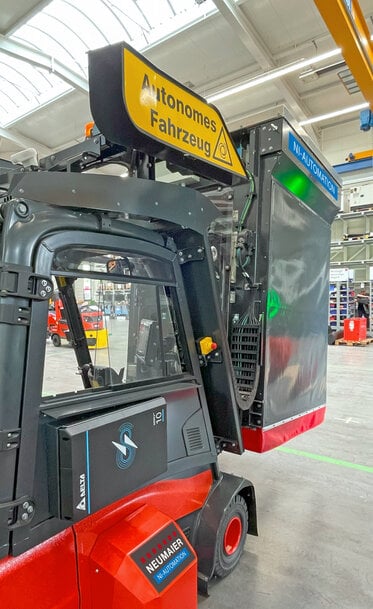
Project 2: Autonomous Outdoor Counterbalanced Forklifts FE616
Neumaier’s second project involved the conversion of several Linde E16 forklifts for autonomous outdoor operation. Here, Neumaier chose Delta’s MOOVair 10 - a 10 kW system providing up to 275 amperes of charging current.
In addition to the same benefits as the larger model - fully automatic, contactless charging with no mechanical wear on connectors - it features Delta’s patented Pad-Pad-Link (PPL) technology for wireless communication between the charging pad and vehicle.
Unlike Wi-Fi, Bluetooth, or infrared, PPL operates via a magnetic communication field outside the heavily used 2.4 GHz band. This makes it immune to radio interference and environmental factors such as dust, dirt, or moisture. The short communication range ensures precise, secure, and efficient data transmission, even in high-traffic environments - making it ideal for automated charging scenarios in modern intralogistics systems.
Integration and Implementation of Delta’s Wireless Solutions
Both aforementioned MOOVair systems were integrated directly during vehicle conversion. The requirements were demanding: rugged outdoor design (IP69), fully weatherproof, no exposed contacts, maintenance-free operation, secure communication, and complete automation of the charging process.
Thanks to close collaboration between Neumaier and Delta’s development teams, implementation progressed rapidly. The inductive charging solution proved particularly convincing due to its durability and reliability even under harsh environmental conditions.
Conclusion: A Milestone in Automated Intralogistics
With Delta’s MOOVair Wireless Charging Systems, Neumaier Industry has realized two intralogistics projects that demonstrate how wireless charging can fundamentally transform operations. The vehicles are always ready for use, maintenance and downtime have been drastically reduced, and integration into existing workflows is seamless.
For logistics decision-makers, this means higher productivity, better planning reliability, and a future-proof technology that meets both today’s and tomorrow’s demands.
The collaboration between Neumaier and Delta stands as a strong example of how innovation and practicality in Industry 4.0 can deliver tangible competitive advantages - and how charging breaks can finally become a thing of the past.
www.delta-emea.com
Unlike Wi-Fi, Bluetooth, or infrared, PPL operates via a magnetic communication field outside the heavily used 2.4 GHz band. This makes it immune to radio interference and environmental factors such as dust, dirt, or moisture. The short communication range ensures precise, secure, and efficient data transmission, even in high-traffic environments - making it ideal for automated charging scenarios in modern intralogistics systems.
Integration and Implementation of Delta’s Wireless Solutions
Both aforementioned MOOVair systems were integrated directly during vehicle conversion. The requirements were demanding: rugged outdoor design (IP69), fully weatherproof, no exposed contacts, maintenance-free operation, secure communication, and complete automation of the charging process.
Thanks to close collaboration between Neumaier and Delta’s development teams, implementation progressed rapidly. The inductive charging solution proved particularly convincing due to its durability and reliability even under harsh environmental conditions.
Conclusion: A Milestone in Automated Intralogistics
With Delta’s MOOVair Wireless Charging Systems, Neumaier Industry has realized two intralogistics projects that demonstrate how wireless charging can fundamentally transform operations. The vehicles are always ready for use, maintenance and downtime have been drastically reduced, and integration into existing workflows is seamless.
For logistics decision-makers, this means higher productivity, better planning reliability, and a future-proof technology that meets both today’s and tomorrow’s demands.
The collaboration between Neumaier and Delta stands as a strong example of how innovation and practicality in Industry 4.0 can deliver tangible competitive advantages - and how charging breaks can finally become a thing of the past.
www.delta-emea.com
