
www.industryemea.com
16
'26
Written on Modified on
Centrica deploys solar farm on steep industrial terrain
Custom ground-mounted system delivers renewable energy for manufacturing site despite slope and site constraints, supporting carbon reduction and operational continuity.
www.centrica.com
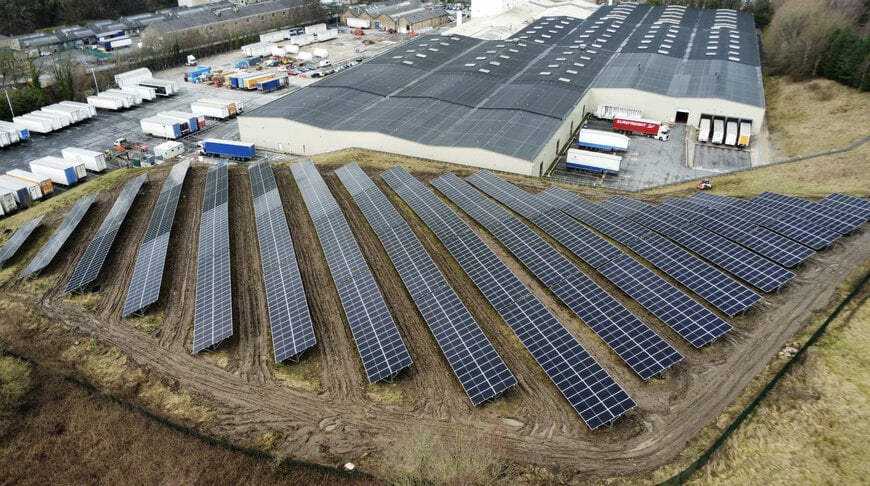
The industrial energy and manufacturing sector, particularly energy-intensive production such as foam processing and materials manufacturing, increasingly requires on-site renewable energy solutions that adapt to spatial and operational constraints. In this context, Centrica Business Solutions has delivered a ground-mounted solar installation for Carpenter Ltd in Glossop, overcoming challenging terrain conditions to enable on-site renewable generation.
The project involved the installation of a solar farm on a 14.62% sloped bank, a site previously considered unsuitable for development. Unlike standard flat-ground installations, the system required adaptive engineering approaches and specialized construction methods to ensure stability and safety during installation, particularly under winter conditions with high soil moisture.
Solar deployment on constrained industrial sites
The installation was developed after rooftop solar was ruled out due to ventilation requirements critical to the manufacturing process. This constraint led to the identification of an alternative ground-mounted solution, demonstrating how solar infrastructure can be adapted to complex industrial environments.
The completed system consists of 1,666 photovoltaic panels, generating approximately 1,025 MWh of electricity annually. This output contributes directly to on-site energy consumption, reducing reliance on grid electricity and supporting long-term energy cost management.
Engineering approach for sloped and unstable terrain
Constructing a solar array on a steep gradient introduces challenges related to structural stability, anchoring, and safe equipment operation. The project required tailored mounting structures and the use of specialist machinery capable of operating on uneven and mud-prone surfaces.
Careful planning and phased installation enabled the project team to manage risks associated with soil conditions and weather exposure. These measures ensured that installation could proceed efficiently while maintaining safety and alignment of the solar array.
Impact on carbon reduction and energy efficiency
The system is expected to reduce carbon emissions by approximately 116,150 kg of CO₂ in the first year, contributing to the manufacturer’s decarbonization strategy. In addition to emissions reduction, the project supports improved energy efficiency and resilience by integrating renewable generation directly into the production site.
Such installations are increasingly relevant for manufacturers seeking to meet sustainability targets while maintaining operational reliability.
Partnership and project delivery
The project was delivered in collaboration with Push Power Ltd, which provided engineering, procurement, and construction (EPC) expertise for the ground-mounted system. The partnership enabled optimization of the installation design to suit the challenging topography and site-specific constraints.
Biodiversity and site integration
In addition to energy generation, the project includes measures to achieve a 10% biodiversity net gain, aligning with regulatory expectations for solar developments. This reflects a broader approach to integrating renewable energy systems within local ecosystems while minimizing environmental impact.
Applications in industrial renewable energy deployment
This project illustrates how ground-mounted solar systems can be adapted for:
- Industrial facilities with limited rooftop availability
- Sites with uneven or sloped terrain
- Manufacturing environments requiring uninterrupted operations
- Companies targeting on-site renewable energy and carbon reduction
By applying customized engineering and site-specific design, solar installations can be extended to locations previously considered unsuitable, expanding the scope of renewable energy deployment in industrial sectors.
Edited by Natania Lyngdoh, Induportals Editor — Adapted by AI.
www.centrica.com
Edited by Natania Lyngdoh, Induportals Editor — Adapted by AI.
www.centrica.com
