
Battery Management IC for Automotive and Industrial Energy Storage
STMicroelectronics has updated its battery management portfolio with an integrated circuit designed for hybrid vehicles, electric vehicles, and high-voltage applications.
www.st.com
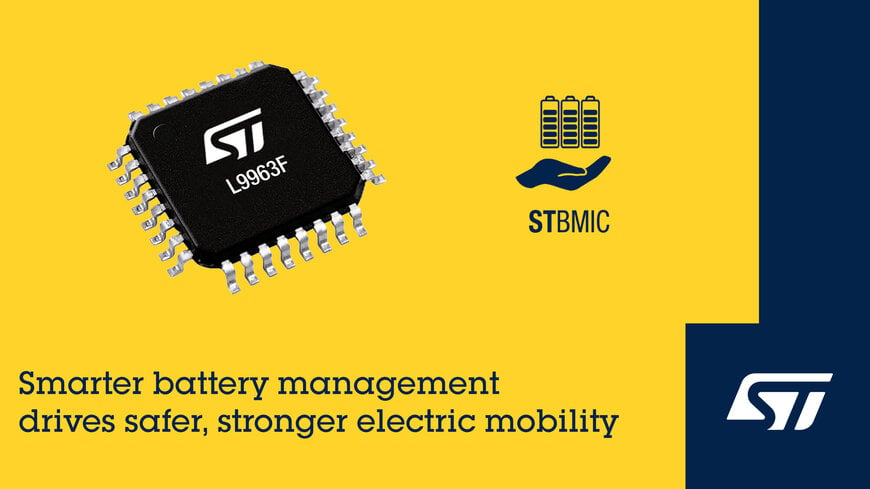
The L9963F automotive battery-management integrated circuit (IC) by STMicroelectronics provides monitoring and control functions for lithium battery packs. This component targets hybrid and full electric vehicles, along with industrial energy storage systems and 48V to 96V architectures. It serves as a fully compatible hardware and software replacement for the earlier L9963E model, allowing integration into existing system designs without requiring engineering modifications.
Scalability and System Architecture
A single L9963F device monitors between four and 14 stacked cells, addressing power applications up to 48V. System engineers can connect multiple ICs to manage larger arrays of up to 31 battery packs, enabling systems with a total of 434 series cells. Communication across these interconnected devices is managed through a 2.66Mbps isolated serial interface. This daisy-chain architecture ensures a maximum latency of 4µs between the first and the 31st device in the network. The IC also includes nine general-purpose input/output pins (GPIOs) and a Serial Peripheral Interface (SPI) for control and monitoring routines.
Measurement Precision and Synchronization
The integrated circuit executes fully synchronized current and voltage sampling, featuring a 0µs desynchronization delay between samples. It incorporates a 16-bit voltage analog-to-digital converter (ADC) that maintains a ±2mV maximum error margin within the 0.5V to 4.3V range. This synchronization accuracy extends across multiple stacked ICs. The device draws its operating power directly from the monitored battery pack. It integrates internal circuitry, including a voltage regulator and bootstrap mechanisms, to generate stable internal references and maintain measurement precision.
Safety Mechanisms and Diagnostics
To support functional safety requirements, the device features a fully redundant cell-measurement path equipped with an ADC swap capability, enabling limp-home functionality during system faults. Coulomb counting mechanisms within the component support battery pack overcurrent detection regardless of whether the vehicle ignition is engaged or disengaged.
The IC manages battery health by supporting cell-balancing currents of up to 200mA. A silent-balancing mode permits the integrated balancing-MOSFET drivers to remain active for a programmed duration after the system enters a low-power state. This mechanism maintains cell protection while minimizing energy consumption from the battery pack. The L9963F includes a comprehensive set of fault-detection and notification functions, is specified for ISO 26262 compliance, and is ASIL-D ready for functional-safety applications.
Additional Context: This section details technical specifications and competitive benchmarking not included in the original product announcement.
Comparable battery management integrated circuits in the 14-cell automotive category include devices utilizing similar isolated daisy-chain communication architectures. Benchmark criteria for these systems typically focus on ADC resolution, synchronization latency across multi-node configurations, and ASIL-D functional safety compliance levels. The 4µs latency across 31 nodes and the integrated redundant measurement paths align with standard communication requirements for high-voltage battery management systems in automotive environments.
Edited by an industrial journalist, Lekshman Ramdas, with AI assistance.
www.st.com
