
www.industryemea.com
03
'26
Written on Modified on
Bulk-Saving Calendering for Board Production
Voith develops a web-conditioning process that reduces fiber demand while maintaining board stiffness, printability, and surface performance.
voith.com
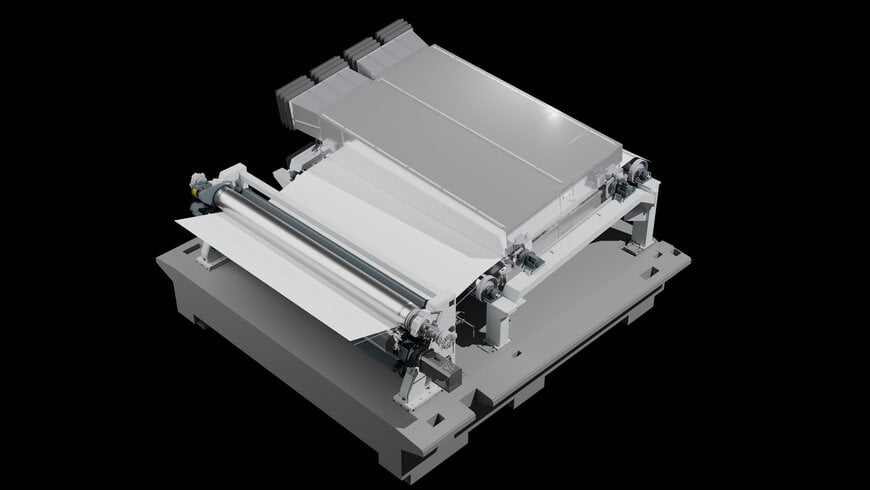
Voith has introduced a new calendering technology designed to improve material efficiency in board manufacturing. The solution combines controlled web conditioning and high-temperature calendering to reduce sheet compression, helping board producers lower fiber consumption while maintaining key product properties such as stiffness, bulk, and printability.
Fiber Efficiency Challenges in Board Manufacturing
Board producers face a longstanding process trade-off between surface quality and structural performance. Conventional calendering improves surface smoothness and printability by compressing the sheet between rolls. However, increased compression typically reduces bulk and bending stiffness, requiring additional fiber input to maintain product specifications.
As fiber costs continue to rise and sustainability targets place greater emphasis on resource efficiency, manufacturers are seeking process technologies that improve surface characteristics without compromising mechanical performance. EcoCal HiBulk was developed to address this challenge through a modified calendering approach that conditions the paper web before it enters the nip.
Web Conditioning Before Calendering
The technology combines three existing Voith process technologies into a single calendering concept.
The first stage uses the MCB Cooler system to cool the paper web throughout its thickness using an air-based cooling process. Immediately before calendering, the outer surface layer is selectively heated and humidified using steam through the OnQ ModuleCal system. The conditioned web is then processed in a high-temperature hard-nip calender.
This sequence alters the deformation behavior of different sheet layers. Cooling reduces the compressibility of the sheet core, while steam conditioning increases the deformability of the surface fibers. As a result, the required surface smoothness can be achieved at lower line loads than in conventional calendering processes.
Lower line loads reduce overall sheet compression, helping preserve bulk and bending stiffness while maintaining the surface characteristics required for printing applications.
Production Validation Under Industrial Conditions
The process was validated during production trials at a European board manufacturer operating a commercial paper machine. According to Voith, the trials demonstrated that the combination of steam application and reduced line loads lowered surface roughness while maintaining higher levels of bulk and bending stiffness compared with conventional calendering methods.
The validation is significant because bulk-saving technologies often show promising results under laboratory conditions but can be difficult to reproduce consistently in industrial-scale production. The reported trials indicate that the process can operate under commercial manufacturing conditions while maintaining stable product quality.
Applications for New and Existing Board Machines
The calendering solution has been designed for both greenfield board production lines and rebuild projects. Facilities that already use cooling systems or high-temperature calendering equipment may be able to integrate the process with a limited number of additional components.
This flexibility could reduce implementation costs and simplify modernization projects compared with complete calender replacements. Potential application areas include packaging board grades where stiffness, printability, and material efficiency directly influence product performance and production economics.
Process Mechanisms Supporting Bulk Preservation
The technical principle behind the process differs from conventional approaches that rely primarily on increasing pressure to improve smoothness. Instead, the method modifies the physical properties of the web before it reaches the calender nip.
By creating a less deformable core and a more deformable surface layer, the process concentrates deformation where it is needed to improve surface quality. This targeted deformation mechanism allows producers to achieve required roughness levels while minimizing losses in sheet thickness and structural rigidity.
For board manufacturers, maintaining bulk is particularly important because bending stiffness is strongly influenced by sheet thickness. Preserving thickness can therefore help maintain mechanical performance while reducing fiber usage.
Industrialization of Bulk-Saving Calendering Technology
The development builds on more than ten years of research and pilot-scale work related to bulk-saving calendering. Earlier studies investigated the effects of cooling, steam conditioning, and temperature-controlled calendering on board properties.
The new process combines these individual technologies into a repeatable production concept suitable for industrial operation. By integrating web conditioning with controlled calendering parameters, the system provides a practical approach for balancing material efficiency, product quality, and sustainability objectives in modern board production.
Additional Context
This section details technical specifications and competitive benchmarking not included in the original news release.
Several equipment suppliers, including Voith, Valmet, and ANDRITZ, offer calendering technologies designed to optimize surface quality while limiting reductions in bulk and stiffness. The distinguishing feature of the described process is the combination of full-sheet cooling, localized steam conditioning, and high-temperature hard-nip calendering within a single integrated workflow.
Compared with conventional hard-nip calendering, where smoothness improvements are primarily achieved through increased mechanical pressure, the process shifts part of the optimization to controlled thermal and moisture treatment of the web. This approach can reduce the line load required to achieve target surface characteristics, which is a recognized method for preserving board thickness and stiffness.
The technology is particularly relevant for packaging board manufacturers producing folding boxboard, coated recycled board, and similar grades where print quality, bending performance, and fiber efficiency must be balanced simultaneously. As sustainability initiatives continue to drive reductions in raw material consumption, process technologies that improve bulk retention are becoming increasingly important performance metrics in the paper manufacturing sector.
Edited by Aishwarya Mambet, Induportals Editor, with AI assistance.
www.voith.com
