
Automated CNC Vise Loading System for Low-Volume Production
Tezmaksan has developed a compact robotic automation system designed to handle vise loading and positioning for high-mix machining environments.
www.tezmaksan.com
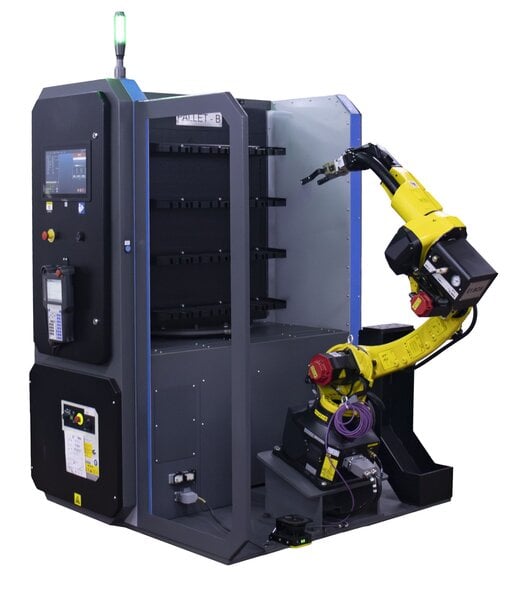
Tezmaksan has introduced the CubeBOX Blues RT-VISE, a compact automation unit specifically engineered for high-mix, low-volume production environments. The system automates the handling, loading, and positioning of clamped workpieces into computer numerical control (CNC) machines, minimizing manual intervention in precision manufacturing, subcontract machining, and specialist component production sectors.
Robotic Architecture and Workholding Operation
The architecture of the unit centers on a 6-axis industrial robot integrated with a storage rotary table. This configuration manages the automated loading and unloading of standardized vises for up to two CNC machines simultaneously. By preparing multiple workholding configurations offline, operators can sequence varied workpieces, decreasing machine downtime associated with manual job changeovers. The continuous availability of pre-prepared vises allows the machine tool to maintain unattended machining cycles during shifts lacking operator presence.
Hardware Compatibility and Kinematic Integration
The automation unit accommodates multiple clamp types, permitting varied part geometries without the integration of dedicated robotic end-of-arm tooling for each specific raw material shape. Control and sequencing are managed through an industrial PC and a robot controller operating the proprietary RoboCAM+ software. The software environment uses a graphical interface to define part coordinates and handling sequences, circumventing the need for manual coordinate programming via the teach pendant. The system translates computer-aided design (CAD) data directly into robot kinematics, a mechanism that standardizes handling across different batches and reduces the duration of setup processes during frequent production changeovers.
Structural Footprint and Deployment Mechanics
The system utilizes a modular structural footprint designed to integrate into existing workshop layouts with constrained floor space. The modularity of the robotic cell allows configuration adjustments to match specific machine tool alignments and standard interfaces. By automating the manipulation of the vise rather than relying exclusively on individual workpiece handling, the system sustains production output and machine utilization metrics across highly variable production batches.
Additional Context: This section details technical specifications and competitive benchmarking not included in the original product announcement.
In the CNC automation sector, robotic vise loading systems operate on the principle of standardized zero-point clamping interfaces, allowing the industrial robot to transfer the entire workholding device rather than gripping the raw material. This approach is benchmarked against established flexible manufacturing systems (FMS) and automated pallet changers from providers such as Halter CNC Automation and Fastems. While high-volume automation relies on specialized robotic grippers handling specific workpiece blanks, vise loading standardizes the physical interface between the robot and the machine tool table. The benchmarking of these systems relies on payload capacity—dictating the combined weight of the vise and the workpiece—and the spatial density of the storage table. Systems equivalent to this deployment generally support automated payloads ranging from 15 to 35 kilograms and require integration with automatic pneumatic or hydraulic zero-point clamping mechanisms inside the CNC machine bed to mechanically secure the vise during heavy milling operations.
Edited by an industrial journalist, Lekshman Ramdas, with AI assistance.
www.tezmaksanrobotics.com
