
www.industryemea.com
11
'26
Written on Modified on
High-Voltage PCB-Mount Relays for Electric Vehicle Charging Infrastructure
OMRON is introducing compact power-control components designed to replace traditional contactors, reducing weight and assembly costs in commercial high-energy applications.
industrial.omron.eu
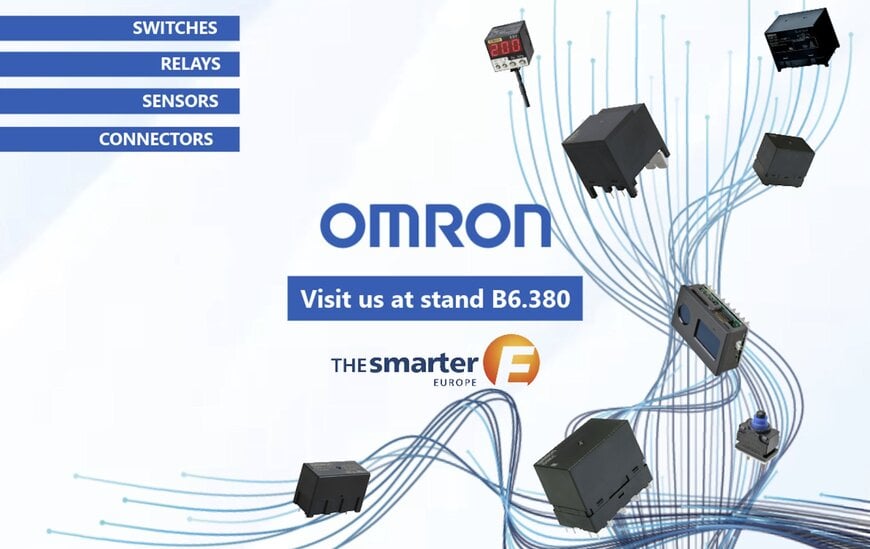
At the smarter E Europe exhibition 2026 (June 23-25), OMRON Electronic Components Europe is demonstrating its latest high-voltage alternating current (AC) and direct current (DC) power relays designed to optimize electric vehicle charging infrastructure and industrial energy storage systems. By transitioning from bulky electromechanical contactors to printed circuit board (PCB)-mounted relays, system designers can achieve significant reductions in physical hardware footprint, structural weight, and continuous coil power consumption across high-energy electrification platforms.
Technical Advancements in High-Energy Switching Systems
The migration toward higher-voltage architectures in solar microgenerators, DC fast-charging networks, and commercial energy storage systems requires highly efficient power isolation mechanisms. At the smarter E Europe exhibition, engineers have the opportunity to examine alternative switching architectures. Instead of relying on traditional large-scale contactors, power system architectures are increasingly utilizing specialized PCB-mounted relays alongside silicon carbide (SiC) MOSFET arrays capable of managing load voltages up to 3,300V. This structural approach minimizes the material footprint and lowers assembly complexity without compromising the thermal management required for high-energy load isolation. Additionally, these systems can integrate smart environmental hardware, such as connected weather sensors, to facilitate Internet of Things (IoT) operational monitoring.
Relay Specifications and Fault Detection Integration
Operating continuous high-power loads requires specific hardware configurations to maintain safe isolation and long operational life cycles. The G9KA series AC relays operate at continuous ratings of up to 300A and 1KV. To support predictive maintenance protocols, both the G9KA and the high-capacity 1,500V G9KD DC power relays feature an optional auxiliary contact mechanism. This hardware addition enables real-time physical weld detection, ensuring the hardware conforms directly to IEC/EN60947-4-1 specifications for electromechanical control gear. Furthermore, the G9KJ series supplies a compact footprint specifically optimized for high-voltage pre-charge actuation within 1,500V DC fast-charging stations.
Architectural Comparisons for Footprint Reduction
The practical engineering impact of replacing traditional contactors with PCB-mount relays is verifiable through direct hardware layout comparisons. A primary industry use case involves a safety-isolation circuit conventionally managed by a standard 230A dual-contactor configuration. By substituting this legacy setup with a functionally identical prototype incorporating six 260A G9KA AC relays, manufacturers generate a substantially lighter and smaller component layout. This reduction in volumetric requirements directly enables the design of slimmer wallbox EV chargers and more densely packed energy storage modules while maintaining continuous fault-detection capabilities.
Additional Context
This section details technical specifications and competitive benchmarking not included in the original news release.
The competitive landscape for high-voltage PCB relays used in electric vehicle charging and energy storage includes component manufacturers such as Panasonic Industry, TE Connectivity, and Hongfa. For example, Panasonic’s HE relay series and TE Connectivity’s high-current PCB relays are designed for similar power switching applications where physical space is highly constrained. When evaluating 300A-class PCB-mounted relays against standard sealed contactors, engineers benchmark critical metrics including initial contact resistance, which is typically engineered below 0.2 milliohms to minimize thermal dissipation under continuous loads.
The industry shift from 400V to 800V and 1,500V architectures in DC fast chargers requires components like the G9KD and G9KJ to maintain extended creepage and clearance distances while mitigating severe arc events associated with high-voltage DC disruption. By incorporating magnetic arc-blowout technologies, compact PCB relays can effectively interrupt high-voltage direct currents, matching the breaking capacity of physically larger traditional contactors while significantly reducing required holding power.
Edited by Aishwarya Mambet, Induportals Editor, with AI assistance.
www.omron.com
