
www.industryemea.com
15
'26
Written on Modified on
Rolls-Royce Partners to Advance Advanced Nuclear Technologies in UK
Collaboration with UKNNL and JAEA accelerates advanced reactor development and next-generation nuclear fuel technologies.
www.rolls-royce.com
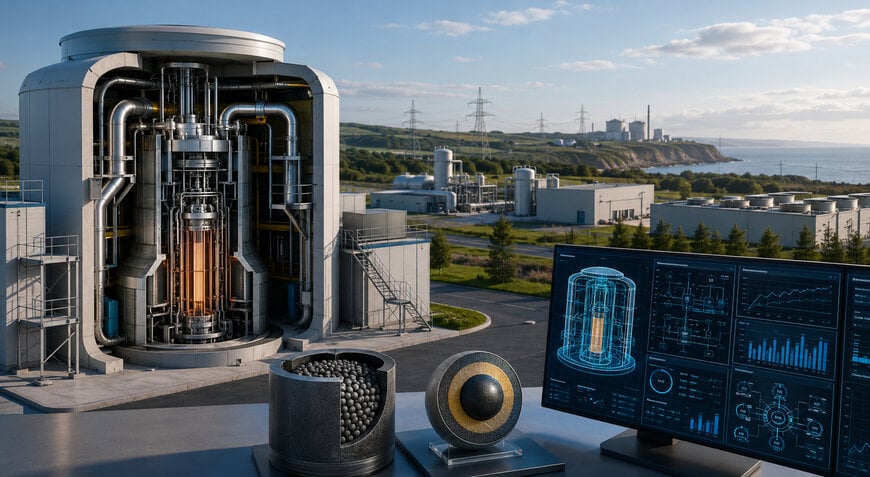
AI Generated Image
The engineering group Rolls-Royce, the United Kingdom National Nuclear Laboratory, and the Japan Atomic Energy Agency have entered into a formal trilateral partnership to accelerate the research, development, and deployment of advanced modular reactors. Under two distinct Memorandums of Cooperation signed at London during an official state visit by the Prime Minister of Japan, Sanae Takaichi, the three entities are establishing a structured framework to introduce next-generation civil nuclear technology into the British energy network.
This industrial collaboration expands the advanced nuclear technologies portfolio of Rolls-Royce beyond its existing small modular reactor initiatives. Within this framework, the United Kingdom National Nuclear Laboratory will leverage its domestic nuclear research infrastructure, while the Japan Atomic Energy Agency provides specialized technical expertise in high-temperature gas systems to achieve early commercial deployment.
Technical Challenges and Energy Resilience
The partnership addresses the critical industrial requirement for decentralized, non-intermittent power and high-temperature thermal energy. Traditional civil nuclear infrastructure relies heavily on large-scale light-water reactors, which require extensive coastal footprints and fixed grid connections, making them unsuitable for off-grid industrial complexes, remote civil facilities, or strategic defense installations.
Furthermore, conventional industrial manufacturing sectors require high-temperature process heat for operations such as hydrogen production, chemical synthesizing, and steel manufacturing. Achieving rapid decarbonization across these heavy industries requires an energy source capable of operating at elevated thermodynamic levels while ensuring absolute safety margins under extreme thermal conditions without the risk of core degradation.
Traction Architecture and Fuel Technology
The primary technical solution deployed through this partnership is the High-Temperature Gas-Cooled Advanced Modular Reactor platform. Unlike traditional water-cooled systems, these reactors utilize an inert gas, typically helium, as a primary coolant, allowing for operating temperatures that significantly exceed those of standard nuclear assets. The compact and modular layout allows the reactor components to be factory-fabricated and rapidly assembled on-site, providing predictable build timelines and scalable power outputs tailored to localized industrial loads.
To guarantee safety under high-temperature regimes, the reactor architecture relies on Coated Particle Fuel. This fuel system is composed of individual uranium spheres encapsulated within multiple protective layers of silicon carbide and pyrolytic carbon. This micro-encapsulation acts as a miniature containment structure, retaining fission products and ensuring structural integrity even during severe transient thermal events, mitigating the possibility of catastrophic fuel melting.
Digital Engineering and Fleet Integration
The collaborative program integrates joint technical research to progress the formal qualification and manufacturing standards of the particle fuel within the United Kingdom. By establishing an open ecosystem of technical innovation, the partners gain reciprocal access to specialized testing facilities and simulation laboratories.
The physical deployment strategy involves designing digital monitoring systems and predictive diagnostic interfaces to monitor core physics and thermal hydraulics in real time. This technical data is structured to integrate with future automated control platforms, validating the operational reliability of the modular reactors across civil and defense use cases before widespread network integration.
Edited by Natania Lyngdoh, Induportals editor, assisted by AI.
www.rolls-royce.com
The engineering group Rolls-Royce, the United Kingdom National Nuclear Laboratory, and the Japan Atomic Energy Agency have entered into a formal trilateral partnership to accelerate the research, development, and deployment of advanced modular reactors. Under two distinct Memorandums of Cooperation signed at London during an official state visit by the Prime Minister of Japan, Sanae Takaichi, the three entities are establishing a structured framework to introduce next-generation civil nuclear technology into the British energy network.
This industrial collaboration expands the advanced nuclear technologies portfolio of Rolls-Royce beyond its existing small modular reactor initiatives. Within this framework, the United Kingdom National Nuclear Laboratory will leverage its domestic nuclear research infrastructure, while the Japan Atomic Energy Agency provides specialized technical expertise in high-temperature gas systems to achieve early commercial deployment.
Technical Challenges and Energy Resilience
The partnership addresses the critical industrial requirement for decentralized, non-intermittent power and high-temperature thermal energy. Traditional civil nuclear infrastructure relies heavily on large-scale light-water reactors, which require extensive coastal footprints and fixed grid connections, making them unsuitable for off-grid industrial complexes, remote civil facilities, or strategic defense installations.
Furthermore, conventional industrial manufacturing sectors require high-temperature process heat for operations such as hydrogen production, chemical synthesizing, and steel manufacturing. Achieving rapid decarbonization across these heavy industries requires an energy source capable of operating at elevated thermodynamic levels while ensuring absolute safety margins under extreme thermal conditions without the risk of core degradation.
Traction Architecture and Fuel Technology
The primary technical solution deployed through this partnership is the High-Temperature Gas-Cooled Advanced Modular Reactor platform. Unlike traditional water-cooled systems, these reactors utilize an inert gas, typically helium, as a primary coolant, allowing for operating temperatures that significantly exceed those of standard nuclear assets. The compact and modular layout allows the reactor components to be factory-fabricated and rapidly assembled on-site, providing predictable build timelines and scalable power outputs tailored to localized industrial loads.
To guarantee safety under high-temperature regimes, the reactor architecture relies on Coated Particle Fuel. This fuel system is composed of individual uranium spheres encapsulated within multiple protective layers of silicon carbide and pyrolytic carbon. This micro-encapsulation acts as a miniature containment structure, retaining fission products and ensuring structural integrity even during severe transient thermal events, mitigating the possibility of catastrophic fuel melting.
Digital Engineering and Fleet Integration
The collaborative program integrates joint technical research to progress the formal qualification and manufacturing standards of the particle fuel within the United Kingdom. By establishing an open ecosystem of technical innovation, the partners gain reciprocal access to specialized testing facilities and simulation laboratories.
The physical deployment strategy involves designing digital monitoring systems and predictive diagnostic interfaces to monitor core physics and thermal hydraulics in real time. This technical data is structured to integrate with future automated control platforms, validating the operational reliability of the modular reactors across civil and defense use cases before widespread network integration.
Edited by Natania Lyngdoh, Induportals editor, assisted by AI.
www.rolls-royce.com
