
www.industryemea.com
17
'26
Written on Modified on
Alfa Laval transforms heat exchanger maintenance
A Swedish district energy provider optimized heat exchanger maintenance with condition-based monitoring, reducing unnecessary cleanings, eliminating 42 hours of downtime, and improving thermal efficiency.
www.alfalaval.com
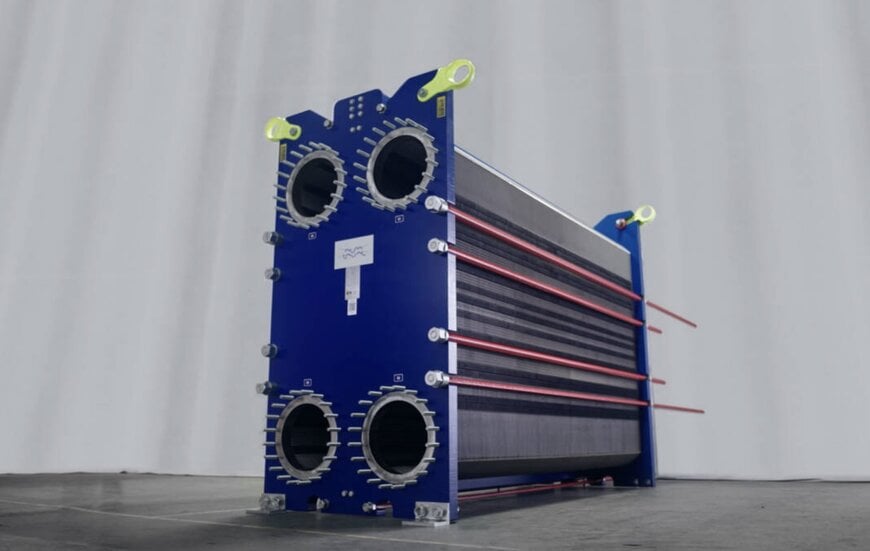
Application Area: Industrial Heat Exchanger Performance Monitoring, Thermal Efficiency Optimization, Predictive Maintenance Systems
Industry Sector: Utilities, District Energy, HVAC, Process Engineering
A Swedish district energy provider has adopted Alfa Laval Performance Monitoring software to replace its legacy, calendar-based cleaning schedules across its urban cooling network. The technical deployment integrates continuous sensor data acquisition and specialized analytics to transition from a fixed maintenance routine to a condition-based, predictive framework. By analyzing a full year of continuous operational profiles across six gasketed plate heat exchangers, the organization eliminated systemic operational guesswork, optimized thermal heat transfer efficiency, and reduced annual mechanical downtime.
Overcoming Thermal Degradation and Calendar-Based Maintenance Inefficiencies
District energy system providers operate under strict commercial metrics directly tied to the thermal efficiency of their heat exchanger fleets. Within cooling networks, any baseline loss in heat transfer capacity caused by micro-scale surface fouling directly decreases the total cooling energy available for commercial sale. Historically, the provider managed this thermal degradation by executing a rigid, unverified maintenance schedule: three chemical cleaning-in-place (CIP) procedures per unit during peak summer months (June through August), supplemented by mandatory manual mechanical cleanings in April and September.
Operationally, this fixed-interval maintenance methodology introduced severe process inefficiencies. Lacking real-time diagnostic visibility or localized thermal resistance data, maintenance crews could not verify whether a specific heat exchanger actually required cleaning based on its physical internal state. This lack of structural data resulted in redundant cleaning cycles, unnecessary material wear, escalated water and energy consumption, and avoidable equipment downtime during high-demand operating seasons. To solve these performance tracking limitations and lower carbon emissions, the utility integrated cloud-connected performance monitoring sensors to build a data-backed operational baseline.
Deploying Condition-Based Analytics to Optimize Heat Transfer Architecture
The installation and deployment of the performance monitoring ecosystem transformed the utility's field operations from a reactive routine into an audited digital workflow:
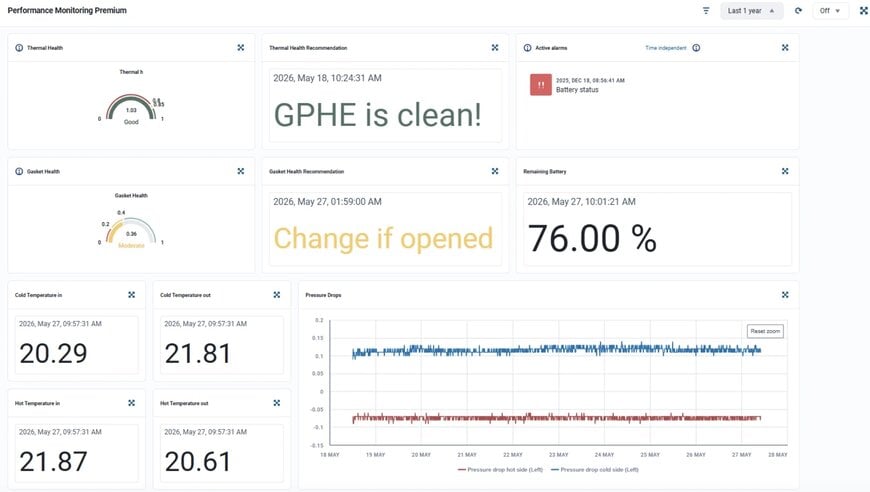
- Continuous Sensor Data Acquisition: Alfa Laval installed specialized digital sensors across all six target gasketed plate heat exchangers. These units continuously stream real-time operational parameters—including differential pressures, volumetric flow rates, and fluid temperatures—capturing precision data profiles across peak seasonal cooling loads.
- Algorithmic Refinement and Collaborative Analysis: Throughout a one-year pilot deployment, data scientists and utility engineers worked in close collaboration to refine the monitoring system's predictive algorithms. This process ensured that the analytics engine accurately accounted for site-specific thermal loads and the unique fouling characteristics of the city’s cooling infrastructure.
- Deep-Dive Diagnostic Reporting: Following the pilot period, the aggregated sensor data underwent a deep-dive analysis to evaluate the physical efficacy of previous maintenance tasks. The resulting personalized technical report mathematically proved that the third peak-summer CIP cycle across the fleet provided no measurable thermal improvement, confirming that two strategically timed CIP procedures per peak season were sufficient to maintain the required heat transfer coefficient.
- Resource and Fleet Optimization: By acting on these data-driven insights, the energy provider permanently reduced its peak-season cleaning requirements by 33%. This maintenance adjustment directly saved 42 hours of annual physical downtime, while simultaneously lowering local water consumption, cleaning-chemical energy use, and the facility's overall carbon footprint.
Additional Context
The section below examines the technical specifications and operational benchmarks not included in the original application story.
Thermodynamic Impact of Fouling and Condition-Based Cleaning
In industrial plate heat exchangers, fouling manifests as an insulated layer of biological growth, mineral scaling, or particulate sedimentation along the internal plate corrugations. This accumulation alters the overall heat transfer coefficient of the unit. The inverse of the overall heat transfer coefficient is determined by summing the thermal resistances of both the hot and cold fluid convective layers, the thickness and thermal conductivity of the underlying metal plate, and the localized fouling factor.
As the fouling factor increases due to unmonitored particulate accumulation, the overall heat transfer capacity drops, demanding a higher log mean temperature difference to transfer the identical thermal load. Traditional calendar schedules often result in cleaning cycles being performed either too late—causing prolonged periods of degraded thermal efficiency—or too early, which induces unnecessary mechanical stress and chemical wear on elastomeric gaskets. Transitioning to sensor-driven predictive monitoring allows operators to isolate the exact value of the fouling factor in real time, triggering a CIP sequence only when the threshold matches optimal economic and thermodynamic tipping points.
Predictive Monitoring vs. Traditional Maintenance Methodologies
Transitioning from fixed calendar scheduling to a continuous, sensor-driven digital twin framework alters key performance metrics across utility operations:
The section below examines the technical specifications and operational benchmarks not included in the original application story.
Thermodynamic Impact of Fouling and Condition-Based Cleaning
In industrial plate heat exchangers, fouling manifests as an insulated layer of biological growth, mineral scaling, or particulate sedimentation along the internal plate corrugations. This accumulation alters the overall heat transfer coefficient of the unit. The inverse of the overall heat transfer coefficient is determined by summing the thermal resistances of both the hot and cold fluid convective layers, the thickness and thermal conductivity of the underlying metal plate, and the localized fouling factor.
As the fouling factor increases due to unmonitored particulate accumulation, the overall heat transfer capacity drops, demanding a higher log mean temperature difference to transfer the identical thermal load. Traditional calendar schedules often result in cleaning cycles being performed either too late—causing prolonged periods of degraded thermal efficiency—or too early, which induces unnecessary mechanical stress and chemical wear on elastomeric gaskets. Transitioning to sensor-driven predictive monitoring allows operators to isolate the exact value of the fouling factor in real time, triggering a CIP sequence only when the threshold matches optimal economic and thermodynamic tipping points.
Predictive Monitoring vs. Traditional Maintenance Methodologies
Transitioning from fixed calendar scheduling to a continuous, sensor-driven digital twin framework alters key performance metrics across utility operations:
- Maintenance Trigger: Traditional fixed-interval maintenance relies on arbitrary time intervals, such as fixed calendar months or operating hours, regardless of actual internal scaling. Conversely, condition-based monitoring calculates real-time thermal degradation thresholds and exact fouling factor limits to initiate service.
- Downtime Management: Under a calendar-based approach, downtime is high because scheduled cleanings take critical units offline during peak summer demand without a verified operational need. In contrast, sensor-driven operations maximize equipment uptime during peak seasons by eliminating unneeded maintenance windows.
- Resource Efficiency: Traditional cleaning frameworks are inefficient, resulting in uniform chemical usage and high water consumption from repetitive, unverified CIP flushes. Switching to a condition-based infrastructure yields high resource efficiency, significantly decreasing chemical and water use due to a documented 33% drop in annual process requirements.
- Asset Lifecycle Protection: Legacy maintenance schedules offer reduced asset protection, as excessive chemical exposure and frequent physical teardowns accelerate plate deformation and gasket fatigue. Predictive monitoring extends asset life because minimized cleaning frequencies prevent premature degradation of plates and sealing materials.
By anchoring utility maintenance decisions within a validated thermodynamic monitoring platform, district energy operators can precisely bridge the gap between high system availability and minimized operational expenditure.
Edited by Romila DSilva, Induportals Editor, with AI assistance.
www.alfalaval.com
Edited by Romila DSilva, Induportals Editor, with AI assistance.
www.alfalaval.com
