
www.industryemea.com
23
'26
Written on Modified on
Heat recovery innovation boosts efficiency in flower bulb processing
Using Danfoss ICF Flexline technology, Dijksma Koudetechniek developed a combined heating and cooling solution that eliminates gas boilers while delivering precise climate control for flower bulb processing.
www.danfoss.com

Application Area: Industrial Heat Recovery, Refrigeration Cycle Integration, Combined Heating and Cooling Systems
Industry Sector: Agriculture, Agro-food, Industrial Refrigeration, HVAC
Dutch refrigeration specialist Dijksma Koudetechniek has deployed the Danfoss ICFD defrost module within a unified industrial refrigeration system to transition from legacy, fossil-fuel-reliant agricultural heating setups to an integrated, low-emission thermal configuration. The technical deployment connects an ICF Flexline™ valve station directly into a closed-loop heat recovery cycle. By utilizing a float-based condensate drain framework rather than traditional pressure-controlled regulator valves, the installation maintains baseline compressor volumetric capacity, mitigates flash gas losses, and provides simultaneous heating and cooling under fluctuating structural thermal loads.
Overcoming Capacity Losses and Fossil-Fuel Dependencies in Climate-Controlled Drying
Agricultural processing operations—particularly flower bulb drying networks—require strict regulation of temperature, air velocity, relative humidity, and ambient ethylene levels to protect raw product quality. Historically, facilities managed these overlapping climate vectors through decoupled thermal architectures, utilizing centralized industrial refrigeration plants for cooling while depending entirely on independent, gas-fired boilers to generate the high-temperature thermal loads required for drying. This division resulted in high fossil-fuel expenses and substantial carbon footprints.
To eliminate fossil-fuel dependencies, systems integrators have sought to tap into the high-temperature discharge lines of active refrigeration cycles to capture waste heat. However, redirecting hot gas to function as a primary heating source rather than a short-term evaporator defrost mechanism introduces severe operational risks to the compressor plant. In legacy setups utilizing conventional internal pressure-regulated valves (IPVs), the elevated pressure drop across the valve reduces the available compressor capacity during high-heat injection phases.
Furthermore, running traditional defrost floats at elevated condensation stages between 40°C and 50°C risked mechanical float collapse, unmetered flash gas bypass, and severe condensate return issues inside the low-pressure accumulator. To solve these dynamic fluid-handling constraints, protect compressor performance, and achieve reliable, tool-free operation beyond conventional temperature limits, Dijksma Koudetechniek initiated a specialized float-regulated pilot deployment.
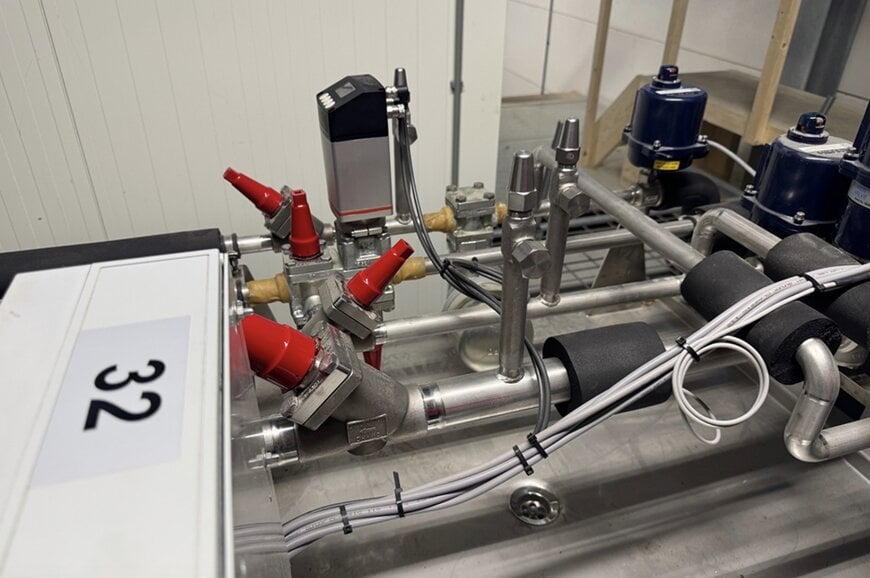
Deploying Mechanical Float Controls to Optimize High-Temperature Heat Recovery
The implementation of the float-based digital and mechanical infrastructure transforms industrial heat-pump loops into a continuous, software-monitored thermal network:
- High-Temperature Hot Gas Injection: The engineering design integrates the Danfoss ICF Flexline™ valve station with an ICFD module to manage direct hot gas injection into the facility's evaporators. The configuration relies entirely on the mechanical refrigeration loop to provide high-capacity heat recovery, condensing the gaseous refrigerant at operational levels reaching up to 40°C to 50°C.
- Liquid-Only Condensate Drainage: Operating as a purely mechanical liquid drain valve, the internal float mechanism opens exclusively when liquid refrigerant accumulates within the valve housing. This functional tracking ensures that only fully condensed liquid refrigerant returns to the suction accumulator, keeping flash gas generation to a minimum and raising the baseline thermodynamic efficiency of the cycle.
- Compressor Capacity Stabilization: Shifting from an IPV configuration to a float-dependent drainage mechanism removes the artificial system pressure constraints that cause suction-pressure dips. By maintaining a steady pressure differential across the expansion loop, the system protects core compressor volumetric capacity during intensive heating runs, enabling the permanent decommissioning of the facility's fossil-fuel gas boilers.
- Reduced Separator Float Loading: The precise mechanical modulation of the hot gas line improves condensate handling during combined heating and cooling operations. This precise flow reduces the volumetric surge load applied to the main economizer (ECO) separator floats, establishing a self-regulating, adjustments-free installation that has since been scaled up across additional processing cells.

Additional Context
The section below examines the technical specifications not included in the original case study.
Fluid Dynamics of Float-Based vs. Pressure-Controlled Refrigerant Drainage
In industrial refrigeration plants configured for heat recovery, managing the state of the refrigerant leaving the heat-exchanger coils is crucial to safeguarding compressor longevity and maximizing coefficient of performance (COP) metrics.
When a system utilizes an internal pressure-regulated valve (IPV), the valve modulates based on upstream vapor pressure thresholds. This method introduces a variable pressure drop that can penalize the system's suction pressure baseline, forcing the compressor to work against an artificial pressure differential and lowering its overall volumetric efficiency.
Conversely, a float-based system like the ICFD relies on the physical density difference between the liquid and gaseous states of the refrigerant. The float valve modulates its orifice area solely based on the liquid level within the chamber:
The section below examines the technical specifications not included in the original case study.
Fluid Dynamics of Float-Based vs. Pressure-Controlled Refrigerant Drainage
In industrial refrigeration plants configured for heat recovery, managing the state of the refrigerant leaving the heat-exchanger coils is crucial to safeguarding compressor longevity and maximizing coefficient of performance (COP) metrics.
When a system utilizes an internal pressure-regulated valve (IPV), the valve modulates based on upstream vapor pressure thresholds. This method introduces a variable pressure drop that can penalize the system's suction pressure baseline, forcing the compressor to work against an artificial pressure differential and lowering its overall volumetric efficiency.
Conversely, a float-based system like the ICFD relies on the physical density difference between the liquid and gaseous states of the refrigerant. The float valve modulates its orifice area solely based on the liquid level within the chamber:
- Flash Gas Suppression: By maintaining a reliable liquid seal over the drain orifice, the mechanical float prevents high-pressure vapor from short-circuiting back to the low-pressure receiver, cutting flash gas losses.
- Mass Flow Optimization: Liquid-only drainage maximizes the latent heat rejection capacity inside the heat-exchanger coils by keeping the internal heat transfer surfaces completely free of liquid logging without manipulating system pressure lines.
- Thermal Range Extension: Standard defrost floats are typically limited to lower condensation ranges (under 20°C). Moving the mechanical float's structural reliability up to 50°C allows industrial loops to deliver high-temperature heat recovery without requiring secondary external booster pumps.
Structural Comparison of Thermal Management Configurations
Transitioning from independent, fossil-fueled heating setups to an integrated, float-regulated refrigeration heat recovery loop introduces core structural changes to industrial utility designs:
Transitioning from independent, fossil-fueled heating setups to an integrated, float-regulated refrigeration heat recovery loop introduces core structural changes to industrial utility designs:
- Thermal Synchronization: Under a traditional decoupled setup, heating and cooling loops are completely fragmented, causing separate gas boilers and refrigeration compressors to run concurrently without thermal communication. An integrated, float-regulated loop provides fully unified thermal synchronization, capturing waste energy directly from the cooling cycle to feed the heating grid via a single mechatronic workflow.
- Compressor Capacity Maintenance: Traditional pressure-controlled hot gas injection systems experience reduced compressor capacity due to the downstream suction-pressure dips caused by valve throttling. A float-regulated setup delivers continuous capacity preservation, maintaining stable suction pressures by relying entirely on mechanical liquid level thresholds to route condensate.
- Maintenance and Setup Complexity: Legacy modulated lines feature high operational complexity, requiring routine sensor calibration, electronic tuning, and manual software adjustments to account for shifting seasonal drying profiles. A purely mechanical float-drain system maintains low complexity, operating automatically via localized buoyancy physics to deliver tool-free control across all seasonal thermal ranges.
Edited by Romila DSilva, Induportals Editor, with AI assistance.
