
www.industryemea.com
03
'26
Written on Modified on
General Atomics Launches EXCALIBUR X-Ray Calibration System
General Atomics has introduced EXCALIBUR, an integrated laboratory metrology system designed to inspect and calibrate X-ray optical components, thin films, and Bragg crystals.
www.ga.com
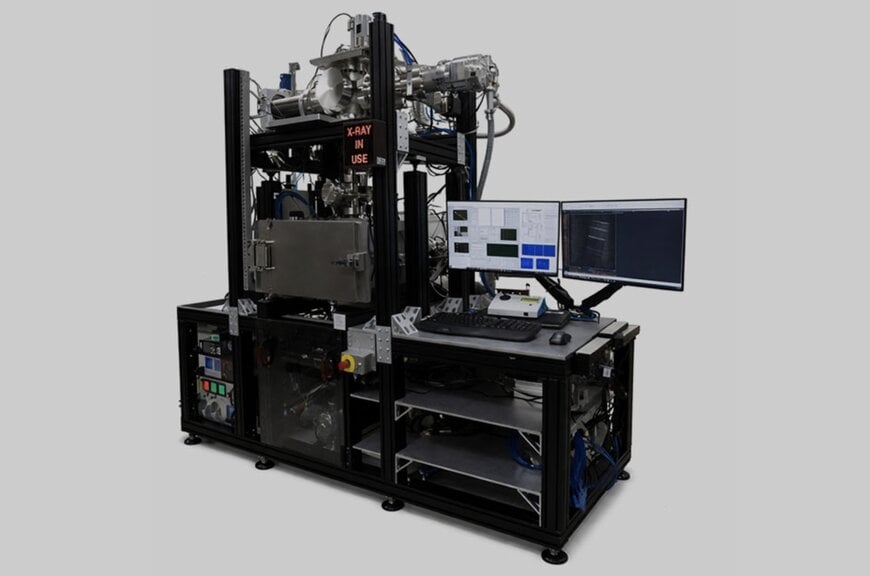
Scientists at General Atomics have unveiled EXCALIBUR (Experimental X-ray CALIBration UseR facility), a laboratory system engineered to measure and calibrate X-ray equipment for industrial research and manufacturing. The platform integrates X-ray sources, high-resolution detectors, imaging cameras, automated sample-handling instruments, and analytical software tools into a single compact footprint. The system characterizes material composition, transmission efficiency, and areal mass density without introducing mechanical or structural damage to the test specimen.
Component Metrology and Manufacturing Defect Detection
Advanced X-ray architectures depend on precise thin films, engineered coatings, and specialized foils to serve as filter windows that shape incident beams, maintain structural vacuum seals, and shield downstream detector electronics. The thickness profiles of these materials vary from the sub-micron scale to dimensions comparable to plastic sheeting.
Standard thin-film manufacturing processes allow thickness variations ranging from 10% to 20%, a baseline tolerance that can introduce significant discrepancies during high-energy-density experiments. EXCALIBUR mitigates this variability by providing high-throughput mapping capabilities across multiple spatial points on a single sample or across dozens of discrete samples within a single multi-sample batch, delivering repeatable metrology data within a standard laboratory setting.
Haibo Huang, Director of the Center of Excellence in Advanced Diagnostics at General Atomics, stated that the system accelerates rapid prototyping loops, metrology-informed performance modeling, and high-precision calibration workflows. The system is designed to provide rapid data feedback loops across high-technology sectors, including:
- Fusion Energy & Plasma Science: Quantifying diagnostic component behavior under intense high-temperature loads.
- Semiconductors: Verifying structural boundaries and thin-film uniformity during deposition steps.
- Sensors & Space Technologies: Assuring sensor longevity and performance metrics under high-radiation profiles.
Crystal Calibration and Diffraction Topography
Beyond the inspection of amorphous foils and coatings, the laboratory system is configured to calibrate X-ray Bragg crystals. These crystalline optics isolate specific X-ray wavelengths to resolve the spectral emissions of an active plasma experiment, mapping metrics such as ion temperature, electronic density, physical bulk movement, micro-turbulence, and localized structural impurities. Because microscopic structural defects or lattice strain variations within the crystal directly degrade spectral resolution, precise calibration is required before deployment in high-radiation experimental chambers.
General Atomics validated the system's performance metrics in a technical paper published in the peer-reviewed journal Plasma Physics and Controlled Fusion. The validation program utilized the laboratory infrastructure to calibrate a quartz crystal arranged in a specific transmission configuration known as Laue geometry.
Ruben Santana, Scientist and Project Lead in Inertial Fusion Technology at General Atomics, noted that high-precision X-ray crystals are traditionally calibrated at large-scale synchrotron facilities. Because access to synchrone beamlines is strictly rationed and rarely integrated into commercial crystal fabrication lines, finished components are frequently deployed in high-energy experiments without precise empirical baseline efficiency tracking. The standalone laboratory platform addresses this infrastructure gap by transferring high-accuracy calibration capabilities directly onto the manufacturer's floor.
Additional Context
This section details technical specifications not included in the original news release.
X-ray metrology and crystal calibration traditionally rely on high-flux synchrotron radiation facilities, which use relativistic electron storage rings and insertion devices (undulators or wigglers) to generate highly coherent, tunable X-ray beams. Replicating this capability within a localized laboratory instrument requires substituting the synchrotron source with a compact, high-brightness micro-focus X-ray tube or a liquid-metal-jet anode source. These compact sources focus an accelerated electron beam onto a small spot size on a target metal (such as copper, molybdenum, or tungsten), producing high-intensity characteristic K-alpha emissions alongside a continuous bremsstrahlung spectrum. The resulting divergent beam is conditioned using multi-layer capillary optics or asymmetric crystal monochromators to deliver a highly collimated, monochromatic X-ray probe beam to the sample stage.
When evaluating Bragg crystals in a Laue geometry configuration, the X-ray beam passes completely through the body of the crystal, and diffraction occurs from internal lattice planes rather than reflecting off the outer surface as seen in Bragg geometry.
To map structural imperfections, the automated instrument mounts the crystal on a high-precision, multi-axis motorized goniometer capable of sub-arcsecond angular steps. As the goniometer rocks the crystal through the exact Bragg angle, a high-dynamic-range photon-counting pixel detector logs the spatial intensity profile of the transmitted and diffracted beams. Internal software algorithms analyze the resulting rocking curve widths and peak intensities, calculating the integrated reflectivity and mapping localized lattice distortions, variations in interplanar spacing, or internal structural defects across the entire volume of the crystal matrix.
Edited by Romila DSilva, Induportals Editor, with AI assistance.
Beyond the inspection of amorphous foils and coatings, the laboratory system is configured to calibrate X-ray Bragg crystals. These crystalline optics isolate specific X-ray wavelengths to resolve the spectral emissions of an active plasma experiment, mapping metrics such as ion temperature, electronic density, physical bulk movement, micro-turbulence, and localized structural impurities. Because microscopic structural defects or lattice strain variations within the crystal directly degrade spectral resolution, precise calibration is required before deployment in high-radiation experimental chambers.
General Atomics validated the system's performance metrics in a technical paper published in the peer-reviewed journal Plasma Physics and Controlled Fusion. The validation program utilized the laboratory infrastructure to calibrate a quartz crystal arranged in a specific transmission configuration known as Laue geometry.
Ruben Santana, Scientist and Project Lead in Inertial Fusion Technology at General Atomics, noted that high-precision X-ray crystals are traditionally calibrated at large-scale synchrotron facilities. Because access to synchrone beamlines is strictly rationed and rarely integrated into commercial crystal fabrication lines, finished components are frequently deployed in high-energy experiments without precise empirical baseline efficiency tracking. The standalone laboratory platform addresses this infrastructure gap by transferring high-accuracy calibration capabilities directly onto the manufacturer's floor.
Additional Context
This section details technical specifications not included in the original news release.
X-ray metrology and crystal calibration traditionally rely on high-flux synchrotron radiation facilities, which use relativistic electron storage rings and insertion devices (undulators or wigglers) to generate highly coherent, tunable X-ray beams. Replicating this capability within a localized laboratory instrument requires substituting the synchrotron source with a compact, high-brightness micro-focus X-ray tube or a liquid-metal-jet anode source. These compact sources focus an accelerated electron beam onto a small spot size on a target metal (such as copper, molybdenum, or tungsten), producing high-intensity characteristic K-alpha emissions alongside a continuous bremsstrahlung spectrum. The resulting divergent beam is conditioned using multi-layer capillary optics or asymmetric crystal monochromators to deliver a highly collimated, monochromatic X-ray probe beam to the sample stage.
When evaluating Bragg crystals in a Laue geometry configuration, the X-ray beam passes completely through the body of the crystal, and diffraction occurs from internal lattice planes rather than reflecting off the outer surface as seen in Bragg geometry.
To map structural imperfections, the automated instrument mounts the crystal on a high-precision, multi-axis motorized goniometer capable of sub-arcsecond angular steps. As the goniometer rocks the crystal through the exact Bragg angle, a high-dynamic-range photon-counting pixel detector logs the spatial intensity profile of the transmitted and diffracted beams. Internal software algorithms analyze the resulting rocking curve widths and peak intensities, calculating the integrated reflectivity and mapping localized lattice distortions, variations in interplanar spacing, or internal structural defects across the entire volume of the crystal matrix.
Edited by Romila DSilva, Induportals Editor, with AI assistance.
