
www.industryemea.com
20
'26
Written on Modified on
DLR Tests Robotic Remote Hazardous Substance Detection Platform
The German Aerospace Center has developed and tested multi-sensor autonomous robotic systems utilizing laser spectroscopy and AI for standoff hazardous material detection.
www.dlr.de
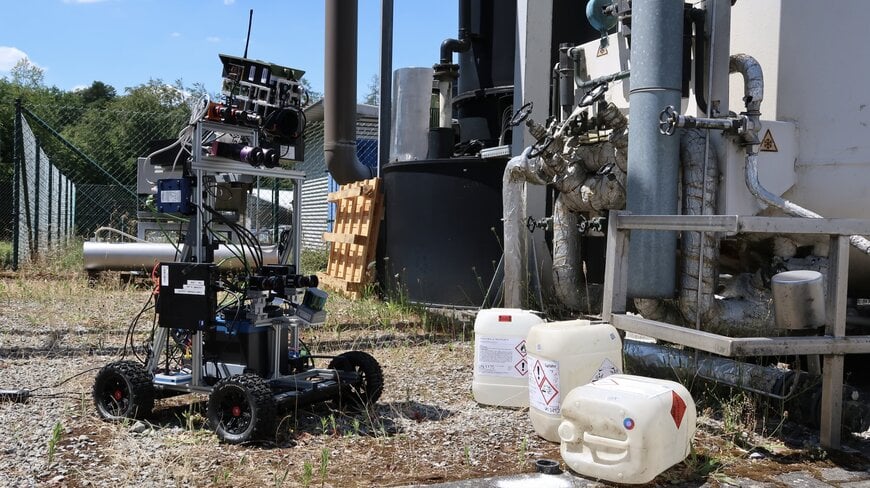
Rover equipped with DLR sensor system examines powder from a container (simulated scenario). Credit: DLR (CC BY-NC-ND 3.0)
The German Aerospace Center (DLR) has developed and tested remote detection platforms deployed on autonomous rovers and drones to evaluate hazardous chemical and biological substances from a distance. The systems combine compact multi-sensor arrays, laser spectroscopy, and artificial intelligence algorithms to provide rapid situational assessments for emergency first responders.
Multi-Sensor Autonomous Detection and Mapping
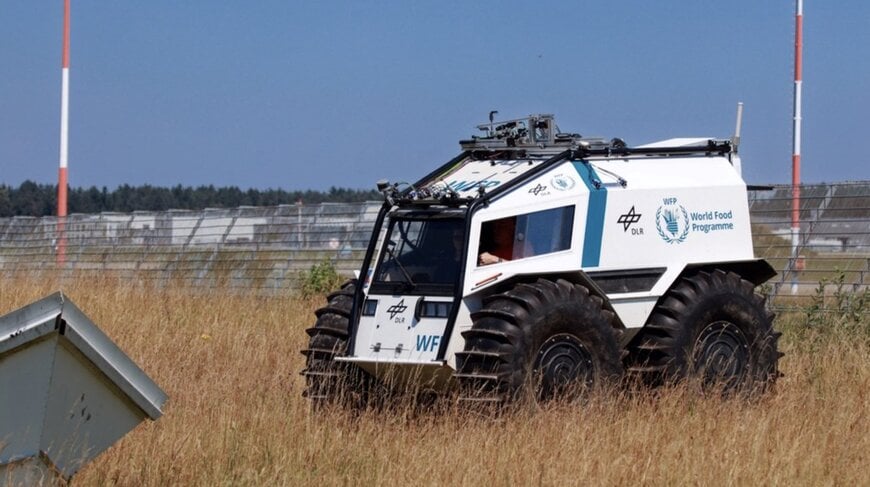
To minimize physical risk during emergency response operations, the development efforts center on automating hazard reconnaissance through multi-sensor integration. The system combines multispectral cameras, laser measurement techniques, and artificial intelligence data processing to identify liquid and powdered solid threats autonomously. Mounted on unmanned ground platforms—such as small rovers or larger vehicles like the SHERP robotic platform tested at DLR's Oberpfaffenhofen facility—the system navigates target areas to detect anomalies without manual intervention.
During initial test runs, the system identified suspicious containers, drums, and localized powder or liquid spill patches across road surfaces and open terrain. Following visual identification, integrated laser spectroscopy instruments evaluate the target locations from distances of several meters without direct physical contact. By measuring the interaction between incident laser light and the target substance, the optical system performs direct, on-site detection, classification, and identification of chemical and biological hazards.
Environmental Simulation and Airborne Sampling Systems
The technology suite was developed by the DLR Institute of Technical Physics in collaboration with the DLR Institute of Software Technology and the DLR Institute of Robotics and Mechatronics. System validation included laboratory evaluations conducted alongside Germany's Federal Office of Civil Protection and Disaster Assistance (BBK) and the Bundeswehr Research Institute for Protective Technologies and CBRN Protection (WIS). Operational simulations were executed at DLR's Lampoldshausen site, utilizing specialized process engineering infrastructure built to replicate real-world chemical processing facilities.
According to Thomas Dekorsy, Director of the DLR Institute of Technical Physics, detection and identification methods vary based on the specific properties of each hazardous substance, requiring automated multi-sensor integration to allow systems to navigate target zones, locate objects, and determine substance categories independently.
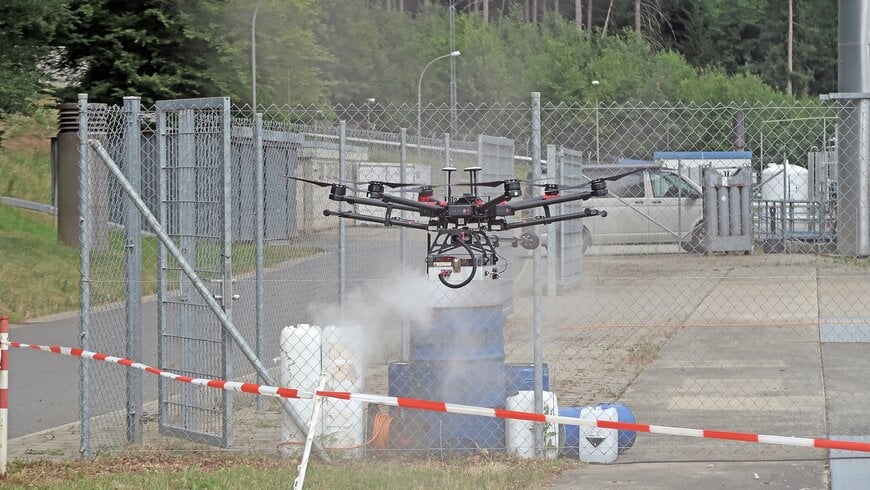
To address airborne threats released during fires, industrial accidents, technical failures, or deliberate acts, DLR developed an aerial sampling platform on behalf of the BBK. Mounted on drones or mobile platforms, the system collects ambient gas and aerosol samples remotely for subsequent laboratory analysis, replacing manual sampling methods that required responders to enter hazardous areas in protective gear.
Additional Context
This section details technical specifications not included in the original news release.
Standoff optical detection of hazardous substances typically relies on active laser spectroscopy techniques, including Laser-Induced Breakdown Spectroscopy (LIBS), Raman spectroscopy, and Laser-Induced Fluorescence (LIF). In LIBS setups, high-energy nanosecond laser pulses focused through a Cassegrain telescope onto a target sample induce microplasma formation at distances up to tens of meters. As the excited ions cool, they emit element-specific atomic spectra that allow quantitative elemental identification without sample preparation.
For molecular identification of organic compounds, standoff Raman spectroscopy measures inelastic photon scattering shifts caused by molecular vibrational modes. Collection optics—comprising high-aperture telescopes and high-throughput diffraction spectrometers—focus the scattered return signal onto cooled charge-coupled device (CCD) detectors. Time-gated detectors synchronize with pulsed laser illumination to suppress ambient daylight and background fluorescence, yielding high signal-to-noise ratios during field operations.
Edited by Romila DSilva, Induportals Editor, with AI assistance.
The German Aerospace Center (DLR) has developed and tested remote detection platforms deployed on autonomous rovers and drones to evaluate hazardous chemical and biological substances from a distance. The systems combine compact multi-sensor arrays, laser spectroscopy, and artificial intelligence algorithms to provide rapid situational assessments for emergency first responders.
Multi-Sensor Autonomous Detection and Mapping
To minimize physical risk during emergency response operations, the development efforts center on automating hazard reconnaissance through multi-sensor integration. The system combines multispectral cameras, laser measurement techniques, and artificial intelligence data processing to identify liquid and powdered solid threats autonomously. Mounted on unmanned ground platforms—such as small rovers or larger vehicles like the SHERP robotic platform tested at DLR's Oberpfaffenhofen facility—the system navigates target areas to detect anomalies without manual intervention.
During initial test runs, the system identified suspicious containers, drums, and localized powder or liquid spill patches across road surfaces and open terrain. Following visual identification, integrated laser spectroscopy instruments evaluate the target locations from distances of several meters without direct physical contact. By measuring the interaction between incident laser light and the target substance, the optical system performs direct, on-site detection, classification, and identification of chemical and biological hazards.
Sensor system for detecting hazardous substances on the SHERP robotic platform. Credit: DLR (CC BY-NC-ND 3.0)
Environmental Simulation and Airborne Sampling Systems
The technology suite was developed by the DLR Institute of Technical Physics in collaboration with the DLR Institute of Software Technology and the DLR Institute of Robotics and Mechatronics. System validation included laboratory evaluations conducted alongside Germany's Federal Office of Civil Protection and Disaster Assistance (BBK) and the Bundeswehr Research Institute for Protective Technologies and CBRN Protection (WIS). Operational simulations were executed at DLR's Lampoldshausen site, utilizing specialized process engineering infrastructure built to replicate real-world chemical processing facilities.
According to Thomas Dekorsy, Director of the DLR Institute of Technical Physics, detection and identification methods vary based on the specific properties of each hazardous substance, requiring automated multi-sensor integration to allow systems to navigate target zones, locate objects, and determine substance categories independently.
To address airborne threats released during fires, industrial accidents, technical failures, or deliberate acts, DLR developed an aerial sampling platform on behalf of the BBK. Mounted on drones or mobile platforms, the system collects ambient gas and aerosol samples remotely for subsequent laboratory analysis, replacing manual sampling methods that required responders to enter hazardous areas in protective gear.
Drone-based investigation of airborne hazardous substances. Credit: DLR (CC BY-NC-ND 3.0)
Additional Context
This section details technical specifications not included in the original news release.
Standoff optical detection of hazardous substances typically relies on active laser spectroscopy techniques, including Laser-Induced Breakdown Spectroscopy (LIBS), Raman spectroscopy, and Laser-Induced Fluorescence (LIF). In LIBS setups, high-energy nanosecond laser pulses focused through a Cassegrain telescope onto a target sample induce microplasma formation at distances up to tens of meters. As the excited ions cool, they emit element-specific atomic spectra that allow quantitative elemental identification without sample preparation.
For molecular identification of organic compounds, standoff Raman spectroscopy measures inelastic photon scattering shifts caused by molecular vibrational modes. Collection optics—comprising high-aperture telescopes and high-throughput diffraction spectrometers—focus the scattered return signal onto cooled charge-coupled device (CCD) detectors. Time-gated detectors synchronize with pulsed laser illumination to suppress ambient daylight and background fluorescence, yielding high signal-to-noise ratios during field operations.
Edited by Romila DSilva, Induportals Editor, with AI assistance.
www.dlr.de
