
www.industryemea.com
21
'26
Written on Modified on
Hexagon brings precision metrology to large scale manufacturing automation
Hexagon SpatialAnalyzer adds its first OPC UA client, bringing real-time metrology data directly into automated production and assembly workflows.
hexagon.com
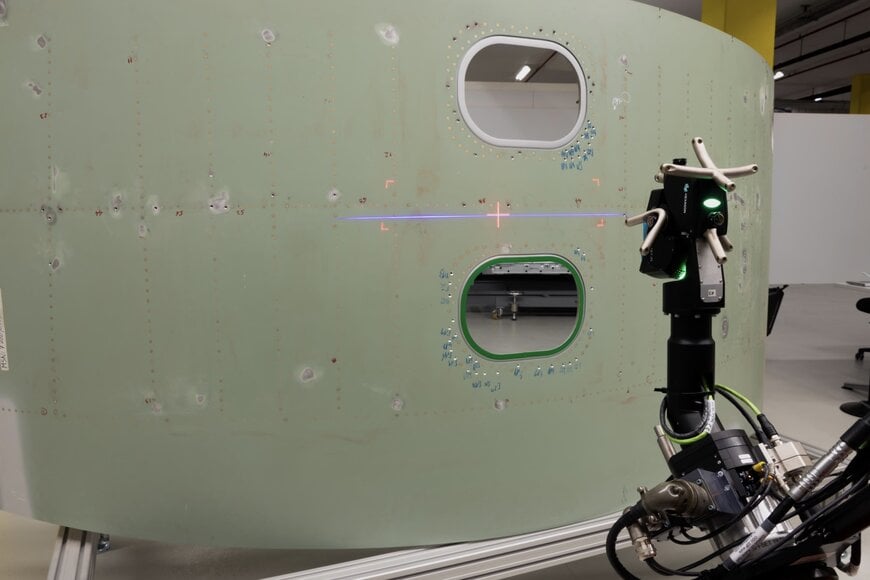
Hexagon’s Manufacturing Intelligence division has introduced OPC UA support in SpatialAnalyzer, its software suite for large-scale metrology and measurement alignment. The integration connects high-precision laser measurement systems directly to the industrial control systems operating industrial robots and automated production lines, aiming to address accuracy constraints in large-format robotic manufacturing.
Large-Format Automation and Industry Demand
Large-format manufacturing across aerospace, energy, and shipbuilding sectors faces operational pressure to increase production volume while maintaining structural precision tolerances. In the commercial aviation sector, Forecast International’s May 2026 Airbus and Boeing orders and deliveries report indicated that combined commercial aircraft order backlogs surpassed 16,000 aircraft at the end of May 2026, representing approximately ten years of production at current delivery rates.
While industrial robotics supply physical reach for large structures, standalone robots lack the inherent positional accuracy required for high-tolerance tasks such as precision hole drilling. OPC UA operates as an encrypted, standardized communication protocol linking industrial control systems, such as Programmable Logic Controllers (PLCs) and robotic controllers, to enable automated metrology feedback loops.
Technical Capabilities and Software Architecture
The OPC UA client implementation includes native encryption and authentication protocols for secure data transmission across industrial networks. The software update provides 25 new Measurement Plan (MP) and Software Development Kit (SDK) commands, allowing system integrators and software engineers to build automated metrology workflows.
Zach Rogers, Product Manager for SpatialAnalyzer at Hexagon, noted that while industrial robots are necessary for large-format manufacturing, alignment challenges increase with component scale. Rogers stated that SpatialAnalyzer functions to orchestrate quality inspection and metrology-assisted manufacturing processes for OEMs, system integrators, and line builders across standard metrology hardware.
Robot Calibration Appliance and Hardware Ecosystem
Alongside the software update, Hexagon introduced SARCA (SpatialAnalyzer Robot Calibration Appliance), a hardware calibration device that utilizes multi-zone, multi-tool calibration routines to increase the absolute positioning accuracy of industrial robots by up to ten times. Used in conjunction with SpatialAnalyzer, the unit allows operators to calibrate industrial manipulators prior to production deployment.
The SpatialAnalyzer 2026.1 release also provides full device support for the Leica Absolute Tracker ATS800 across room scanning, conventional reflector-based laser tracking, and direct feature scanning. Device integration is delivered through Hexagon’s updated System Integrator Programme.
Furthermore, SpatialAnalyzer 2026.1 introduces native Google Sheets integration for automated data processing workflows, alongside expanded instrument compatibility for the API LADAR, Leica RTC360, and Nikon LR precision scanners, as well as operational compatibility with RDS 6.6 and the Leica TS20.
Additional Context
This section details technical specifications not included in the original news release.
Industrial robots exhibit high repeatability but poor absolute positioning accuracy due to joint compliance, thermal expansion, gear backlash, and kinematic link tolerances. SpatialAnalyzer’s OPC UA integration addresses positional drift by establishing real-time feedback between optical metrology instruments, such as laser trackers, and the robot controller. The software uses the OPC UA protocol stack over TCP/IP to transmit real-time 6D pose data—comprising linear coordinates and rotational orientation angles—directly to a programmable logic controller (PLC) or motion controller. When performing high-precision tasks like aerospace skin drilling, the laser tracker measures the end-effector position, compares it against target CAD coordinates, and transmits offset vectors through the OPC UA interface, allowing the controller to dynamically correct for tool deflection during operation.
Edited by Romila DSilva, Induportals Editor, with AI assistance.
www.hexagon.com
