
www.industryemea.com
29
'26
Written on Modified on
Siemens Unifies AI and Altair Technologies in Simcenter
Siemens has introduced a unified Simcenter portfolio that combines Siemens and Altair simulation technologies with AI-driven engineering tools to accelerate multiphysics simulation workflows.
www.siemens.com
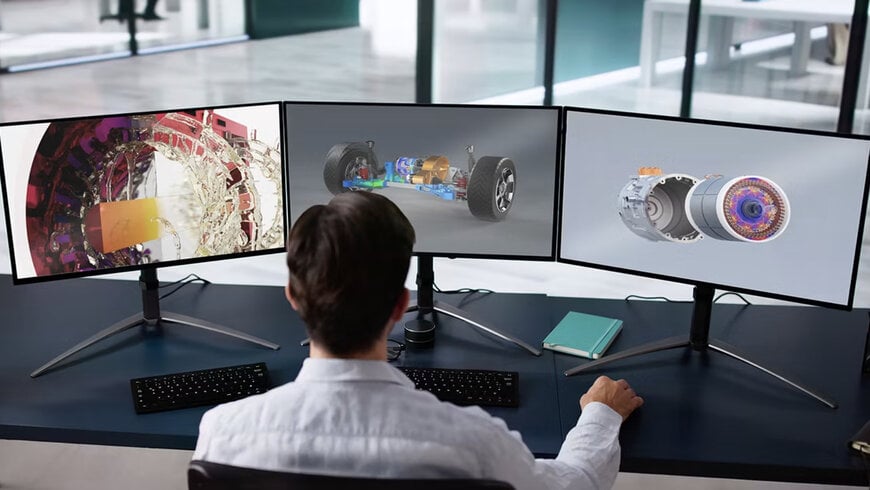
Engineering teams are increasingly expected to evaluate more design alternatives while reducing product development time and managing increasingly complex systems. To address these challenges, Siemens has released the latest version of its Simcenter portfolio, introducing a unified simulation environment that combines Siemens and Altair technologies with expanded artificial intelligence (AI), GPU acceleration and enhanced multiphysics capabilities. The update is designed to help engineers obtain simulation insights earlier in the design process, accelerate design exploration and improve collaboration across engineering disciplines.
Unified Portfolio Brings Together Siemens and Altair Simulation Technologies
The latest Simcenter release marks the first unified simulation portfolio following Siemens' integration of Altair's engineering simulation technologies. By aligning previously separate simulation tools within consistent engineering workflows, Siemens aims to simplify simulation deployment while enabling organizations to perform more comprehensive analyses across multiple physics domains.
The unified portfolio supports a connected engineering environment where structural, fluid, thermal, electromagnetic and system-level simulations can be integrated more effectively throughout the product development lifecycle. According to Siemens, this approach helps engineering teams reduce workflow complexity while making simulation accessible to a broader range of users.
AI Accelerates Simulation and Design Exploration
Artificial intelligence represents one of the most significant enhancements in the new release. Siemens has expanded Simcenter PhysicsAI, its geometric deep learning technology that converts simulation data into predictive engineering models capable of estimating performance without requiring full numerical simulations for every design iteration.
Instead of relying solely on computationally intensive solver calculations, engineers can rapidly evaluate numerous design alternatives before selecting the most promising concepts for detailed validation. Siemens states that PhysicsAI can generate predictive results up to 1,000 times faster than traditional solver-based simulations, enabling substantially faster engineering decision-making.
The predictive models generated with Simcenter PhysicsAI can also be integrated with Intelligence Center X, Siemens' industrial AI orchestration platform, allowing simulation knowledge to be incorporated into broader digital engineering workflows.
Physics-Aware Generative AI Creates New Engineering Concepts
A new capability introduced in this release is Simcenter PhysicsAI Generate, a physics-aware generative AI tool that creates entirely new engineering concepts using target dimensions, performance objectives and historical engineering data.
Unlike conventional optimization tools that refine existing geometries, PhysicsAI Generate develops new concepts that remain constrained by learned physical behaviour. This enables engineering teams to explore significantly larger design spaces while maintaining engineering realism, reducing barriers to innovation during the earliest stages of product development.
AI Integration Expands Across Engineering Applications
Siemens has integrated PhysicsAI into additional applications across the Simcenter portfolio. Within Simcenter Inspire, engineers can use AI-assisted prediction for structural analysis as well as manufacturing processes including casting, injection molding, die stamping and extrusion. These capabilities allow engineers to estimate product and manufacturing performance much earlier in development, reducing the number of detailed simulations required.
The technology has also been enhanced within Simcenter HyperMesh, where improvements focus on faster AI model training and increased confidence in predictive results. In addition, Simcenter STAR-CCM+ now supports multi-GPU computing, enabling significantly faster computational fluid dynamics (CFD) simulations for AI model training. Siemens reports that this combination can reduce AI training times by more than a factor of ten, allowing engineers to iterate more rapidly when developing CFD-based predictive models.
Simulation Moves Earlier into Product Development
The latest release also extends simulation capabilities earlier in the engineering workflow through tighter integration between Designcenter and Simcenter Simsolid.
Design engineers can transfer CAD geometry directly from Designcenter into Simcenter Simsolid, apply loads and constraints, and perform structural simulations without creating a finite element mesh. Eliminating the meshing step substantially reduces model preparation time, enabling engineers to evaluate product performance within minutes rather than hours. Earlier access to simulation results allows design issues to be identified before detailed engineering or physical prototyping begins.
Enhanced Multiphysics Supports Complex Engineering Systems
Siemens has further strengthened its multiphysics simulation capabilities by improving interoperability between electromagnetic, thermal, system-level and three-dimensional simulation environments. These enhancements enable engineers to analyse complex products more holistically while maintaining consistency across engineering disciplines.
For electric powertrain development, engineers can now export reduced-order motor models from Simcenter Flux into system simulation and 3D engineering tools. Together with new capabilities in Simcenter STAR-CCM+, these improvements enhance analyses involving motor cooling, battery thermal management and overall electric powertrain performance. The connected workflows also improve collaboration between specialists responsible for different aspects of product development.
Supporting Continuous AI-Driven Engineering
The enhanced Simcenter portfolio forms part of the broader Siemens Xcelerator platform, where simulation data, AI-generated predictions and engineering models can move continuously between design, validation and operational stages. By integrating AI with multiphysics simulation and connected engineering workflows, Siemens aims to help manufacturers shorten development cycles, reduce engineering risk and improve product performance across a wide range of industries.
Applications
The unified Simcenter portfolio is intended for organizations developing automotive systems, electric vehicles, aerospace platforms, industrial machinery, energy equipment, electronics, semiconductor devices and advanced manufacturing processes. It is particularly suited to multidisciplinary engineering projects where structural, thermal, fluid, electromagnetic and system simulations must be performed within an integrated engineering environment.
Additional Context :
This section details technical specifications and competitive benchmarking not included in the original product announcement
The engineering simulation market is increasingly adopting artificial intelligence to reduce computational costs and accelerate product development. Software vendors including Ansys, Cadence, Dassault Systèmes (SIMULIA), Hexagon, and Autodesk have introduced AI-assisted simulation, GPU acceleration and surrogate modeling technologies to improve engineering productivity. Siemens' latest Simcenter release distinguishes itself by integrating the simulation portfolios of Siemens and Altair into a unified environment while extending AI across structural, manufacturing and computational fluid dynamics workflows. The introduction of PhysicsAI Generate also reflects a broader industry shift toward physics-informed generative engineering, where AI develops new product concepts based on physical behaviour rather than purely geometric optimization.
Edited by Sucithra Mani, Induportals editor – adapted by AI.
www.siemens.com
