
www.industryemea.com
04
'26
Written on Modified on
AI-Powered 3D Machine Vision for Automated Quality Inspection
SICK introduces neural network architectures to its configurable inspection platforms, merging deep learning algorithms with precise spatial height analysis for complex defect detection.
www.sick.com
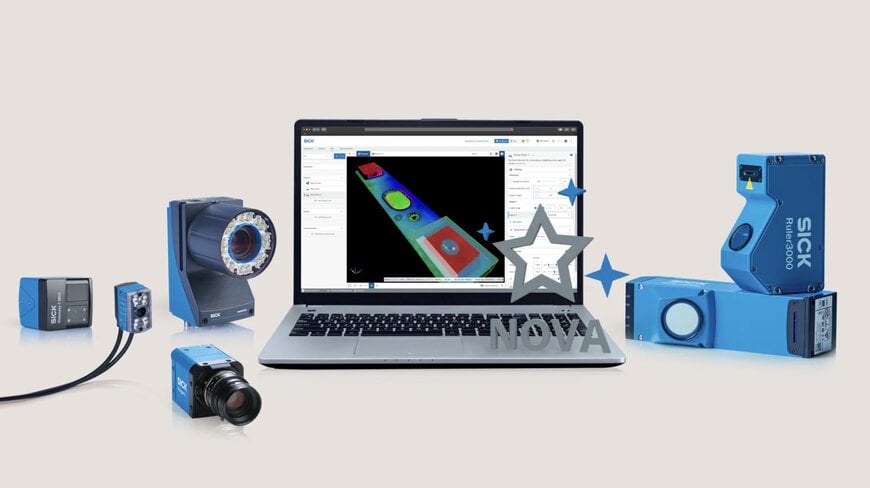
SICK is releasing new AI-powered 3D machine vision capabilities within its Nova foundation software, combining deep learning algorithms with precise spatial height data analysis. This intelligent inspection solution addresses complex automation requirements across the logistics, electronics, battery manufacturing, automotive, and consumer goods industries.
Integration of Neural Networks with 3D Spatial Imaging
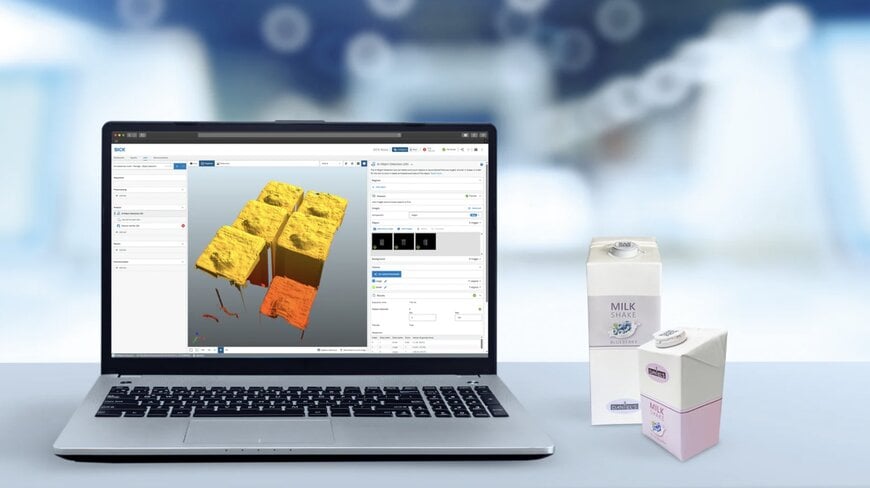
Traditional rule-based machine vision frameworks face limitations when detecting low-contrast or highly variable defects. The updated Nova software captures a distinct height value for every pixel using high-precision spatial sensors, enabling the reconstruction of 3D topological data. A neural network embedded directly within the software analyzes this dataset to perform color- and contrast-independent quality checks. By merging spatial understanding with artificial intelligence, the system isolates anomalies that bypass conventional 2D imaging configurations, mapping detected structural flaws onto a visual anomaly heatmap.
Industrial Application Areas and Technical Use Cases
Applying deep learning to 3D height analysis enables defect detection in automated environments where standard optical contrast is insufficient. In the food, beverage, and consumer goods sectors, the system conducts package deformation inspection by measuring height deviations on carton surfaces to identify structural anomalies at high operational speeds. Logistics operations utilize the spatial data for matrix packaging verification, detecting empty boxes or missing objects within totes. Additional technical applications include assembly verification and surface inspection for electronics and battery manufacturing, alongside completeness checks and 3D Optical Character Recognition (OCR) for automotive tire classification.
On-Device Training and System Deployment
The machine vision architecture utilizes a teach-by-example methodology, allowing engineers to train deep learning models using site-specific sample datasets. Data collection, model training, and inspection execution occur entirely on-device, streamlining production batch changeovers without requiring supplemental external processing hardware. The toolset is activated via software licensing on pre-defined hardware and retains standard rule-based machine vision tools alongside the AI functions. Diego Quintana Tukasaki, Market Product Manager, emphasized the technical utility of the system, noting that embedding neural network capabilities into the platform expands inspection parameters and "provides greater control over data and analytics to deliver highly accurate, configurable, easy-to-train, customised intelligent inspection solutions."
Additional Context
This section details technical specifications and competitive benchmarking not included in the original product announcement.
The integration of deep learning into 3D profiling sensors is an evolving segment in the machine vision systems market, positioning platforms like Nova against established industrial optical solutions such as the Cognex In-Sight 3D-L4000 and the Keyence LJ-X8000 series. While traditional 3D profilers rely on strict geometric rule-based algorithms—such as blob analysis, edge detection, and plane intersection—embedded AI architectures allow for localized, feature-agnostic defect detection. Benchmarking these commercial systems typically involves evaluating point cloud processing latency, Z-axis repeatability, and on-board neural processing capabilities. Solutions that perform both neural network training and inference directly on the sensor head reduce network latency and eliminate the dependency on external industrial PCs, which serves as a critical performance metric for high-speed manufacturing lines.
Edited by Aishwarya Mambet, Induportals Editor, with AI assistance.
www.sick.com
