
Leuze Sensor Technology Enables Safe Automation at SEW-EURODRIVE
RSL 400 safety laser scanners and other Leuze sensor solutions help safeguard material transfer, monitor processes and enable precise positioning in SEW-EURODRIVE’s automated production buffer warehouse.
www.leuze.com
Anyone entering the world of drive technology and drive automation will know about SEW-EURODRIVE: Products by the family business from Baden-Württemberg drive almost everything that moves – from baggage-handling systems in airports to parcel sorters in e-commerce logistics centers to conveyor technology in networked production environments. This is made possible by around 22,700 employees in 92 assembly plants and 18 manufacturing plants across 57 countries. SEW-EURODRIVE continuously invests in its locations. Most recently, for example, in Graben-Neudorf (Baden-Württemberg, Germany) near its company headquarters in Bruchsal, the company opened a smart factory for the production of shafts and gear parts at the end of 2024. An important part of the expansion is a fully automated production buffer warehouse (logistics module) in its North Hall, for which SEW-EURODRIVE relied on SIVAplan’s intralogistics expertise and Leuze’s sensor expertise.
Systematic buffer
The logistics module – a fully automated, single-aisle high-bay warehouse – serves as a production buffer between gear and shaft production as well as with the hardening shop: “The automated warehouse decouples the soft machining, hardening and hard machining processes,” explains Michael Schütz, head of the hardening shop at SEW-EURODRIVE. “In the hardening shop, the gear parts and shafts are made more resistant, wear-resistant and durable in special furnaces.” The warehouse’s dimensions, made from 70 tons of steel, are impressive: Two nine-meter-high racks stretch over a length of more than 76 meters, each five meters wide. They are designed with double-deep storage – meaning that two frames can be placed one behind the other on each side of the shelving.
The module offers a total of 2,300 storage locations. Between the two racks, two fully automated stacker cranes operate on one traversing axis. “The stacker cranes transport the special hardening racks with products from production to the furnace system. “After hardening, the racks containing the shafts and gear parts are also returned to storage via the stacker cranes and retrieved as needed for further processing,” says Christian Langsdorf, Head of Sales at SIVAplan. The total conveying distance is 152 meters. The stacker cranes do the heavy lifting: A single rack, including the materials it holds, can weigh up to 510 kilograms.
A clear run for mobile robots
As a specialist in fully automated storage systems, SIVAplan implemented the logistics module, including the higher-level control system, for immediate use. The Troisdorf-based company was also responsible for implementing the higher-level control system as the general contractor in collaboration with PROCAM Steuerungstechnik GmbH. The control system communicates with and coordinates all subordinate machines, systems, and vehicles. It also handles all processes with the higher-level ERP system (SAP). SIVAplan has thus delivered numerous key components that play a crucial role in ensuring efficient and autonomous production operations. An important warehouse component is the sensor technology from Leuze: “SIVAplan’s solutions and Leuze’s sensor expertise complement each other perfectly,” says Christian Langsdorf. “We have been working together in a spirit of trust for many years and are confident in the reliability and quality of Leuze’s sensor technology. That is why we continue to rely on this partnership for our new projects as well.” The products from Leuze play a key role in numerous process steps, ensuring that the loading and unloading of racks is carried out safely and efficiently. This begins as soon as the goods are delivered: Mobile robots from SEW-EURODRIVE automatically transport finished components to the high-bay warehouse.
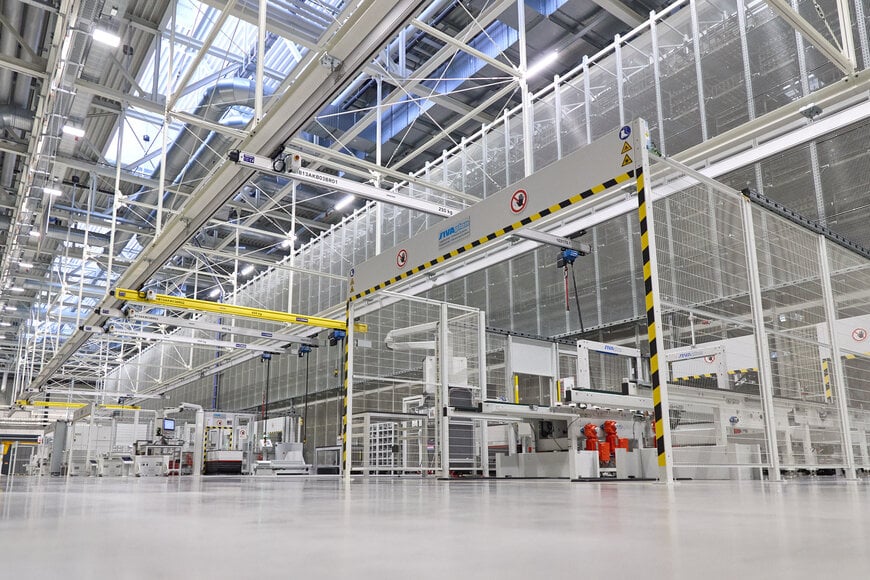
SEW-EURODRIVE relied on Leuze sensor expertise and SIVAplan’s intralogistics expertise for its fully automated production buffer warehouse in Graben-Neudorf, Germany.
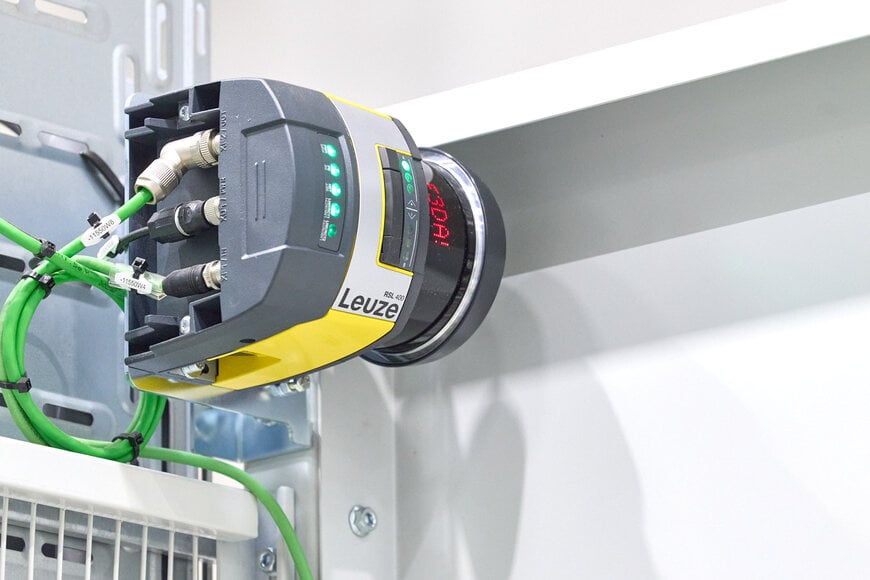
The mobile robots are guided via the higher-level master controller. Two RSL 400 safety laser scanners from Leuze are installed above each material transfer station to reliably safeguard access to the system. “The RSL 400s generate a vertical protective field and grant access once the mobile robot has successfully registered. The mobile robot can then use this access to deliver the goods. Access remains secured on the side of the vehicle,” emphasizes Frank Wüster, Sales Manager at Leuze. They then pick up the materials from the production area. After a short drive to the warehouse, they transfer the load via four storage and retrieval bays – material transfer stations. As soon as the mobile robot has passed through the open protective field, the area is reset to its original, closed state. Practical: The integrated PROFIsafe/PROFINET interface makes it particularly easy to integrate the RSL 400 into the safety control system.
In-process contour check
After the loaded rack is transferred by the AGV, it is transported to a contour checking station via the conveyor system. Leuze type HT25C diffuse sensors detect the racks and control the conveyor technology. During the contour check, the object’s outer contours are detected as it passes using type CML 720i measuring light curtains. The inspection results are output via the integrated PROFINET interface. Additional Leuze sensors are installed to monitor the presence of the racks and control the light curtains. One advantage of this is that the diffuse sensors that detect objects ahead in the direction of the delivery area are designed to ignore high-vis vests, as Frank Wüster explains: “This prevents incorrect detections caused by people wearing high-vis vests who are standing in front of or walking past the transfer station, which is a very practical feature.” Industrial IP cameras from Leuze are also part of the sensor system at this station, capturing additional images of the racks. They are installed at the side and above the contour inspection station.
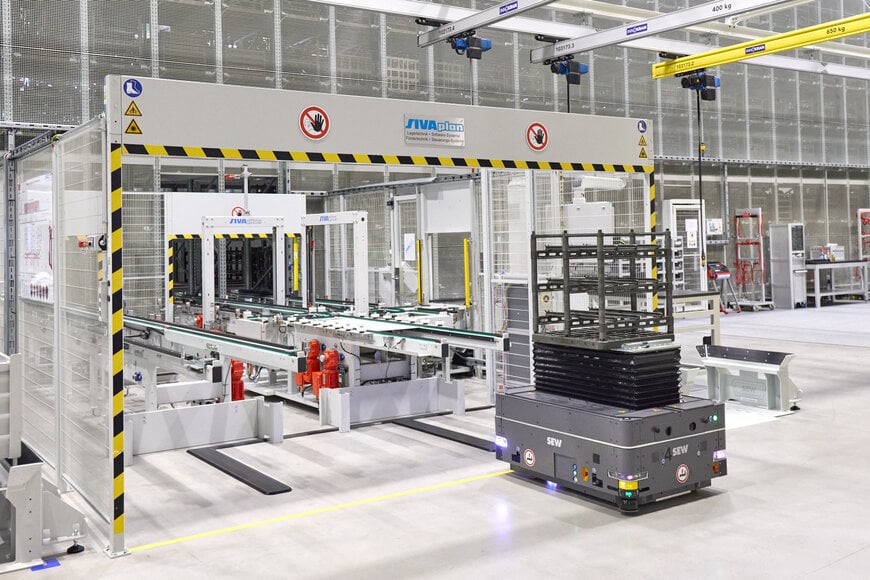
Mobile robots at four material transfer stations deliver the gears and shafts produced on the production line. These are temporarily stored in the logistics module and then hardened in special furnaces.
Safe loading and unloading
A manual workstation is integrated into each material transfer station to enable SEW-EURODRIVE employees to manually unload and inspect racks. MLC 530-SPG safety light curtains ensure that the racks can be loaded and unloaded safely at all times. Personnel protection is not the only noteworthy aspect – the sensorless muting via the patented Smart Process Gating (SPG) is also a highlight, as it enables a particularly compact and space-saving system design. A switching signal provided by the PLC and interruption of the protective field by the transported goods are used as triggers for activation of the gating function.
This means that no additional muting sensors are required immediately up- or downstream. These compact safety light curtains are designed to take up minimal space, can be installed quickly and easily using various mounting brackets, and can be controlled reliably via pin configuration. The installed type 4 MLC 530-SPGs meet the highest safety requirements in accordance with EN IEC 61496 and achieve performance level PL e as well as SIL 3. “The racks are loaded into the furnaces along with the workpieces to be hardened.” They are therefore subjected to extreme thermal conditions. This can deform them in the long term,” says hardening shop manager Michael Schütz. “That’s why the racks are automatically discharged to this station to be remeasured after a certain number of furnace cycles.”
Reliable routing via barcode
After the goods destined for the hardening shop have been measured, one of the stacker cranes picks up the rack. Here, too, precise processes are essential to ensure that the goods reach their designated storage location safely and reliably. The stacker cranes are therefore positioned using Leuze FBPS 600i safety barcode positioning systems, which ensure safeguarded velocity monitoring in conjunction with the latest-generation MOVI-C® inverters from SEW-EURODRIVE. The FBPS 600i enable safe position detection. The stacker cranes’ position and velocity are continuously monitored based on the system status. This is particularly important because the two stacker cranes operate on the same rail. Accurate position detection is also required to reliably safeguard two pedestrian walkways in the high-bay warehouse. To do this, the system switches the travel range’s safety envelopes. If people cross the aisle, the stacker cranes are “held” in defined segments and monitored to allow a safe crossing.
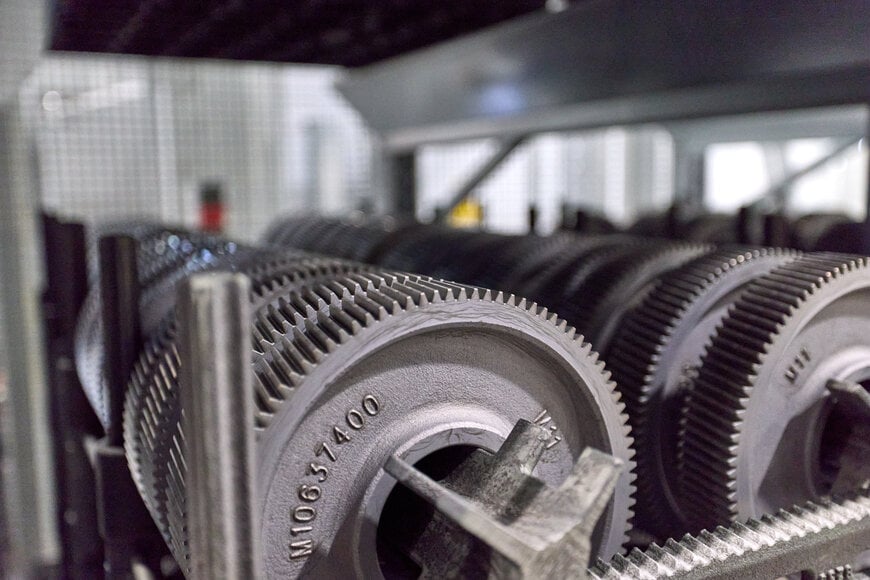
A seamless solution from start to finish. Leuze sensor technology enables SIVAplan’s automated production buffer warehouse (logistics module) at SEW-EURODRIVE.
The 600i safety bar code positioning system only requires one sensor for safe position detection. This greatly simplifies integration and makes the system much easier to set up. Two FBPS 600i are installed on each stacker crane: One for positioning the lifting axis and the other for the travel axis. The FBPS 600i safety barcode positioning systems can be used flexibly thanks to their reading distances of 50 to 170 millimeters from the bar code tape. Multiple codes are read with each scan; these are processed redundantly internally and then again with millimeter precision in the SEW inverter’s safe connection unit via the dual SSI interface. “The scanning beam is intentionally positioned at an angle. The device’s movement along this angled path ensures each code is scanned at different points. This prevents reading errors caused by local dirt or damage,” says Oliver Gortner, Key Account Manager Intralogistics at Leuze. This solution is compact and space-saving and allows the stacker cranes to be positioned precisely and safely in accordance with Performance Level e / SIL 3. In addition, the extremely short error response time of just 10 milliseconds allows short braking distances and, consequently, faster speeds. In this way, the FBPS 600i plays a decisive role in maximizing the high-bay warehouse’s performance – with minimal installation effort and a high level of safety.
Camera-based precision compartment placement
Leuze sensors also support the stacker cranes and the rack storage areas: Diffuse sensors detect the racks’ presence. Once a stacker crane has reached the designated storage location using barcode positioning, it proceeds to compartment fine positioning: The loaded rack must be positioned precisely within the designated storage compartment. For this purpose, a camera-based Leuze IPS 200i sensor with integrated PROFINET interface is mounted on each stacker crane. The small, compact sensor is suitable for positioning tasks with distances ranging from 100 to 600 millimeters. It focuses on a reflector attached to the shelf support. If the marker is within the IPS 200i’s working range, this sends absolute values to the SEW controller. This allows the stacker crane to precisely transfer the rack. This efficient solution eliminates the need for multiple diffuse sensors.
Summary
With the fully automated high-bay warehouse, SIVAplan has implemented a technically highly complex logistics system that integrates seamlessly into SEW-EURODRIVE’s production processes in Graben-Neudorf. Sensor technology from Leuze plays a key role in virtually all central areas, ensuring fully automated and safe processes. It reliably safeguards material transfers, precisely detects and measures racks, and accurately positions the stacker cranes down to the individual storage compartment. SEW‑EURODRIVE thus benefits from a production buffer storage (logistics module) that flexibly supports production, absorbs peak loads, and is suitable for future expansions and adaptations thanks to its modular design.
Info box:
“A mobile robot is an automated, sensor- and computer-based system that can move autonomously or semi-autonomously within its environment and perform tasks. It is the umbrella term for systems such as AGVs/FTS and AMRs. While AGVs/FTS follow fixed, predetermined transportation paths and are therefore less flexible, AMRs navigate freely, detect their surroundings, and dynamically adjust their routes. Technically, both fall under the term ‘mobile robot.’ In practice, however, ‘mobile robot’ is often used synonymously with AMR to specifically highlight autonomous, flexible, and future-oriented solutions.”
www.leuze.com
