
www.industryemea.com
27
'26
Written on Modified on
Regal Rexnord Launches Powerlign 2.0 Torque Monitoring System
Powerlign 2.0, an add-on feature to Kop-Flex and Ameridrives couplings, offers improved torque trend monitoring for better predictability and increased uptime.
www.regalrexnord.com
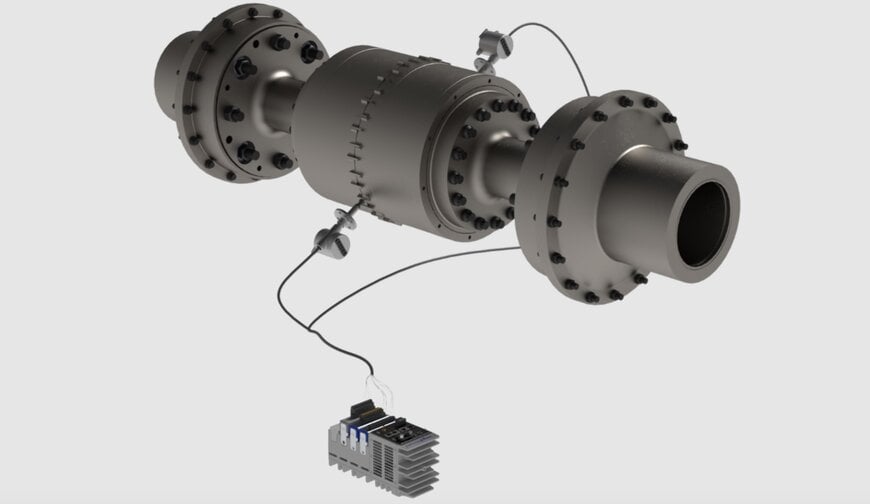
Regal Rexnord Corporation has announced the launch of Powerlign 2.0, an updated non-contact torque monitoring system engineered for high-performance turbomachinery applications. The updated platform simplifies deployment and eliminates the requirement for on-site calibration to deliver full-scale torque measurement data.
Operational Insights and Equipment Optimization
Powerlign 2.0 provides continuous operational trending to support maintenance and operational planning across critical mechanical assets:
- Fuel Optimization and Tuning: Delivers real-time data to support fuel optimization, emissions compliance, and dynamic load balancing across multi-body compressor trains.
- Maintenance and Asset Verification: Supports predictive maintenance programs, optimized compressor washing schedules, and performance validation following turbomachinery retrofits or upgrades.
- Throughput Confirmation: Verifies that newly commissioned driving and driven machinery reach designed nameplate throughput ratings during initial startup phases.
Hardware Architecture and System Integration
Powerlign 2.0 operates as an add-on monitoring option for standard Kop-Flex and Ameridrives couplings, featuring a condensed dual-sensor physical arrangement. The system can be retrofitted onto existing rotating equipment subject to mass-elastic data compliance, allowing existing coupling guards to be modified for sensor mounting. The rotating coupling assembly contains no active electronics or electrical power sources, enhancing operational safety in hazardous operating environments.
Key software and hardware updates include:
Powerlign 2.0 operates as an add-on monitoring option for standard Kop-Flex and Ameridrives couplings, featuring a condensed dual-sensor physical arrangement. The system can be retrofitted onto existing rotating equipment subject to mass-elastic data compliance, allowing existing coupling guards to be modified for sensor mounting. The rotating coupling assembly contains no active electronics or electrical power sources, enhancing operational safety in hazardous operating environments.
Key software and hardware updates include:
- Visual Interface and Diagnostics: Graphical output displays for real-time trend tracking, paired with integrated diagnostic checks covering sensor coil integrity, resistance temperature detector (RTD) validation, analog output health, noise filtering, and waveform analysis.
- Expanded Communication Protocols: Standard Modbus RS-485 interfaces complemented by Modbus TCP/IP (Ethernet) and analog 4–20 mA outputs for direct DCS and SCADA connectivity.
- Control Loop and Safety Automation: Patented architecture supporting closed-loop process integration to trigger automated alarms, initiate safety trip shutdowns, or modulate fuel/gas flow to stabilize equipment loading.
Additional Context
This section details technical specifications not included in the original news release.
Phase-displacement torque measurement calculates transmitted shaft torque by measuring the mechanical angular twist of a calibrated torsion shaft or coupling spacer under load. As torque increases, the angular displacement between two toothed target rings mounted on opposing ends of the coupling creates a relative phase shift between the alternating voltage signals induced in stationary magnetic pickup coils. Because the torsional stiffness and geometric dimensions of the coupling spacer are precisely characterized during factory calibration, this phase angle shift is directly converted into transmitted shaft torque, rotational speed, and transmitted mechanical shaft power without requiring physical slip rings, wireless telemetry transmitters, or rotating strain gauges.
In turbomachinery installations compliant with American Petroleum Institute standards (including API 670 for machinery protection and API 671 for special-purpose couplings), the absence of active electronic components on the rotating shaft provides continuous mean time between failures (MTBF) exceeding decades of operational service. Passive variable-reluctance pickup sensors housed within the coupling guard detect passing teeth through hazardous-area rated stainless steel enclosures, isolated via certified intrinsic safety barriers or explosion-proof conduit runs. The signal processing module converts the continuous phase-shift pulse train into digital values with update rates exceeding 100 Hz, enabling the detection of torsional vibration harmonics, shaft resonance, and compressor surge phenomena before mechanical fatigue damages internal components.
Edited by Romila DSilva, Induportals Editor, with AI assistance.
This section details technical specifications not included in the original news release.
Phase-displacement torque measurement calculates transmitted shaft torque by measuring the mechanical angular twist of a calibrated torsion shaft or coupling spacer under load. As torque increases, the angular displacement between two toothed target rings mounted on opposing ends of the coupling creates a relative phase shift between the alternating voltage signals induced in stationary magnetic pickup coils. Because the torsional stiffness and geometric dimensions of the coupling spacer are precisely characterized during factory calibration, this phase angle shift is directly converted into transmitted shaft torque, rotational speed, and transmitted mechanical shaft power without requiring physical slip rings, wireless telemetry transmitters, or rotating strain gauges.
In turbomachinery installations compliant with American Petroleum Institute standards (including API 670 for machinery protection and API 671 for special-purpose couplings), the absence of active electronic components on the rotating shaft provides continuous mean time between failures (MTBF) exceeding decades of operational service. Passive variable-reluctance pickup sensors housed within the coupling guard detect passing teeth through hazardous-area rated stainless steel enclosures, isolated via certified intrinsic safety barriers or explosion-proof conduit runs. The signal processing module converts the continuous phase-shift pulse train into digital values with update rates exceeding 100 Hz, enabling the detection of torsional vibration harmonics, shaft resonance, and compressor surge phenomena before mechanical fatigue damages internal components.
Edited by Romila DSilva, Induportals Editor, with AI assistance.
