
www.industryemea.com
01
'26
Written on Modified on
Collaborative Robotics Integration for Cleanroom and Industrial Automation
Epson introduces a carbon-body collaborative arm manipulator engineered to resolve space constraints and hygiene requirements within sensitive automated manufacturing environments.
www.epson.com
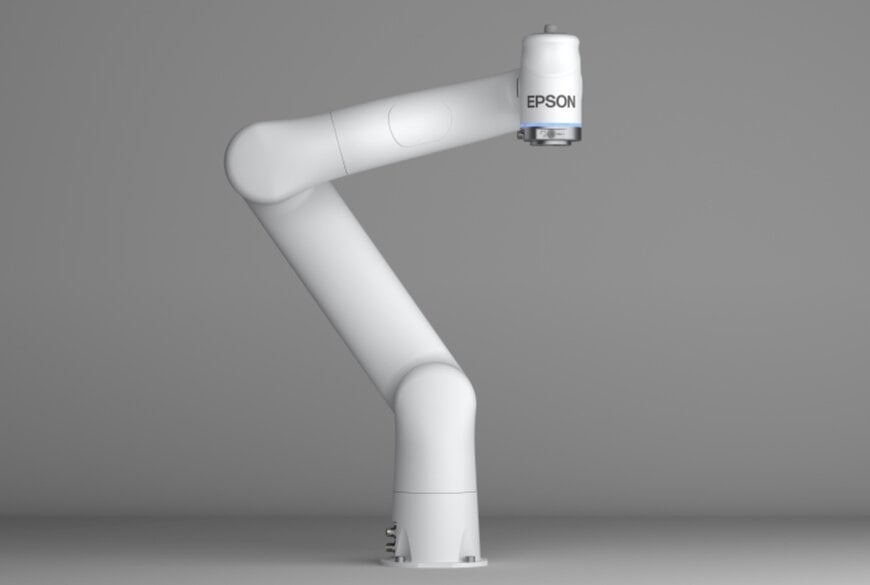
AX6 collaborative robot now arrives in Southeast Asia to support flexible, scalable automation with intuitive operation and collaborative deployment.
Epson has released the AX6 Collaborative Robot in Southeast Asia to provide flexible, space-efficient automation for tightly regulated cleanroom environments. The hardware targets operational bottlenecks in the pharmaceutical, logistics, automotive, and electronic manufacturing sectors by enabling direct human-machine cooperation without requiring extensive infrastructure modifications.
Mechanical Architecture and Spatial Integration
Introduced to the Southeast Asian market in August, the system addresses physical footprint constraints in established laboratories and production facilities. The AX6 utilizes a carbon-body arm manipulator that limits the unit's total weight to 17 kilograms. This mass reduction facilitates deployment on mobile platforms, making the hardware natively compatible with autonomous mobile robot (AMR) and automated guided vehicle (AGV) systems. The integration of both AC and DC power supply support allows the robot to function as an untethered, mobile manipulation node within a broader digital supply chain, bypassing the need to redesign existing facility layouts.
Control Interfaces and Programming Standards
To mitigate deployment friction amid industry-wide technical labor shortages, the system incorporates multiple control interfaces designed for varying levels of engineering expertise. Floor operators can utilize hand-guided teaching functions to manually establish physical waypoints and spatial workflows. For programmed sequences, the interface supports visual block programming alongside standard development languages. Native compatibility with Python and the Robot Operating System (ROS) enables systems integrators to customize complex robotic behaviors, interface with external vision systems, and embed the unit deeply into established industrial data ecosystems.
Hygiene Specifications and Collaborative Safety Protocols
Cleanroom compliance remains a fundamental parameter for life sciences and semiconductor manufacturing. The AX6 features a screwless exterior chassis with internal wiring and pneumatic tubing to prevent particulate accumulation and mitigate contamination risks. The hardware meets an ISO Class 5 cleanroom classification and maintains an IP54 rating for dust and splash resistance. Because collaborative robots operate within shared human workspaces, the system is governed by integrated, sensor-driven safety protocols. These mechanisms include Power and Force Limiting (PFL) to prevent impact injuries, alongside Safe Operating Stop (SOS), Safe Limited Speed (SLS), and Safe Limited Position (SLP) functions, ensuring regulatory safety compliance during direct physical interaction.
Additional Context
This section details technical specifications and competitive benchmarking not included in the original product announcement.
Within the mid-range payload collaborative robot sector, devices are typically benchmarked against established units such as the Universal Robots UR5e and the Omron TM5 series. While standard 6-axis cobots in this payload category typically utilize cast aluminum or steel components resulting in weights exceeding 20 kilograms (the UR5e weighs 20.6 kg), the AX6 utilizes carbon-fiber construction to achieve its 17-kilogram mass. This specific weight reduction provides a measurable advantage for mobile robotics applications, as lower manipulator mass directly increases the available payload capacity and extends the battery life of the AMR or AGV chassis hosting the system.
Edited by Aishwarya Mambet, Induportals Editor, with AI assistance.
Epson has released the AX6 Collaborative Robot in Southeast Asia to provide flexible, space-efficient automation for tightly regulated cleanroom environments. The hardware targets operational bottlenecks in the pharmaceutical, logistics, automotive, and electronic manufacturing sectors by enabling direct human-machine cooperation without requiring extensive infrastructure modifications.
Mechanical Architecture and Spatial Integration
Introduced to the Southeast Asian market in August, the system addresses physical footprint constraints in established laboratories and production facilities. The AX6 utilizes a carbon-body arm manipulator that limits the unit's total weight to 17 kilograms. This mass reduction facilitates deployment on mobile platforms, making the hardware natively compatible with autonomous mobile robot (AMR) and automated guided vehicle (AGV) systems. The integration of both AC and DC power supply support allows the robot to function as an untethered, mobile manipulation node within a broader digital supply chain, bypassing the need to redesign existing facility layouts.
Control Interfaces and Programming Standards
To mitigate deployment friction amid industry-wide technical labor shortages, the system incorporates multiple control interfaces designed for varying levels of engineering expertise. Floor operators can utilize hand-guided teaching functions to manually establish physical waypoints and spatial workflows. For programmed sequences, the interface supports visual block programming alongside standard development languages. Native compatibility with Python and the Robot Operating System (ROS) enables systems integrators to customize complex robotic behaviors, interface with external vision systems, and embed the unit deeply into established industrial data ecosystems.
Hygiene Specifications and Collaborative Safety Protocols
Cleanroom compliance remains a fundamental parameter for life sciences and semiconductor manufacturing. The AX6 features a screwless exterior chassis with internal wiring and pneumatic tubing to prevent particulate accumulation and mitigate contamination risks. The hardware meets an ISO Class 5 cleanroom classification and maintains an IP54 rating for dust and splash resistance. Because collaborative robots operate within shared human workspaces, the system is governed by integrated, sensor-driven safety protocols. These mechanisms include Power and Force Limiting (PFL) to prevent impact injuries, alongside Safe Operating Stop (SOS), Safe Limited Speed (SLS), and Safe Limited Position (SLP) functions, ensuring regulatory safety compliance during direct physical interaction.
Additional Context
This section details technical specifications and competitive benchmarking not included in the original product announcement.
Within the mid-range payload collaborative robot sector, devices are typically benchmarked against established units such as the Universal Robots UR5e and the Omron TM5 series. While standard 6-axis cobots in this payload category typically utilize cast aluminum or steel components resulting in weights exceeding 20 kilograms (the UR5e weighs 20.6 kg), the AX6 utilizes carbon-fiber construction to achieve its 17-kilogram mass. This specific weight reduction provides a measurable advantage for mobile robotics applications, as lower manipulator mass directly increases the available payload capacity and extends the battery life of the AMR or AGV chassis hosting the system.
Edited by Aishwarya Mambet, Induportals Editor, with AI assistance.
