
www.industryemea.com
08
'26
Written on Modified on
PC-Based Automation Redesign for High-Speed Pipe Laser Cutting
TTEngineering integrated Beckhoff PC-based control and multi-axis servos into its Top series laser cutting machines, cutting cycle times and resolving microjoint machining bottlenecks.
www.beckhoff.com
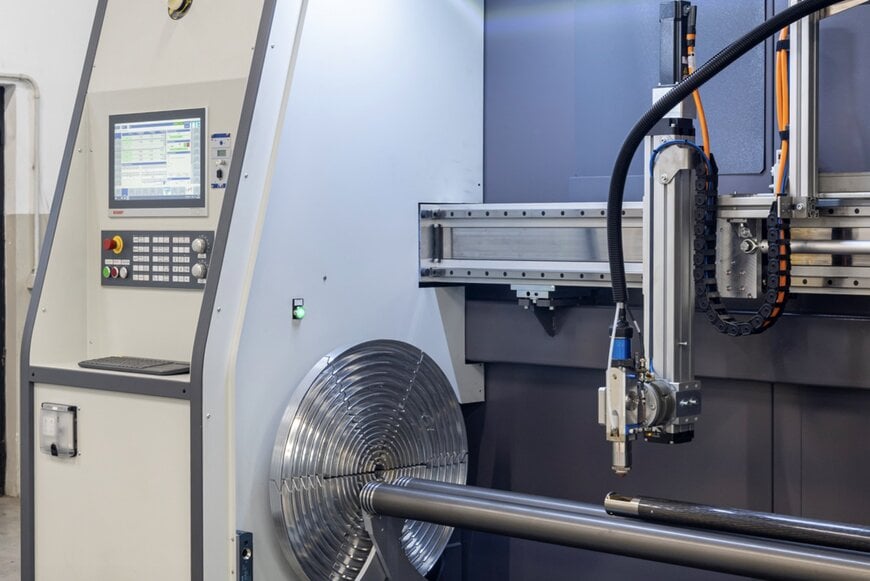
Top-series pipe laser cutting machine with CP29xx multi-touch Control Panel and CNC-specific multifunction keyboard
Application Areas: Sheet Metal Coil Processing, Orbital 3D Laser Cutting, Pipe Manufacturing
Industry Sectors: Heating and Ventilation Systems, Flue Gas Pipe Production, Automotive Industry
TTEngineering, based in Lomazzo, Italy, has specialized for more than 30 years in manufacturing automated process machinery that converts sheet metal coils into finished pipes. Its Top series encompasses two 3D orbital laser cutting machines designed to operate as standalone units or integrated within robot-automated production lines. These systems handle diverse geometries, including curved cuts, 90-degree joints, and lateral branch connections.
A primary bottleneck in earlier machine revisions involved the fabrication of microjoints—material bridges under 0.1 mm retained during cutting to stabilize workpieces and prevent scrap movement prior to secondary finishing. Conventional CNC architectures lacked the processing speed to dynamically modulate laser output power adjacent to these micro-features. Consequently, the system had to decelerate axes, deactivate the laser source to zero power, and re-initiate the cutting cycle, resulting in performance drops and prolonged overall cycle times.
To overcome these constraints, TTEngineering initiated a comprehensive control redesign focused on higher computing capacity, tighter synchronization between motion axes and the laser source, and streamlined software integration.
Coordinated Multi-Axis Control and Sensor Interpolation
The upgraded Top series architecture centers on a Beckhoff CX2033 Embedded PC powered by an AMD Ryzen™ V1202B dual-core processor (2.3 GHz), running TwinCAT software over high-speed EtherCAT communication. Motion control is managed by an AX8000 multi-axis servo system coupled with AM8000 servomotors, providing dynamic synchronization across the system’s rotary and linear axes.
During cutting operations, the NC algorithms interpolate rotary and linear motion to guide the cutting head. Because coiled pipe raw material deviates from true circularity, a capacitive sensor tracks height variances in real time, feeding data into the control loop to dynamically maintain a constant nozzle-to-workpiece standoff distance. The real-time bus speed and computing capacity allow the AX8000 drives to execute these profiles continuously, eliminating the stop-and-go motion previously required for microjoint cutting.
Operator interaction is facilitated through a Beckhoff CP29xx multi-touch Control Panel paired with a CNC-specific multifunction keyboard.
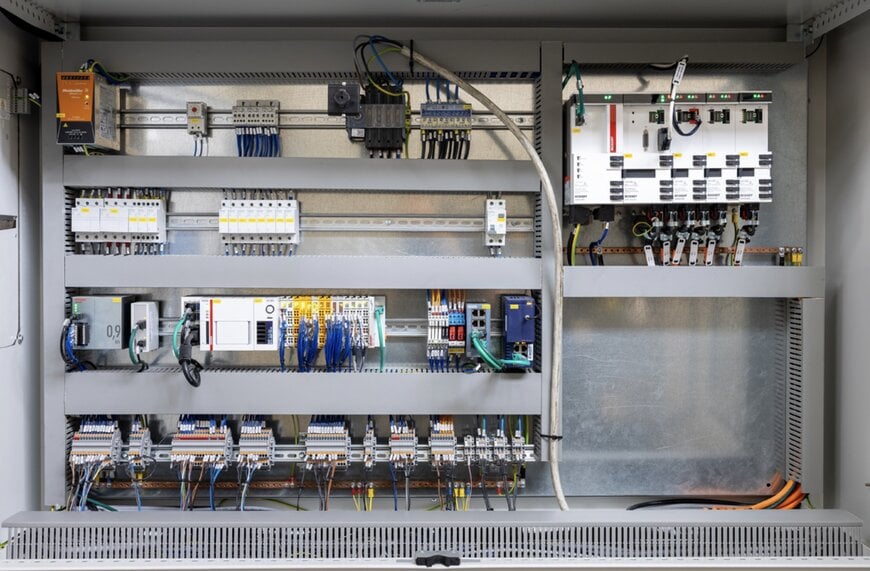
The control architecture includes a CX2033 Embedded PC, the AX8000 multi-axis servo system with AM8000 servomotors, and EtherCAT and TwinSAFE Terminals – all connected via ultra-fast EtherCAT communication.
Unified Software Architecture and Integrated Safety
TTEngineering migrated its control logic to the TwinCAT software suite, using it to reduce programming overhead and consolidate disparate hardware tasks.
"TwinCAT is a very flexible development platform that has proven to be perfect for our needs. The entire development process could be controlled with precision, including even the most complex functions. And we were able to integrate parts of the C# code that we had already developed over time. We were also impressed by the precision and simplicity with which the transition from kinematic simulation to the actual execution of machine movements can be made. This allowed us to develop a large part of the application and achieve reliable results even during the prototyping phase." — Roberto Angeli, Software Developer, TTEngineering
The programming workflow gained efficiency from TwinCAT's architecture, which enabled developers to access internal machine variables directly without routing through the PLC.
For machine safety, TTEngineering implemented TwinSAFE Terminals directly within the standard I/O segment. Running safety and standard control on a common platform eliminated separate safety controllers and related wiring overhead. Axis-level safety routines—including Safe Torque Off (STO), Safely-Limited Speed (SLS), and Safe Brake Test (SBT)—are configured and managed natively within the main development environment.
Modular Integration and Optical Processing Roadmap
The standardized EtherCAT foundation allows modular mechanical expansion, such as interfacing standalone cutting units with robotic loading and unloading cells without structural re-engineering.
Looking forward, TTEngineering is leveraging the PC platform's processing capacity to enhance its optical seam detection, which currently tracks weld lines using a laser diode and camera. The engineering team is currently evaluating TwinCAT vision algorithms and Beckhoff vision hardware to deploy AI-based pattern recognition directly on the machine controller.
Edited by Romila DSilva, Induportals Editor, with AI assistance.
Application Areas: Sheet Metal Coil Processing, Orbital 3D Laser Cutting, Pipe Manufacturing
Industry Sectors: Heating and Ventilation Systems, Flue Gas Pipe Production, Automotive Industry
TTEngineering, based in Lomazzo, Italy, has specialized for more than 30 years in manufacturing automated process machinery that converts sheet metal coils into finished pipes. Its Top series encompasses two 3D orbital laser cutting machines designed to operate as standalone units or integrated within robot-automated production lines. These systems handle diverse geometries, including curved cuts, 90-degree joints, and lateral branch connections.
A primary bottleneck in earlier machine revisions involved the fabrication of microjoints—material bridges under 0.1 mm retained during cutting to stabilize workpieces and prevent scrap movement prior to secondary finishing. Conventional CNC architectures lacked the processing speed to dynamically modulate laser output power adjacent to these micro-features. Consequently, the system had to decelerate axes, deactivate the laser source to zero power, and re-initiate the cutting cycle, resulting in performance drops and prolonged overall cycle times.
To overcome these constraints, TTEngineering initiated a comprehensive control redesign focused on higher computing capacity, tighter synchronization between motion axes and the laser source, and streamlined software integration.
Coordinated Multi-Axis Control and Sensor Interpolation
The upgraded Top series architecture centers on a Beckhoff CX2033 Embedded PC powered by an AMD Ryzen™ V1202B dual-core processor (2.3 GHz), running TwinCAT software over high-speed EtherCAT communication. Motion control is managed by an AX8000 multi-axis servo system coupled with AM8000 servomotors, providing dynamic synchronization across the system’s rotary and linear axes.
During cutting operations, the NC algorithms interpolate rotary and linear motion to guide the cutting head. Because coiled pipe raw material deviates from true circularity, a capacitive sensor tracks height variances in real time, feeding data into the control loop to dynamically maintain a constant nozzle-to-workpiece standoff distance. The real-time bus speed and computing capacity allow the AX8000 drives to execute these profiles continuously, eliminating the stop-and-go motion previously required for microjoint cutting.
Operator interaction is facilitated through a Beckhoff CP29xx multi-touch Control Panel paired with a CNC-specific multifunction keyboard.
The control architecture includes a CX2033 Embedded PC, the AX8000 multi-axis servo system with AM8000 servomotors, and EtherCAT and TwinSAFE Terminals – all connected via ultra-fast EtherCAT communication.
Unified Software Architecture and Integrated Safety
TTEngineering migrated its control logic to the TwinCAT software suite, using it to reduce programming overhead and consolidate disparate hardware tasks.
"TwinCAT is a very flexible development platform that has proven to be perfect for our needs. The entire development process could be controlled with precision, including even the most complex functions. And we were able to integrate parts of the C# code that we had already developed over time. We were also impressed by the precision and simplicity with which the transition from kinematic simulation to the actual execution of machine movements can be made. This allowed us to develop a large part of the application and achieve reliable results even during the prototyping phase." — Roberto Angeli, Software Developer, TTEngineering
The programming workflow gained efficiency from TwinCAT's architecture, which enabled developers to access internal machine variables directly without routing through the PLC.
For machine safety, TTEngineering implemented TwinSAFE Terminals directly within the standard I/O segment. Running safety and standard control on a common platform eliminated separate safety controllers and related wiring overhead. Axis-level safety routines—including Safe Torque Off (STO), Safely-Limited Speed (SLS), and Safe Brake Test (SBT)—are configured and managed natively within the main development environment.
Modular Integration and Optical Processing Roadmap
The standardized EtherCAT foundation allows modular mechanical expansion, such as interfacing standalone cutting units with robotic loading and unloading cells without structural re-engineering.
Looking forward, TTEngineering is leveraging the PC platform's processing capacity to enhance its optical seam detection, which currently tracks weld lines using a laser diode and camera. The engineering team is currently evaluating TwinCAT vision algorithms and Beckhoff vision hardware to deploy AI-based pattern recognition directly on the machine controller.
Edited by Romila DSilva, Induportals Editor, with AI assistance.
www.beckhoff.com
