
www.industryemea.com
10
'26
Written on Modified on
Atlas Copco Introduces H2Y Hydraulic Booster for UK Hydrogen Infrastructure
Oil-free system delivers pressures up to 1,000 bar(g), supporting hydrogen storage, distribution, refuelling and mobility applications with reduced venting and maintenance.
www.atlascopco.com
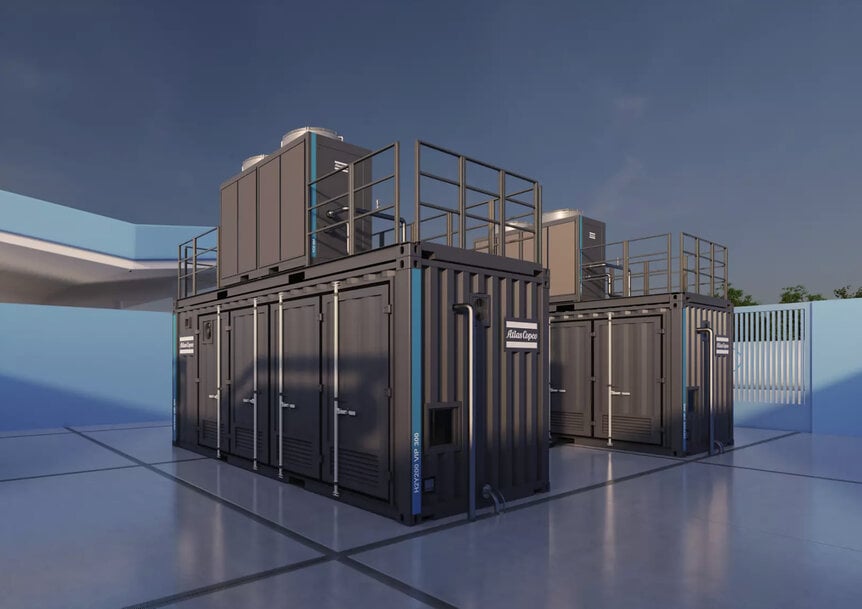
Atlas Copco has introduced the H2Y hydraulic booster to expand its gas compression portfolio across the United Kingdom. The system targets infrastructure developers, industrial decarbonization initiatives, tube-trailer filling hubs, and commercial hydrogen refueling stations for light- and heavy-duty fuel cell transport.
Contamination-Free Compression and Fugitive Emission Control
Compressing gaseous hydrogen for mobility protocols requires compliance with strict fuel quality criteria, such as ISO 14687 Grade D, which strictly caps oil aerosol and particulate contamination to protect proton exchange membrane fuel cells. Mechanical reciprocating compressors utilizing lubricated crankcases pose contamination risks if seals degrade, requiring multi-stage downstream coalescing filters that introduce pressure drops and maintenance overhead.
The H2Y platform implements an oil-free displacement mechanism driven by an external hydraulic circuit, isolating the process gas chamber from lubricants. To mitigate fuel losses, the design prevents gas blow-off during routine start and stop sequences, avoiding the atmospheric venting typical of conventional pressure-relief procedures. Integrated closed-loop water cooling manages heat rejection during high compression ratios, maintaining gas temperatures within safe operational limits.
Variable-Pressure Operation and Packaging Configurations
Hydrogen generation from electrolyzers or variable-pressure tube-trailer offloading presents dynamic intake conditions. The H2Y handles fluctuating inlet pressures and flow rates, discharging at pressures up to 1,000 bar gauge to support standard 350-bar and 700-bar dispenser cascades.
Equipment can be deployed as a skid-mounted assembly or within a pre-engineered containerized package. Onboard instrumentation interfaces with supervisory control platforms to support predictive maintenance routines and extend standard service intervals across continuous duty cycles.
Additional Context:
This section details technical specifications and competitive benchmarking not included in the original product announcement
High-pressure compression for 700-bar hydrogen distribution is primarily served by hydraulic piston boosters, metal diaphragm compressors, and ionic liquid reciprocating systems. Competing manufacturers in this operational segment include PDC Machines, Howden, Maximator, and Haskel.
Diaphragm compressors from manufacturers like PDC Machines isolate the process gas using triple metal diaphragms with intermediate leak detection, historically representing the baseline for contamination-free 1,000-bar gas compression. However, metal diaphragms can experience mechanical fatigue under cyclic start-stop conditions, requiring scheduled diaphragm replacements.
Hydraulic piston boosters, including Haskel's H-Drive and Maximator's MAX Compression series, compete directly with the Atlas Copco H2Y architecture. These systems utilize hydraulically actuated linear drives with non-metallic dynamic seals to accommodate deep pressure swings and intermittent gas delivery without mechanical fatigue of metal membranes. The H2Y aligns with these benchmark metrics by offering 1,000 bar discharge pressures while eliminating startup venting cycles to improve overall system efficiency.
Edited by Natania Lyngdoh, Induportals editor, assisted by AI.
www.atlascopco.com
