
www.industryemea.com
07
'26
Written on Modified on
Advantech AI module achieves Ubuntu 24.04 LTS certification
Advantech partners with Canonical to provide long-term software stability and security for industrial edge AI computing.
www.advantech.com
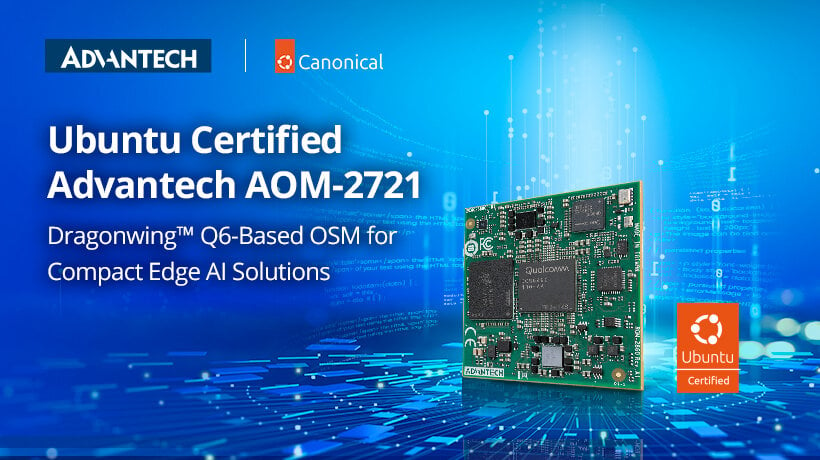
As artificial intelligence integration expands at the industrial edge, developers require computing platforms that guarantee long-term software stability and hardware compatibility. To address these integration risks, Advantech has announced that its AOM-2721 Open Standard Module (OSM), based on the Qualcomm Dragonwing QCS6490 processor, has achieved Ubuntu 24.04 LTS certification. This validation ensures a reliable, secure foundation for deploying AI and Internet of Things (AIoT) workloads across machine vision, autonomous mobile robots, and portable medical devices.
Edge AI computing and hardware specifications
Industrial edge applications demand high computational performance within strict thermal and spatial constraints. The AOM-2721 delivers up to 12 Tera Operations Per Second (TOPS) of AI processing power within a compact 45 × 45 mm OSM form factor, operating at a low thermal design power (TDP) of 6.9 watts. The module integrates multimedia processing, dual-camera support, and high-speed memory interfaces such as LPDDR5 and UFS storage. Furthermore, it supports advanced connectivity standards, including 5G and Wi-Fi 6, enabling rapid data transfer for latency-sensitive workloads.
Software lifecycle management and enterprise security
Deploying AI systems in industrial environments requires predictable maintenance and robust cybersecurity measures. The Ubuntu 24.04 LTS certification verifies that the hardware has passed comprehensive compatibility testing with the operating system, reducing development effort for system integrators. For organisations requiring extended lifecycle management, the module supports the Ubuntu Pro for Devices subscription. This service provides up to 15 years of security maintenance, continuous vulnerability management, compliance tools, and enterprise-grade device fleet management, ensuring deployed hardware remains secure against evolving cyber threats.
Additional Context: Open Standard Modules and LTS firmware
In the embedded computing sector, the Open Standard Module (OSM) specification defines a standard for soldering compute modules directly onto carrier boards. This eliminates mechanical connectors, reducing the system's physical footprint and increasing resistance to industrial vibrations. Pairing a standardised hardware form factor with a Long Term Support (LTS) operating system is critical for original equipment manufacturers. Because industrial machinery often remains in the field for over a decade, utilising an LTS software foundation prevents the need for disruptive operating system migrations, allowing developers to focus strictly on optimising their proprietary AI models and control algorithms.
Edited by Lekshman Ramdas, InduPortals editor – adapted by AI.
www.advantech.com
