
www.industryemea.com
27
'26
Written on Modified on
Tokamak Negative Triangularity Magnetic Fusion Power
General Atomics, Columbia University, and institutional partners demonstrated negative triangularity plasma confinement to suppress wall-damaging edge instabilities in commercial fusion energy systems.
www.ga.com
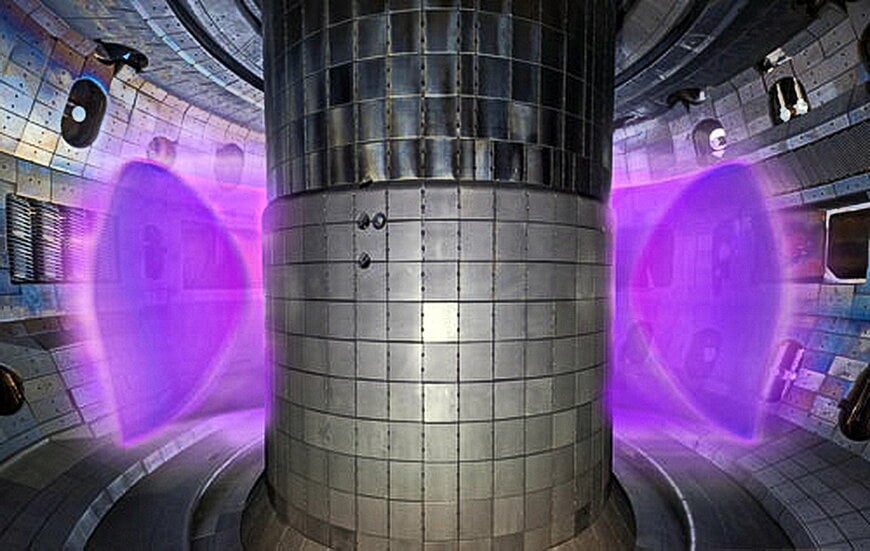
General Atomics collaborated with Columbia University, the University of Texas at Austin, University of California San Diego, and Lawrence Livermore National Laboratory to evaluate negative triangularity plasma shaping at the DIII-D National Fusion Facility. The multi-institutional research demonstrated high-performance magnetic confinement while mitigating transient thermal loads on plasma-facing components in magnetic fusion energy applications.
Operational Constraints in Tokamak Plasma Confinement
Standard tokamak architectures rely on positive triangularity plasma geometry, where the cross-sectional D-shape curves outward from the central torus axis. While this configuration provides thermal insulation and core pressure needed for fusion reactions, it frequently triggers edge-localized modes (ELMs).
ELMs are rapid magnetohydrodynamic instabilities that expel violent bursts of energetic particles and heat flux toward interior structural surfaces. In prospective commercial reactors, repeated ELM-driven thermal shocks risk eroding protective divertor armor and compromising structural integrity. Addressing these heat-exhaust constraints required collaborative expertise in plasma physics, magnetic control systems, and high-heat-flux materials engineering.
Implementation of Inverted Magnetic Shaping
The research team altered the magnetic equilibrium within the DIII-D tokamak to reverse the plasma boundary, curving the outer profile inward toward the central column to establish negative triangularity.
To support the modified geometry, engineers replaced targeted sections of the vessel's internal protective armor with specialized high-temperature tiles suited for inverted divertor strike points. General Atomics developed active magnetic control techniques to stabilize and maintain the inverted plasma profile across extended discharge sequences. The operational framework allowed researchers to assess core transport, confinement margins, and edge boundary dynamics under high-power conditions.
System Stability and Wall Protection Performance
Experimental runs established sustained plasma performance over multi-week testing cycles without the occurrence of edge-localized modes. By naturally suppressing ELM events at the boundary layer, the configuration significantly diminished peak transient thermal loads on the containment walls without degrading core performance.
"We produced high-performance plasmas on DIII-D for weeks without seeing a single ELM," said Kathreen Thome, staff scientist at General Atomics and experimental campaign co-lead. "Negative triangularity is a potentially revolutionary way to design and operate a tokamak for fusion energy."
Future Divertor Integration
General Atomics entered a public-private partnership with Kyoto Fusioneering to advance the system toward plant-scale requirements. The upcoming development phase focuses on engineering an optimized divertor module designed for negative triangularity heat exhaust. This hardware upgrade aims to quantify particle extraction rates, power handling limits, and continuous-duty operational margins required for commercial fusion energy power plants.
Edited by Evgeny Churilov, Induportals Media - Adapted by AI.
www.ga.com
