
www.industryemea.com
29
'26
Written on Modified on
Voith launches new Baselay Pro roll cover concept
High-performance polyurethane roll cover for stable, efficient dewatering, higher production output, and improved paper quality.
voith.com
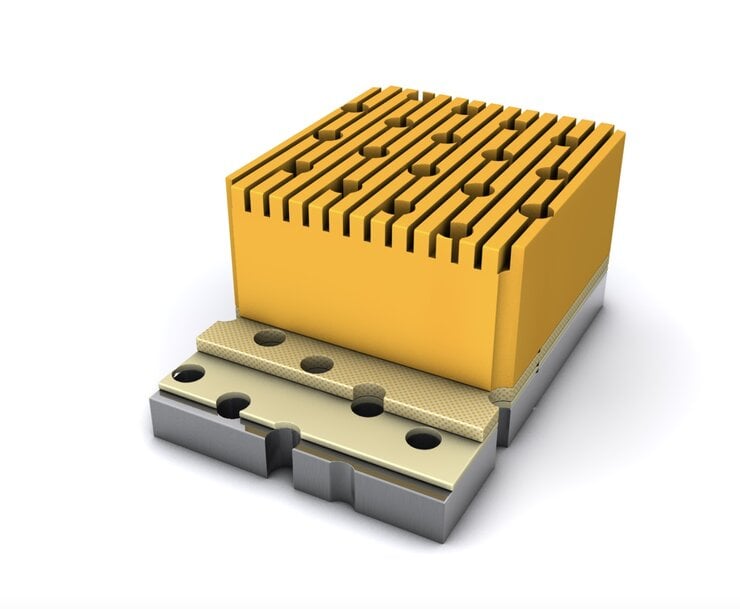
Papermakers face severe mechanical and operational challenges in the press section of modern paper machines, where water removal directly dictates machine speed and downstream drying energy consumption. Operating under continuous linear nip loads and high machine speeds, press roll covers are subjected to cyclic mechanical deflection, severe dynamic shear stresses, aggressive process chemicals, and abrasive fiber fines. Mechanical shocks caused by paper wads, sheet wraps, or foreign debris passing through the nip can generate localized stress peaks, resulting in cover delamination, surface spalling, or catastrophic debonding from the metal roll core. Such mechanical failures force unplanned shutdowns, degrade dewatering uniformity, and shorten roll grinding cycles. Mitigating these operational risks requires resilient composite cover architectures engineered to redistribute localized impact forces and dissipate internal interfacial shear stress without sacrificing surface drainage characteristics.
Advanced Base Layer Architecture and Stress Dissipation
To address these operational stresses, Voith expanded its industrial polyurethane portfolio with the launch of the BaseLayer Pro roll cover concept. Engineered specifically for demanding dewatering operations in paper machine press sections, the architecture incorporates an advanced structural base layer design that alters internal mechanical load distribution.
The BaseLayer Pro construction reduces shear stress concentrations during sudden mechanical impacts and lowers peak stress levels throughout the composite cover matrix. By distributing compressive and shear forces across a broader structural volume, the technology enhances structural durability, mitigates the risk of internal core-to-cover bond failure, and extends the operational service life of the roll between re-cover intervals.
Product Generation Lineup and Surface Customization
The new generation of press roll covers built on the BaseLayer Pro platform encompasses three core product families:
- AquaPress Pro
- AquaFlow Pro
- SolarFlow Pro
While the proprietary BaseLayer Pro underlayer provides enhanced mechanical load dissipation, the functional outer polyurethane layers of the SolarFlow Pro, AquaFlow Pro, and AquaPress Pro lines retain the chemical stability and abrasion resistance established in Voith's conventional Solar and Aqua product ranges.
Voith application engineers collaborate directly with mill operators to configure specialized surface profiles—including tailored blind-drilled holes, grooves, or multi-dimensional surface combinations—matched to specific mill paper grades, press nip configurations, and production target speeds. These customized drainage topographies maintain high-volume void capacity under dynamic load, delivering uniform nip dewatering and web runnability at peak operating velocities.
Additional Context
This section details technical specifications and competitive benchmarking not included in the original product announcement.
In industrial paper machine operations governed by TAPPI (Technical Association of the Pulp and Paper Industry) standards, press section roll covers operate under linear nip loads reaching up to 1,200 to 1,500 kilonewtons per meter and machine speeds surpassing 1,800 to 2,000 meters per minute. Polyurethane elastomers in these environments are formulated with hard durometer ratings typically ranging from 0 to 5 P&J (Pusey & Jones hardness) to prevent excessive dynamic heat buildup (hysteresis) caused by rapid cyclical deformation. Under repeated nip passage, internal heat generation can accelerate viscoelastic softening and initiate subsurface fatigue cracking along the bonding boundary where the polymer adheres to the cast-iron or forged-steel roll shell. The multi-layer construction of BaseLayer Pro utilizes high-modulus, thermally stable intermediate elastomeric formulations and reinforced bonding primers to provide a gradual stiffness gradient between the rigid metal roll core and the resilient working layer, dampening radial and circumferential shear deformations.
Within the paper machine roll cover and dewatering technology market, Voith's BaseLayer Pro benchmarks directly against high-performance polyurethane roll covers from Valmet (such as the PressPolar and PressFalcon series) and Yamauchi Corporation. While competing solutions historically counter mechanical wad impacts by increasing overall cover hardness or deploying specialized fiber-reinforced intermediate layers, excessively rigid covers often reduce void volume compression recovery and heighten the risk of brittle fracture under non-uniform nip pressures. By decoupling the stress-damping capabilities of the base layer from the chemical resistance, open void volume, and wear resistance of the outer polyurethane functional layer, Voith addresses operational reliability in high-speed packaging, containerboard, and graphic paper production lines without requiring compromises in water evacuation efficiency.
Edited by Romila DSilva, Induportals Editor, with AI assistance.
