
www.industryemea.com
06
'26
Written on Modified on
SKF brings industrial solutions to COP31
SKF is demonstrating how technologies available today can help industry reduce its environmental impact while improving performance and resilience.
www.skf.com
Industrial rotating equipment accounts for a substantial fraction of global electrical consumption, with mechanical friction alone consuming more than twenty percent of worldwide primary energy. In heavy processing facilities, continuous manufacturing lines, and mission-critical artificial intelligence data centers, friction between mechanical surfaces introduces parasitic electrical loads, thermal runaway risks, and continuous lubricant breakdown. Historically, plant operators and data center infrastructure architects relied on hydrodynamic or rolling-element bearings bathed in closed-loop oil circuits. These conventional setups require mechanical pumps, oil reservoirs, fluid filters, and maintenance-heavy seals that remain vulnerable to seal leakage, fluid contamination, and mechanical wear over time. Furthermore, traditional bearing maintenance strategies have favored disposable linear lifecycles, discarding large structural steel rings whenever localized fatigue spalling occurs. Mitigating these systemic energy penalties and material scrap volumes requires a convergence of zero-friction levitation hardware, continuous nanoscale chemical oil reclamation, and precision additive remanufacturing that extends asset lifespans without recurring raw steel extraction.
Frictionless Magnetic Suspension for AI Data Center Cooling
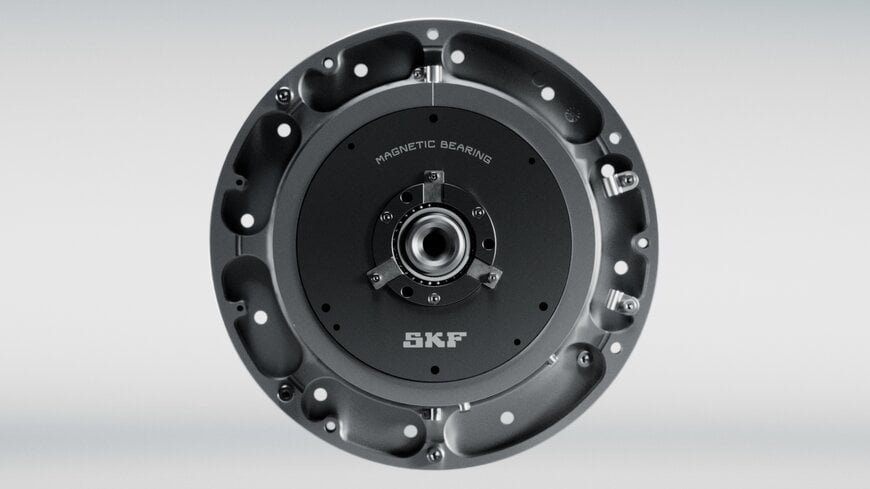
To address escalating thermal loads across artificial intelligence server farms and high-density computing clusters, SKF is highlighting its active magnetic bearing platforms at COP31. Data center facilities require vast power envelopes for compute processors as well as the mechanical centrifugal chillers that evacuate heat from server racks. Traditional oil-lubricated compressor bearings introduce parasitic shear friction and oil migration into refrigerant circuits, which fouls internal heat exchanger tube surfaces and degrades thermal conductivity over time.
SKF magnetic bearings eliminate physical contact entirely by levitating rotating compressor shafts within a continuous electromagnetic field governed by high-speed digital controllers. Operating without contact eliminates mechanical friction, mechanical wear, and the requirement for lubricating oil loops. This frictionless rotation delivers higher compressor rotational speeds, higher thermodynamic cycle efficiency, and enhanced system uptime. Frederic Ponson, Director of Magnetic Mechatronics at SKF, emphasized that expanding artificial intelligence infrastructure demands efficiency gains across foundational cooling facilities as well as silicon compute engines. SKF estimates that chillers equipped with its magnetic bearings commissioned in 2030 will avoid 3.4 million tonnes of carbon dioxide equivalent emissions over their operational service lives through reduced electricity consumption and minimized maintenance downtime compared to conventional oil-lubricated systems.
Asset Longevity, Oil Reclamation, and Additive Re-Cladding
Beyond mechanical power reduction, SKF’s showcase focuses on decoupling industrial operations from continuous raw material extraction through an integrated circular equipment portfolio. Susanne Larsson, Chief Financial Officer and Chief Sustainability Officer at SKF, stated that with over a fifth of global energy consumed in overcoming friction, industrial decarbonization relies on scaling proven circular and efficiency technologies across wider customer bases.
The circular portfolio encompasses multiple maintenance and material recovery technologies:
- SKF Insight Bearings: Integrates wireless condition-monitoring sensors directly into bearing housings to track dynamic loads, vibrations, and thermal excursions, enabling predictive maintenance prior to catastrophic mechanical seizure.
- RecondOil Circular Chemistry: Utilizes Double Separation Technology to extract sub-micron particulates and chemical oxidation degradation products from industrial lubricants, preventing catalytic oil degradation and allowing lubricants to circulate indefinitely without periodic fluid changes.
- Bearing Remanufacturing Services: Restores worn industrial rolling bearings back to original OEM functional tolerances, consuming up to ninety percent less energy than fabricating replacement units from virgin metallurgical steel.
- SKF Infinium Additive Restoration: Applies additive manufacturing directed-energy deposition to re-clad damaged raceway surfaces on large-diameter bearings, renewing fatigued contact surfaces without scrapping the underlying forged core ring.
To accelerate global industrial deployment, SKF confirmed its entry into the Energy Efficiency Movement, a cross-sector collaborative network dedicated to promoting industrial energy abatement frameworks and accelerating supply-chain decarbonization.
Additional Context
This section details technical specifications and competitive benchmarking not included in the original product announcement.
In large-scale industrial thermal systems and turbomachinery governed by standards such as ISO 14839 for active magnetic bearing (AMB) systems and AHRI 550/590 for water-chilling packages, active magnetic bearings utilize position sensors to track shaft displacement at kilohertz sampling frequencies. Pulse-width-modulated power amplifiers dynamically regulate current through electromagnetic stator coils, maintaining shaft concentricity within five to twenty micrometers across radial and axial axes. By completely removing oil from the chiller circuit, magnetic systems eliminate the oil-film fouling on evaporator and condenser tubes that degrades the overall coefficient of performance (COP) by two to eight percent in traditional flooded evaporators over multi-year operational cycles. Concurrently, in circular lubrication governed by ISO 4406 cleanliness codes, conventional mechanical micro-filtration captures particles down to roughly three to five micrometers. SKF RecondOil’s Double Separation Technology pairs mechanical filtration with proprietary chemical conditioning boosters that agglomerate liquid oxidation polymers and sub-micron soot nanoparticles under one micrometer, stopping the autocatalytic oxidation loop that depletes anti-wear and extreme-pressure additives.
Within the high-efficiency chiller and active magnetic bearing domain, SKF’s magnetic mechatronics portfolio benchmarks directly against magnetic bearing systems from Waukesha Bearings, Siemens Energy, and specialized compressor manufacturers such as Danfoss (Turbocor oil-free centrifugal compressors) and Daikin Applied. While competitors like Danfoss Turbocor package magnetic levitation exclusively within proprietary, enclosed variable-speed centrifugal compressors designed primarily for medium-tonnage commercial HVAC installations, SKF supplies modular magnetic bearing actuators, touchdown auxiliary bearings, and standalone digital controllers directly to heavy industrial compressor and turboexpander OEMs. In the heavy circular metallurgy and remanufacturing sector, SKF competes with Timken’s bearing repair services and Schaeffler’s circular remanufacturing centers. By deploying the SKF Infinium laser metal deposition approach to rebuild raceways on pulp, paper, and steel mill roll bearings, SKF avoids the mechanical dimensional limitations of conventional subtractive grinding, which can only remove minor subsurface microcracks before exceeding radial internal clearance (RIC) design thresholds.
Edited by Romila DSilva, Induportals Editor, with AI assistance.
