
www.industryemea.com
16
'26
Written on Modified on
EMC Cable Gland for Multi-Cable Routing
AGRO AG of the KAISER GROUP introduces a variable EMC cable gland system for the joint entry of shielded cables with different cross-sections into industrial enclosures.
www.kaiser-gp.com
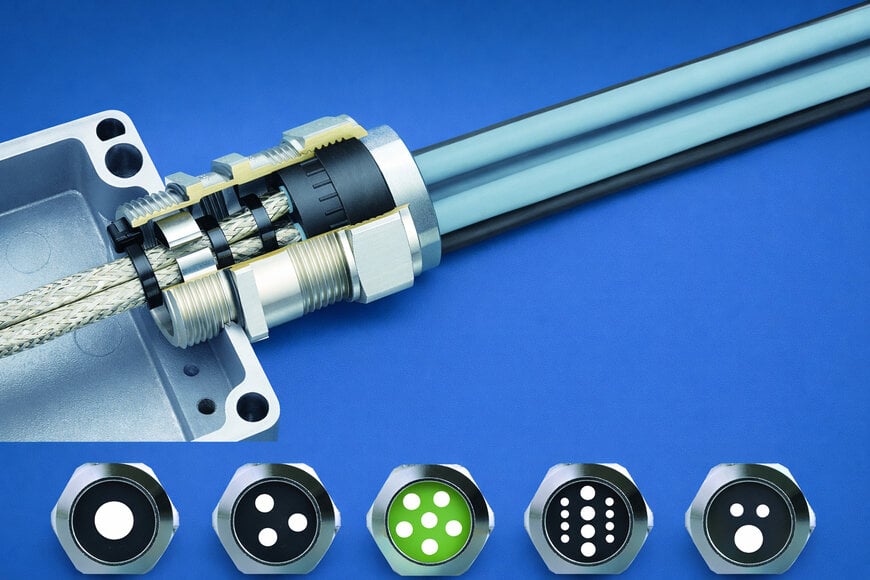
A new EMC cable gland concept enables multiple shielded cables of varying diameters to be routed through a single gland while maintaining defined shield contact and strain relief according to DIN EN 62444. The system targets industrial enclosures in machinery, vehicles, and equipment where reliable electromagnetic compatibility (EMC) and space efficiency are required.
Multi-Cable Entry with Defined Shield Contact
In control cabinets, drive systems, and machine installations, shielded cables are often introduced individually to ensure low-impedance shield termination. This increases installation time and enclosure space requirements. The new system from AGRO AG addresses this constraint by allowing several shielded cables also with different cross-sections to pass through a single EMC cable gland while ensuring effective shield connection.
The design supports cables with interrupted or partially stripped braided shields that continue beyond the gland. During installation, cables remain rotatable, slidable, and removable, which simplifies alignment and maintenance in complex assemblies. This feature is particularly relevant for modular machine concepts and retrofit scenarios within the digital supply chain, where reconfiguration of electrical systems is common.
Contact Mechanism and Mechanical Performance
Electrical contact with the cable shield is established via a stainless steel contact spring made of material grade 1.4310. The spring geometry provides circumferential clamping force while protecting the braided shield from mechanical damage. The defined clamping pressure ensures low transfer impedance and stable dissipation of interference currents to the enclosure.
The gland body is manufactured from nickel-plated brass to provide corrosion resistance and mechanical robustness in industrial environments. Standard versions are available for conventional enclosure boreholes; customer-specific sealing inserts can be configured on request to accommodate particular cable combinations.
Strain relief complies with DIN EN 62444, execution A, defining mechanical retention forces for cable glands in fixed installations. This ensures that tensile loads are not transferred to the electrical termination point.
Temperature Range and Sealing Options
In its standard configuration, the system operates within a temperature range of –60 °C to +100 °C. When equipped with FPM sealing inserts, the permissible temperature range extends up to +200 °C (lower limit –40 °C). This enables deployment in applications such as industrial drives, energy systems, and high-temperature machinery environments.
Application Context
Typical use cases include control cabinets, power electronics, automation systems, and vehicle installations where multiple shielded signal or power cables must be introduced with limited panel space. Compared with conventional single-cable EMC glands, the multi-cable approach reduces the number of enclosure penetrations while maintaining EMC contact quality defined by standardized mechanical retention and material specifications.
The manufacturer, KAISER GmbH & Co. KG, headquartered in Schalksmühle, Germany, develops cable entry and protection systems for machinery, equipment, and industrial installations under the umbrella of the KAISER GROUP.
www.kaiser-elektro.com
