
www.industryemea.com
19
'26
Written on Modified on
Inline Barcode Verification for Industrial Traceability
Omron introduces an inline verification technology for ISO-compliant barcode quality control directly within high-speed production and packaging environments.
industrial.omron.eu
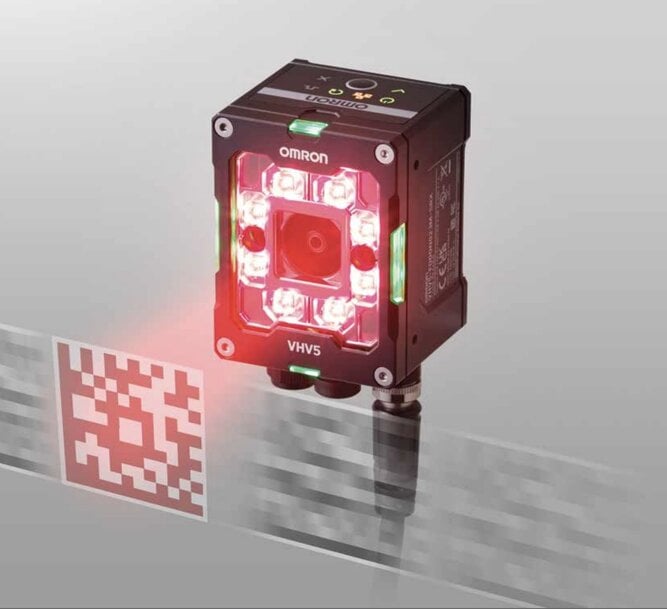
Inline barcode verification systems enable manufacturers to evaluate the readability and compliance of identification codes immediately after marking or printing. Omron has developed a high-speed verification technology designed to assess 1D, 2D and direct part mark codes directly on the production line, supporting traceability requirements in automated manufacturing and packaging processes.
Real-Time Barcode Quality Control in Production Lines
Barcode quality plays a central role in industrial traceability systems. Codes applied during manufacturing must remain readable across internal logistics, final assembly, distribution and product use. Errors in marking or printing can disrupt automated scanning processes and compromise compliance with supply chain documentation requirements.
The inline verification technology developed by Omron addresses this requirement by validating barcodes directly during production. The system performs real-time verification of Code 128, Data Matrix, QR and direct part mark (DPM) codes at speeds of up to 1,000 codes per minute.
This approach allows manufacturers to detect marking defects immediately after code generation. If printing or laser marking problems occur, they can be corrected before the product continues through downstream processing steps.
Inline verification therefore functions as part of a digital supply chain, ensuring that product identifiers remain readable and standards-compliant throughout automated logistics and manufacturing workflows.
Compliance with International Barcode Verification Standards
Industrial barcode verification systems must evaluate code quality according to internationally accepted measurement standards. The Omron verification technology applies several ISO-based methodologies depending on the type of code.
For linear barcodes, verification follows ISO/IEC 15416, which specifies grading parameters such as symbol contrast, edge determination and modulation. Two-dimensional symbols are evaluated using ISO/IEC 15415, which defines metrics including cell contrast and axial non-uniformity.
Direct part mark codes applied by laser, dot-peen or inkjet marking are verified according to ISO/IEC TR 29158 (AIM DPM). This standard addresses the optical challenges associated with codes engraved or etched directly into components.
Applying these standards ensures consistent and repeatable grading results across labels, packaging and permanently marked parts. Such verification is particularly relevant in automotive manufacturing, medical technology, electronics, pharmaceuticals and general industrial production, where product traceability is often regulated.
Optical Design for Challenging Surfaces
Barcode verification accuracy depends heavily on the imaging conditions used to capture the code. Industrial environments often involve reflective metals, curved packaging or low-contrast surfaces that can distort measurement results.
To address these challenges, the verification system uses tilted coaxial lighting, an illumination technique that reduces glare and enhances edge definition. By directing light at an optimized angle, the system improves readability of codes on reflective or curved surfaces.
This optical configuration is particularly effective for DPM codes on metallic components, glossy labels and curved plastic packaging. Such conditions are common in high-speed assembly and packaging lines where conventional imaging systems can struggle to maintain consistent contrast.
Image Correction for Angled or Curved Installations
Production lines frequently impose mechanical constraints that prevent cameras from viewing codes from a perfectly perpendicular angle. Distortion caused by curved surfaces or off-axis imaging can affect barcode grading parameters.
To compensate for these effects, the verification system incorporates unwarp transformation algorithms that correct geometric distortion in captured images. The correction enables accurate measurement of parameters such as axial non-uniformity in two-dimensional codes.
In addition, flat-field correction equalizes illumination and pixel response across the camera’s field of view. This prevents variations in lighting intensity from influencing grading results depending on where the code appears within the image.
Together, these imaging techniques ensure that barcode verification remains consistent even in compact production setups with limited installation space.
Integrated Data Validation and System Configuration
Beyond visual verification, barcode quality control also requires validation of the encoded data structure. The system therefore includes a GS1 syntax check that confirms whether the data format follows GS1 identification rules commonly used in global logistics and retail supply chains.
Configuration and monitoring are handled through a browser-based interface, allowing operators to access the system without dedicated software installations. A guided calibration assistant supports setup and ensures that the imaging system maintains the required verification accuracy.
These features simplify deployment in industrial environments while enabling ongoing monitoring and diagnostics of barcode verification processes.
Role in Automated Manufacturing Traceability
Barcode verification technologies form an essential component of modern manufacturing traceability infrastructures. By validating both code quality and data structure immediately after marking, inline systems reduce the risk of unreadable identifiers entering downstream logistics processes.
Such verification is increasingly relevant in automated production environments where barcode scanning supports digital documentation, product genealogy and regulatory compliance across the supply chain.
Edited by Sucithra Mani — AI-powered.
www.omron.com
