
www.industryemea.com
18
'26
Written on Modified on
ADLINK Launches Edge AI Platforms with NVIDIA Thor
New industrial systems deliver high-performance computing, functional safety, and connectivity for robotics, medical imaging, and autonomous edge AI applications.
www.adlinktech.com
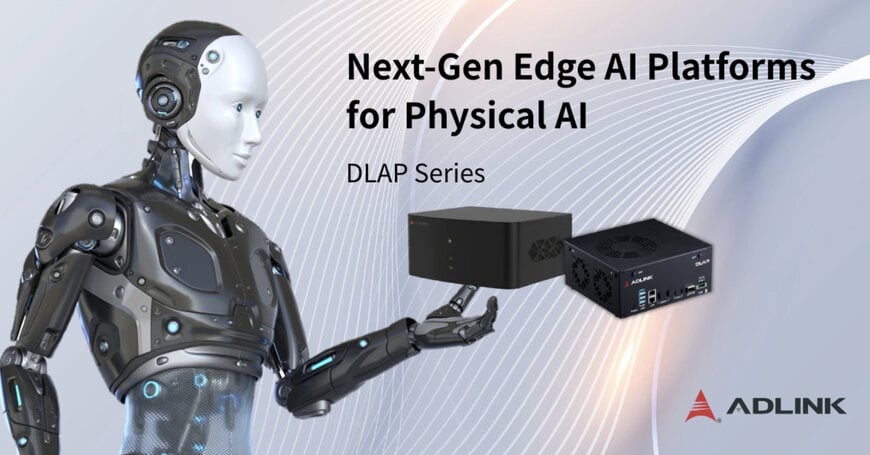
Industrial automation, medical imaging, and robotics increasingly require edge AI platforms capable of running complex models locally with high performance and reliability. ADLINK Technology Inc. has introduced its next-generation DLAP Edge AI platforms powered by NVIDIA IGX Thor and NVIDIA Jetson Thor, designed to support real-time “physical AI” workloads in demanding environments.
The portfolio includes the enterprise-grade DLAP-IGX Series and the compact DLAP-700 Series, both engineered to process large AI models such as large language models (LLMs) and vision-language models (VLMs) directly at the edge.
High-performance edge AI with functional safety architecture
The DLAP-IGX Series targets industrial environments where deterministic performance and safety are critical. Built on the NVIDIA IGX T7000 platform, the system delivers up to 4,293 TFLOPS (FP4 sparse) when combined with an NVIDIA RTX PRO 5000 Blackwell GPU, enabling multi-model AI processing within a single system.
A key technical feature is its functional safety architecture, which includes a dedicated safety island on the system-on-chip, a safety microcontroller on the carrier board, and a board management controller for remote monitoring. This design supports deployment in applications where fail-safe operation and system supervision are required, such as medical systems and autonomous machines.
The platform also integrates high-bandwidth networking through an NVIDIA ConnectX-7 SmartNIC with dual 200 GbE ports, enabling real-time ingestion of high-volume sensor data from cameras, LiDAR, or industrial sensors.
Compact Jetson Thor platforms for edge deployment
The DLAP-700 Series extends edge AI capabilities into more compact and distributed applications. The DLAP-701 model is designed for general-purpose edge AI workloads, including medical image analysis and high-bandwidth data processing. It is powered by NVIDIA Jetson T5000 or T4000 modules, delivering up to 2,070 TFLOPS (FP4) of AI performance.
The system integrates a 14-core ARM Neoverse-V3AE CPU and supports up to 128 GB LPDDR5X memory, enabling concurrent execution of multiple AI models. With dimensions of 211 mm × 194 mm × 94 mm and an operating range of -10°C to 35°C, it is suited for controlled industrial environments.
Edge AI for robotics and autonomous systems
The DLAP-711 model is specifically designed for robotics applications, including humanoid robots, autonomous mobile robots (AMRs), and vision sensing systems. It shares the same compute architecture as the DLAP-701 but is optimized for harsher environments, operating between -20°C and 65°C.
Enhanced connectivity—including four Gigabit Ethernet ports, additional LAN interfaces, and high-speed QSFP networking—supports integration with multiple sensors and robotic subsystems. Its compact form factor (224 mm × 124 mm × 85 mm) allows deployment in space-constrained robotic platforms where onboard processing is required.
Enabling physical AI at the edge
Compared with previous NVIDIA IGX Orin-based systems, the new platforms deliver up to eight times higher AI compute on integrated GPUs, 2.5 times higher performance on discrete GPUs, and improved connectivity and efficiency. These gains enable real-time inference for complex AI workloads directly on edge devices, reducing latency and dependency on cloud infrastructure.
The platforms support the NVIDIA AI Enterprise ecosystem, including frameworks such as Isaac for robotics and Holoscan for medical applications, providing a unified software environment for development and deployment.
Application in industrial and medical environments
These systems are designed for applications where real-time decision-making and reliability are essential, including robotic automation, medical diagnostics, and autonomous systems. By combining high compute density, functional safety, and rugged design, the platforms enable deployment of AI in environments where traditional computing systems may not meet performance or reliability requirements.
This approach reflects the growing shift toward edge-based AI processing, where data is analyzed locally to improve responsiveness, reduce bandwidth usage, and ensure operational continuity in critical systems.
Edited by Industrial Journalist, Natania Lyngdoh — Adapted by AI.
www.adlinktech.com
