
www.industryemea.com
20
'26
Written on Modified on
Helix Dryer Improves Lithium-Ion Battery Recycling
ANDRITZ introduces a vacuum-based helix dryer to enhance solvent removal, black mass purity, and process safety in battery recycling operations.
www.andritz.com
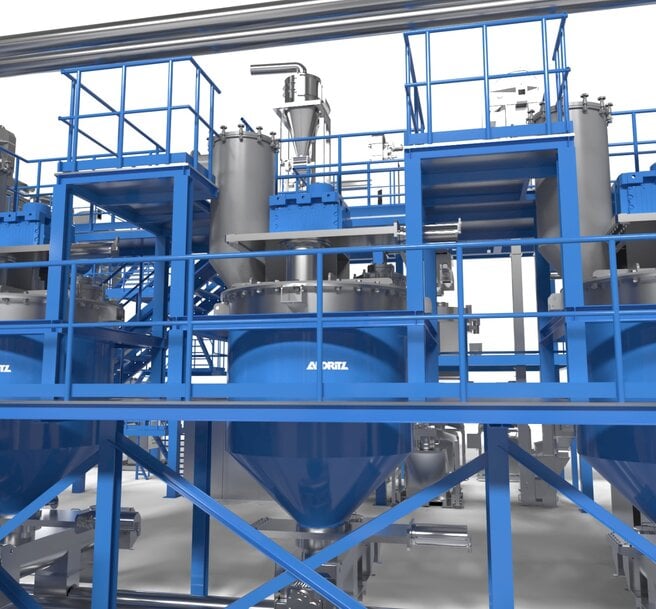
ANDRITZ has launched a helix dryer designed for lithium-ion battery recycling, focusing on efficient solvent removal and consistent processing of complex shredded materials. The system supports high-purity black mass recovery while maintaining stable and safe operating conditions across variable feed streams.
Processing Complex Battery Materials
Battery recycling involves heterogeneous input materials, including shredded pouch and prismatic cells containing foil fragments, black mass, and metallic particles. These materials often retain residual solvents with varying boiling points, requiring controlled removal to ensure product quality and process safety.
The helix dryer is engineered to handle this variability through indirect heating under vacuum within an inert, closed-loop environment. This configuration enables controlled evaporation of both low- and high-boiling solvents while minimizing oxidation and thermal degradation.
Vacuum Drying and Heat Transfer Optimization
The system combines vacuum drying with optimized heat transfer and mechanical mixing. A helical agitator ensures uniform material movement, improving heat distribution and solvent evaporation efficiency.
Operating under reduced pressure lowers solvent boiling points, enabling effective drying at lower temperatures. This reduces energy consumption and helps maintain the integrity of recovered materials, which is critical for downstream processing.
An integrated product filter prevents material loss during vacuum operation, while the conical vessel design supports complete discharge, reducing residual waste and improving material recovery rates.
Measured Performance and Extraction Efficiency
Testing with pouch and prismatic battery materials has demonstrated solvent extraction rates of up to 99.5%. This level of performance supports the production of high-purity black mass, which is essential for efficient recovery of valuable metals such as lithium, cobalt, and nickel.
Consistent solvent removal also contributes to safer handling and storage of processed materials, reducing the risk of thermal or chemical instability.
Flexible Batch Processing
The helix dryer operates as a batch system, allowing recyclers to adapt to different battery chemistries and feed compositions. This flexibility is important in recycling environments where input materials vary significantly depending on source and processing stage.
Batch processing also enables better control over process parameters, supporting consistent output quality and easier integration into existing recycling workflows.
Role in Circular Battery Supply Chains
The introduction of the helix dryer aligns with increasing demand for efficient lithium-ion battery recycling technologies. As battery usage grows across electric vehicles and energy storage systems, recycling processes must scale while maintaining material recovery efficiency and environmental compliance.
By improving solvent removal and enabling high-quality black mass recovery, the system supports a more efficient digital supply chain for battery materials, contributing to resource conservation and reduced environmental impact.
Edited by Romila DSilva, Induportals Editor, with AI assistance.
www.andritz.com
