
www.industryemea.com
27
'26
Written on Modified on
OMC Introduces Laboratory-Grade Polish for Fibre Optic Cables
Cobot-assisted manufacturing achieves unprecedented link-to-link consistency for demanding research and big physics datalink applications.
www.omcint.com
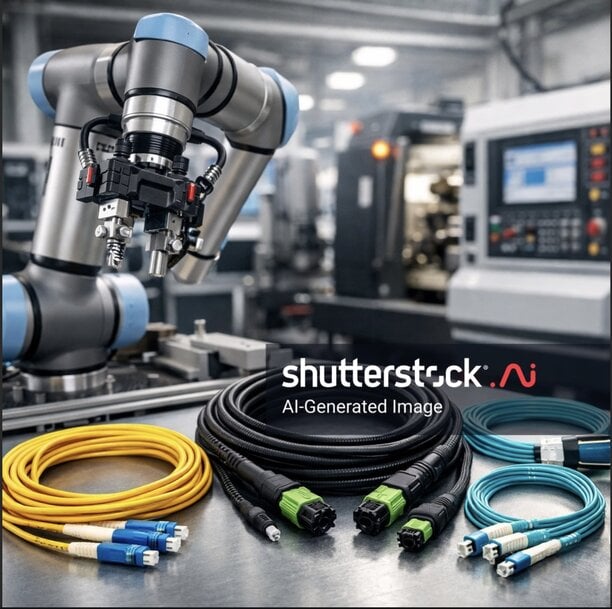
OMC, a pioneer in optoelectronics design and manufacture, has introduced an ultra-performance laboratory-grade polish finish for its industrial fibre optic cables and datalinks. Designed to serve the most demanding environments—such as research laboratories and big physics applications—the new finish achieves an unprecedented level of link-to-link consistency. To accomplish this, OMC integrates highly skilled human operators with custom-trained, calibrated, and tooled collaborative robots (cobots). While the company's existing premium industrial-grade polish is suitable for most industrial data communications, this new grade ensures reliable performance in settings with extremely tight performance tolerances.
For over 40 years, OMC has relied on its skilled workforce to achieve the precision multi-stage polishing necessary for industrial-grade datalinks used in critical infrastructure like power stations and railways. By introducing cobots into its shared workspace, the company has effectively given operators a "bionic arm," according to Managing Director William Heath. The bespoke programming and tooling for the cobots handle the repetitive physical demands of the process, increasing throughput capacity up to tenfold and reducing operator fatigue while simultaneously elevating the quality and consistency of the polish.
The recent development aligns with increasing global demand for fibre-optic datalinks driven by electrification in high-voltage, medical, and transportation sectors. Maintaining stringent quality standards while scaling production allows OMC to deliver the highest grade of performance and robustness required for long-life industrial applications. The company’s continued investment in next-generation robotic automation earned it a commendation at the 2025 electronics industry Elektra Awards for its innovative manufacturing culture.
Additional Context
This section provides technological and market background not explicitly detailed in the original release.
In fiber optic communications, the end-face polish of a connector is a critical factor determining the link's overall performance. Any microscopic scratches, pits, or deviations in the ferrule's geometry can cause severe insertion loss (attenuation) and optical return loss (back reflection), which degrade signal integrity over long distances or in highly sensitive environments. Achieving a "laboratory-grade" physical contact polish typically requires a meticulous, multi-step lapping process using progressively finer abrasive films, often down to 0.01 µm, to create a perfectly smooth, defect-free surface. Traditionally, manual hand-polishing relies entirely on operator technique and consistent applied pressure, making batch-to-batch uniformity extremely difficult to maintain at high volumes. By integrating cobots—which provide highly precise, repeatable force and motion control—with human oversight, manufacturers can eliminate the mechanical variability of manual polishing while safely scaling up production to meet the surging demand for high-isolation optical interconnects.
Edited by Lekshman Ramdas, Induportals editor – adapted by AI.
www.omc-uk.com
