
www.industryemea.com
23
'26
Written on Modified on
Battery Module Production Advances Electric Vehicle Manufacturing
Porsche establishes Smart Battery Shop in Slovakia to produce high-voltage modules for the Cayenne Electric, integrating advanced manufacturing, quality control, and sustainable production.
www.porsche.com
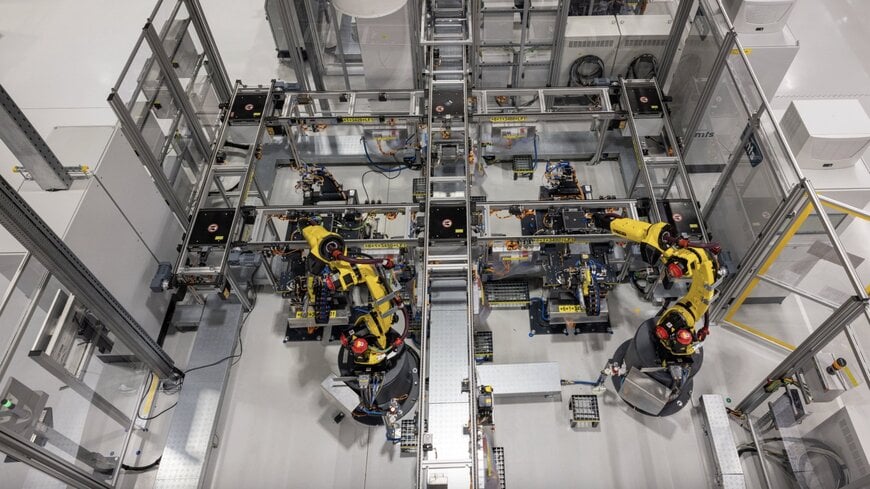
Porsche has developed an in-house battery production facility, the Smart Battery Shop, in Horná Streda, Slovakia, to manufacture high-voltage battery modules for the Cayenne Electric. The facility integrates product development and series production, supporting improved performance, efficiency, and quality in electric vehicle manufacturing.
Integrated Development and Production
The Smart Battery Shop was established in collaboration with Porsche Werkzeugbau GmbH, enabling direct transfer of expertise from prototype development to series production. The facility spans approximately 40,200 square meters and was completed within a compressed timeline, with production equipment installed in 2023 and the first modules manufactured in May 2024.
Each battery module consists of 32 individual pouch cells, with six modules forming the complete high-voltage battery system. This modular architecture supports scalability and efficient assembly within vehicle production lines.
Multi-Stage Battery Module Manufacturing
The production process is designed to ensure precision, safety, and repeatability across all stages. Strict electrostatic discharge (ESD) protection and cleanliness standards are applied throughout manufacturing to prevent defects and ensure process stability.
Cell preparation includes testing and conditioning of pouch cells before assembly. During stack formation, cells are aligned with controlled spacing and positioning to ensure consistent electrical performance. The stacks are then inserted into carriers, and cell tabs are prepared for joining.
Laser welding is used to connect cell tabs, providing both electrical conductivity and mechanical strength. Continuous quality checks are performed during this stage to verify weld integrity. Subsequent steps include the application of foam for mechanical stabilization and the integration of cell stacks into module housings.
Thermally conductive materials are added to improve heat dissipation, followed by bonding of cooling plates to maintain thermal efficiency. The module is then sealed through top plate assembly and welding, creating a fully enclosed structure.
Quality Assurance and Traceability
End-of-line testing includes leak detection, electrical verification, insulation measurement, and functional checks. These procedures ensure that each module meets performance and safety requirements before leaving the production line.
The facility employs real-time process data acquisition, enabling continuous monitoring and full traceability. Production data is archived in the cloud, allowing long-term access to manufacturing records and supporting lifecycle management within a digital supply chain.
Additional validation is conducted in laboratory environments, where batteries are tested under extreme conditions, including temperatures between 60°C and 100°C and immersion scenarios. These tests assess durability, charging performance, and long-term reliability.
Integration into Vehicle Production
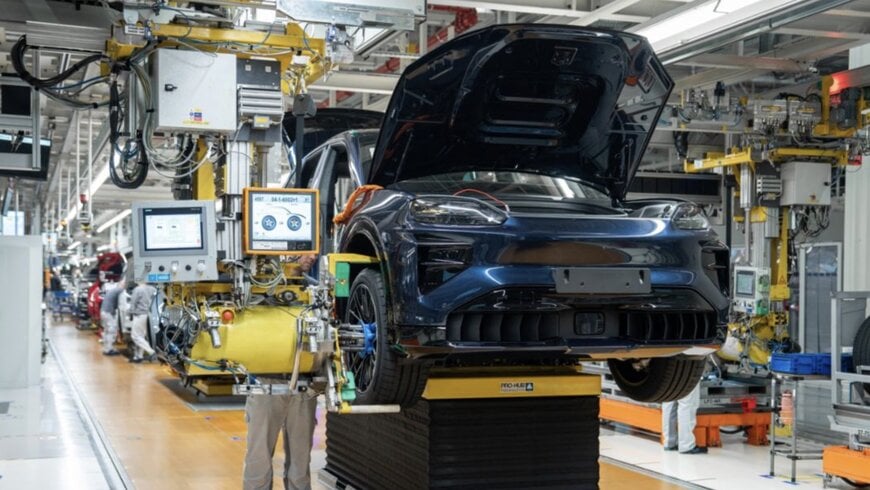
After module production, external suppliers integrate high-voltage cabling and connectors. The completed battery systems are then delivered using just-in-sequence (JIS) logistics to Porsche’s assembly plant in Bratislava, ensuring synchronized integration into vehicle production.
This approach minimizes inventory requirements and supports efficient manufacturing flow in electric vehicle assembly.
Sustainable Manufacturing Approach
The Smart Battery Shop incorporates environmental measures aimed at reducing emissions and improving resource efficiency. Photovoltaic systems provide renewable energy, while heat pumps support energy-efficient operations.
Green roofing and on-site water supply contribute to climate resilience and reduced environmental impact. These measures align with broader industry efforts to develop more sustainable battery production processes.
Relevance for Electric Mobility
The establishment of in-house battery module production reflects a strategic shift toward vertical integration in the automotive industry. By controlling key aspects of battery design and manufacturing, automakers can optimize performance, improve quality control, and enhance supply chain resilience.
Such facilities play a critical role in supporting the transition to electric mobility, where battery systems are central to vehicle performance, efficiency, and lifecycle sustainability.
Edited by Romila DSilva, Induportals Editor, with AI assistance.
www.porsche.com
