
www.industryemea.com
25
'26
Written on Modified on
Automated Dissolution System Increases Lab Throughput
ERWEKA introduces RoboDis II+ platform to automate dissolution testing workflows, improving compliance, data integrity, and productivity in pharmaceutical QC and R&D laboratories.
www.erweka.com
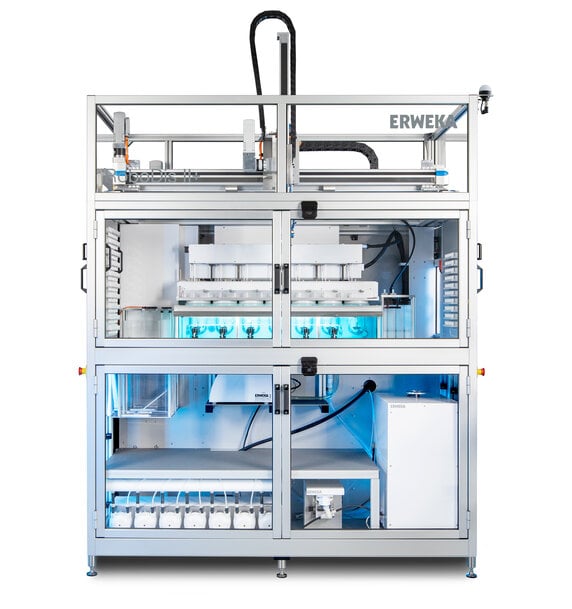
ERWEKA has introduced the RoboDis II+ fully automated dissolution system, designed to streamline solid dosage testing by integrating robotics, digital control, and analytical workflows into a single platform for pharmaceutical laboratories.
Context: Increasing demands in dissolution testing
Pharmaceutical quality control (QC) and research laboratories face growing pressure to improve throughput, ensure regulatory compliance, and maintain data integrity. Manual dissolution testing processes are time-consuming and prone to variability, particularly in high-volume environments.
RoboDis II+ addresses these challenges by automating the full dissolution workflow, from media preparation to analysis and reporting, enabling consistent and reproducible results.
Automation architecture: Parallel processing and robotics
The system uses a parallel-working architecture combined with a robotic handling unit to execute multiple dissolution tests simultaneously. A high-precision robotic arm automates key steps, including sample handling, media filling, basket handling, and vessel cleaning.
This approach reduces operator involvement and ensures consistent execution of each test cycle, minimising variability and human error.
A flexible sample magazine supports batch sizes of 10, 20, or 40 runs, enabling continuous operation, including unattended overnight or weekend testing.
Integrated media preparation and dosing precision
RoboDis II+ includes automated media preparation with support for up to six media types, handling heating, degassing, and delivery. This ensures consistent media quality across test runs.
A ceramic piston pump system enables precise dosing and sampling with low maintenance requirements. The system supports a wide range of dosage forms, including tablets, granulates, powders, pellets, and sinker-based formulations.
Automated pH adjustment according to pharmacopeia methods allows complex dissolution profiles to be executed with controlled pH changes and documented measurements.
Analytical integration and data integrity
The platform integrates sampling and analysis through inline filtration and optional UV-Vis or HPLC systems. Automated sample transfer and measurement reduce manual intervention and enable end-to-end testing within a single system.
Disso.NET software manages all operations, providing role-based access control, secure data storage, and audit trails compliant with 21 CFR Part 11. Integration with laboratory information management systems (LIMS) via XML interfaces supports data exchange and reporting within existing IT environments.
Regulatory compliance and global standards
RoboDis II+ is compliant with USP, EP, and JP standards and supports USP Methods 1 (basket) and 2 (paddle). Integrated system suitability tests and continuous process monitoring ensure inspection-ready operation and adherence to regulatory requirements.
Operational impact: Throughput and efficiency gains
The compact footprint of approximately 2 × 1 meters allows high-capacity operation within limited laboratory space. Continuous 24/7 operation improves equipment utilisation and reduces turnaround times for both batch release and development processes.
Automation reduces labour requirements and supports consistent test execution, contributing to improved productivity and reduced operational variability.
Conclusion: End-to-end automation for dissolution workflows
With RoboDis II+, ERWEKA delivers a fully integrated dissolution testing platform combining robotics, analytics, and compliance-ready software. The system supports high-throughput, standardised testing while reducing manual effort and enabling reliable, inspection-ready laboratory operations.
Edited by an industrial journalist, Lekshman Ramdas, with AI assistance.
www.erweka.com
