
www.industryemea.com
01
'26
Written on Modified on
M12 Connector Design Enables Controlled Torque Assembly
binder updates coupling ring geometry to support tool-assisted tightening, improving assembly consistency and traceability in industrial automation and field-installed connectivity systems.
www.binder-connector.com
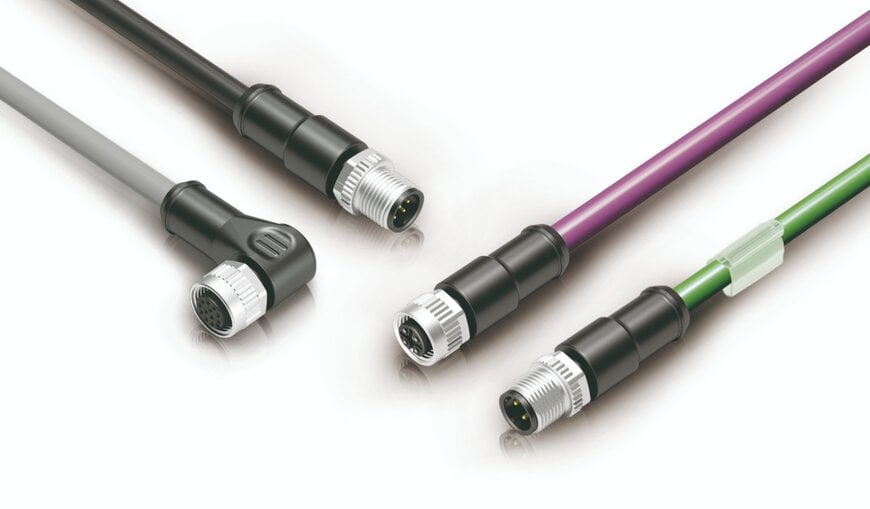
Reliable signal, data, and power transmission in automation systems depends not only on connector performance but also on installation quality. In this context, binder has introduced an updated coupling ring design for moulded, shielded M12 connectors, combining knurled surfaces with a hexagonal geometry.
From manual tightening to controlled torque application
M12 connectors are widely used across automation technology, including sensors, actuators, and machine building systems, where consistent electrical and mechanical connections are required. Traditional coupling ring designs rely primarily on manual tightening, which can lead to variability in applied torque.
The revised geometry introduces a hexagonal feature that enables the use of standard tools such as torque wrenches. This allows installers to apply defined torque values during assembly, improving repeatability and reducing the risk of under- or over-tightening. In applications where vibration resistance and long-term stability are critical, controlled torque contributes directly to connection integrity.
Aligning connector design with standardized assembly processes
Industrial environments increasingly require traceable and standardized assembly procedures, particularly in sectors adopting digital supply chain practices. The addition of a hexagonal interface allows the connectors to meet common specifications for torque-controlled installation, supporting process documentation and quality assurance.
This update also aligns shielded M12 connectors with existing unshielded variants that already use a similar knurled and hexagonal combination. The result is a more uniform design approach across connector types, simplifying selection, installation, and maintenance for engineering and operations teams.
Balancing manual handling with tool-based precision
The combined knurled and hexagonal structure supports both manual pre-assembly and final tightening using tools. Knurling enables quick hand installation in early stages, while the hexagonal form allows precise torque application during final assembly.
This dual approach provides flexibility in field conditions, where installation workflows may vary depending on accessibility, environmental constraints, or project requirements. It also reduces dependency on purely manual methods, which can introduce inconsistencies across installations.
Application relevance in mechanically demanding environments
The updated connector design is intended for use in automation systems, mechanical engineering, and plant construction, where connectors are often exposed to mechanical stress, vibration, and environmental variation. In such conditions, maintaining consistent mechanical fastening is essential for both electrical reliability and system uptime.
By enabling torque-controlled assembly, the revised coupling ring design adds a measurable layer of process control to connector installation, supporting long-term operational stability in demanding industrial environments.
Moving toward consistent connector architectures
The standardization of coupling ring geometry across product variants reflects a broader effort to simplify connector portfolios while meeting evolving industrial requirements. A consistent mechanical interface reduces training complexity, minimizes installation errors, and supports scalable deployment across different systems and applications.
Edited by Aishwarya Mambet, Induportals Editor, with AI assistance.
www.binder-connector.com
