
www.industryemea.com
20
'26
Written on Modified on
Hexagon Unveils Advanced NCSIMUL Release Featuring Selective G-Code Simulation
The updated software introduces patent-pending GPU-accelerated Rest Stock Previews to help manufacturers navigate complex NC programs faster and dramatically reduce simulation time without risking accuracy.
hexagon.com
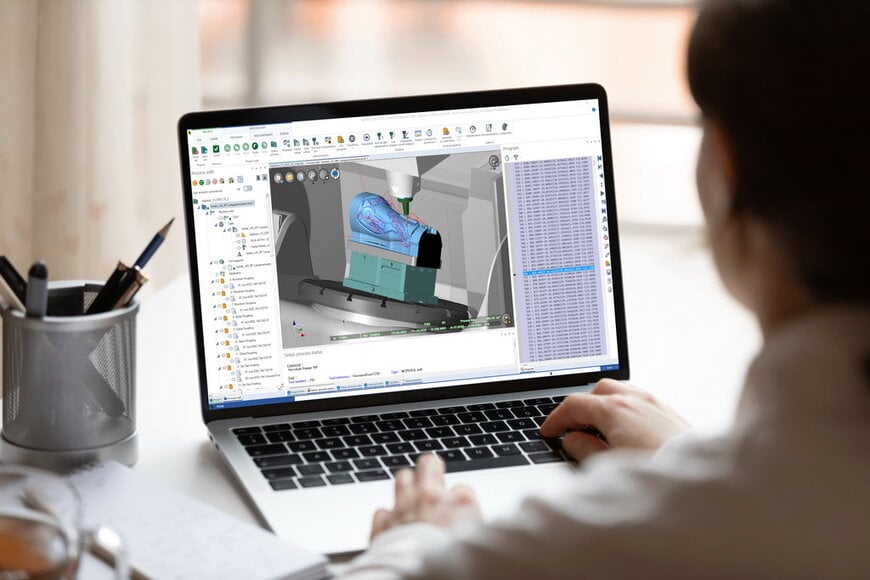
Hexagon’s Production Software Division has introduced a selective simulation capability within its NCSIMUL software platforms to optimize G-code verification and CNC machine tool simulation. This technical approach integrates toolpath optimization and collision detection within a unified digital twin environment to serve high-value machining sectors, including aerospace mold making and heavy industrial equipment manufacturing.
Graphics Processing Unit Acceleration in G-Code Decoding
High-value manufacturing workflows often require multi-axis CNC programs with extensive cycle times, where traditional sequential simulation introduces processing bottlenecks. The integrated software utilizes a patent-pending capability that applies graphics processing unit (GPU) acceleration to generate intermediate rest stock previews during the initial numerical control (NC) decoding phase.
By calculating the material removal state at discrete stages rather than computing the entire machining sequence linearly, the system produces multi-axis geometry models before executing full cycle rendering. In a technical field validation involving a 47-hour machine cycle for an athletic footwear mold, the GPU-accelerated decoding reduced the time required to visualize specific mid-program operations from 48 minutes of sequential simulation down to less than two minutes.
Dual-Phase Verification and Toolpath Inspection Workflows
The software architecture splits the verification workflow into an early-stage geometric evaluation phase and a final safety verification phase. Programmers utilize the intermediate rest stock previews to locate visual defects, tool deflection evidence, or incorrect machining allowances prior to executing full-scale kinematics testing.
[NC Code Input]
│
├──► [GPU-Accelerated Decoding] ──► [Rest Stock Previews (<2 Min)] ──► Early Stage Inspection
│
└──► [Full Kinematic Engine] ──────► [Complete Collision Detection] ─► Final Machine Sign-Off
While the rapid preview functionality identifies macro-programming errors early in the iteration cycle, full NC code simulation remains mandatory for operational sign-off. The primary simulation engine conducts exhaustive collision detection between the machine components, workholding fixtures, cutting tools, and the evolving stock model to ensure deterministic machining safety before program transfer to the physical workshop floor.
Additional Context: Technical Specifications and Competitive Benchmarking
Within the computer-aided manufacturing (CAM) verification market, standard systems process G-code sequentially, meaning the time required to inspect an operation near the end of a program is directly proportional to the total length of the toolpath. Competitors like CGTech VERICUT address this through fast-forward algorithms or cutting-history saving mechanisms, which remain bound to central processing unit (CPU) instruction speeds and sequential step skipping.
The application of dedicated GPU acceleration specifically to compute intermediate rest stock models during the decoding phase represents an architecture shift that decouples inspection positioning from total program length. While traditional sequential simulation and standard competitive software require linear processing or step-dependent checkpoint saving—resulting in a 48-minute wait time for a 47-hour cycle mold application—the hybrid GPU-accelerated engine compresses this state generation down to under two minutes. Crucially, this non-linear accessibility to intermediate models is achieved without sacrificing safety, as the system still maintains full kinematic machine tool component verification and exhaustive collision detection identical to traditional high-fidelity simulation engines.
Edited by Evgeny Churilov, Induportals Media - Adapted by AI.
www.hexagon.com
