
www.industryemea.com
21
'26
Written on Modified on
Enterprise NVMe Storage for Continuous Availability
Synology introduces an active-active enterprise storage platform for mission-critical SAN and NAS workloads requiring high availability and data resilience.
www.synology.com
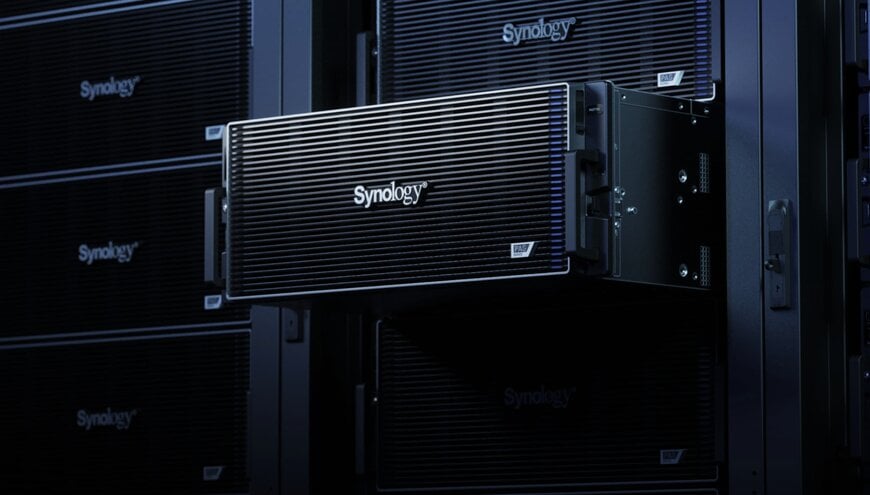
As enterprise applications generate higher transaction volumes and lower latency requirements, infrastructure teams are increasingly evaluating all-NVMe primary storage platforms that can maintain service continuity during hardware or software failures. Synology’s latest enterprise storage system targets these requirements through active-active controller architecture, integrated data protection, and high-density flash storage for data center environments.
Active-Active Storage Architecture for Mission-Critical Workloads
The system is designed for organizations where downtime directly affects operations, including virtualization environments, transactional databases, enterprise file services, analytics infrastructure, and production applications.
Its architecture uses dual active-active controllers rather than active-passive failover, allowing both controllers to process workloads concurrently while maintaining redundancy. Synology states that resilience mechanisms include triple-parity RAID (RAID-TP), synchronized memory write protection using a non-transparent bridge (NTB), IP failover, and protocol-level failover. This layered redundancy model is intended to reduce single points of failure across compute, network, and storage layers.
The platform runs on DSM Enterprise, which supports non-disruptive software, firmware, and application updates through a Continuous Availability Manager, reducing maintenance-related service interruptions.
NVMe Performance and Storage Efficiency
The system uses an all-NVMe architecture for enterprise primary storage, reflecting the growing shift away from hybrid storage designs for latency-sensitive workloads. Synology reports support for up to 2 million IOPS and 30 GB/s sequential throughput in internal testing, with connectivity options including 100GbE networking and NVMe-oF support.
Integrated storage efficiency features include inline and post-process deduplication, with Synology citing a potential 5:1 data reduction ratio using its Btrfs-based storage architecture. Under that ratio, the vendor estimates effective usable capacity of approximately 8.25 PB, although actual reduction depends on workload characteristics such as data type, duplication patterns, and compression suitability.
Upcoming automated storage tiering functionality is intended to move cold data to lower-cost storage tiers based on configurable policies, preserving high-performance NVMe resources for active applications.
Integrated Data Protection and Security Controls
The platform includes built-in enterprise data protection mechanisms including Self-Encrypting Drives (SEDs), full-volume encryption, Write Once Read Many (WORM) data retention, immutable snapshots, snapshot replication, and backup integration.
Out-of-band management is supported through a dedicated 1GbE management interface per controller, enabling remote administration independent of primary production traffic. This architecture supports operational isolation during maintenance or fault remediation.
These capabilities are relevant for sectors including financial services, healthcare, manufacturing, media production, and enterprise IT environments where data integrity, compliance retention, and rapid recovery are operational requirements.
Additional Context
This section details technical specifications and competitive benchmarking not included in the original news release.
The enterprise all-flash storage segment includes comparable platforms such as Dell PowerStore and Pure Storage FlashArray, which compete on metrics including controller redundancy, protocol support, scalability, latency, and data reduction efficiency.
Synology’s platform supports up to 48 NVMe SSDs in a 4U chassis, scaling to 216 drives with expansion, with maximum raw capacity reaching approximately 1.65 PB. Dell PowerStore similarly offers end-to-end NVMe support, unified block and file workloads, 100GbE connectivity, and a 5:1 data reduction guarantee in selected configurations.
A technical differentiator for Synology is its active-active architecture combined with integrated immutability and non-disruptive maintenance within a unified software stack. Competitive evaluation in this category typically depends on sustained performance under mixed workloads, failover recovery behavior, protocol flexibility, and ecosystem integration with virtualization and backup infrastructure.
Edited by Aishwarya Mambet, Induportals Editor, with AI assistance.
www.synology.com
