
www.industryemea.com
10
'26
Written on Modified on
Industrial power conversion architectures expand grid flexibility across varied load echelons
TDK-Lambda extends the D1SE single-phase power distribution line to integrate new step-down potential thresholds.
www.tdk.com
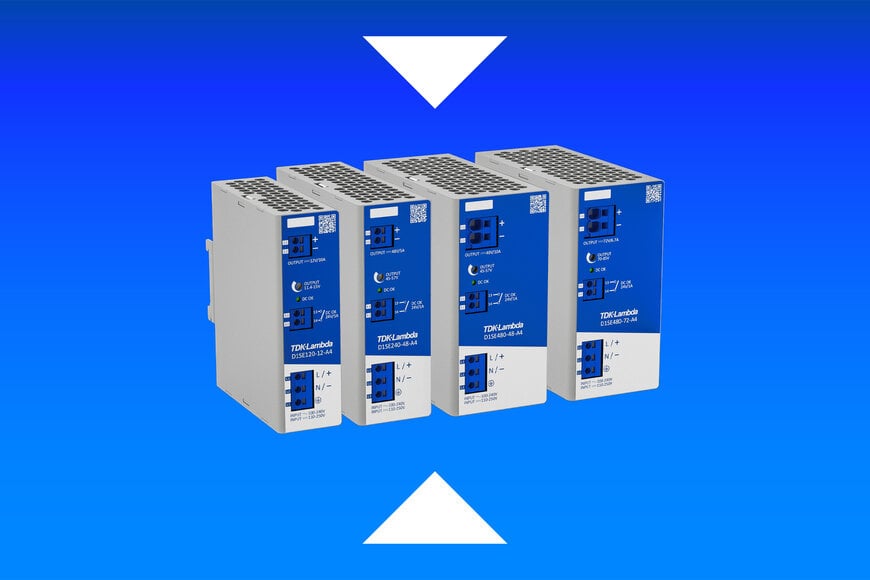
TDK has expanded the operational scope of its D1SE DIN-rail mount power supplies by adding twelve, forty-eight, and seventy-two volt output variants to the existing component portfolio. This hardware deployment introduces dedicated voltage conversion nodes engineered to sustain complex automation networks, industrial telemetry links, and multi-axis kinetic systems from a unified single-phase power architecture.
Input/Output isolation and compliance frameworks
The updated component family is constructed to deliver robust galvanic isolation and strict electromagnetic compliance within dense electrical equipment enclosures. The structural layout achieves an input-to-output isolation rating of 5000 Vdc, an input-to-ground barrier of 3100 Vdc, and an output-to-ground threshold of 750 Vdc. To ensure stable grid integration, the hardware limits harmonic current distortion in accordance with EN 61000-3-2 Class A criteria, while maintaining an asymmetrical surge voltage rating of 4 k Vac under IEC 61000-4-5 guidelines.
Furthermore, the electrical assemblies suppress electromagnetic interference, meeting the stringent EN 55011-B and CISPR11-B radiated and conducted emission boundaries with large operating margins. Safety and structural architecture verifications conform to universal hardware benchmarks, including IEC, EN, UL, and CSA 61010-1 and 61010-2-201, as well as the 62368-1 third edition standard.
Thermal efficiency and boost power tolerances
The internal power conversion topologies achieve a thermal conversion efficiency of up to 96 percent, which minimizes localized heat dissipation within unventilated control cabinets. By lowering internal power losses, the units limit the thermal degradation of heat-sensitive components, such as internal electrolytic capacitors, ensuring predictable field service lifetimes. The convection-cooled chassis operates across an ambient temperature range of -25 to +70 °C, applying a linear output derating configuration when operating above 55 °C.
To accommodate high-inrush start-up currents from inductive or capacitive downstream loads, the power supplies feature transient boost power capabilities of up to 150 percent. Specifically, the forty-eight volt, 480 W variant tolerates peak transient draws of 600 W for up to 200 seconds, enabling the network to absorb sudden load changes without triggering overcurrent protection shutdowns.
Automated wiring interfaces and telemetry integration
Physical installation times are minimized through the integration of tool-free, push-in wire terminations on the front-facing terminal blocks. These high-vibration resistant terminals facilitate rapid manual wiring and support automated robotic insertion during high-volume wiring harness manufacturing. The physical dimensions feature space-saving case widths of 38 mm for 120 W models, 44 mm for 240 W models, and 60 mm for 480 W models, maximizing component density along the horizontal mounting rail.
Engineers can specify an optional protective board coating, designated as the A5 variant, which includes an integrated closed-contact relay to provide discrete DC OK status signals. This hardware configuration permits terminal devices to operate from nominal AC grid inputs between 85 and 264 Vac, or common DC bus voltages ranging from 93 to 300 Vdc, allowing flexible integration alongside centralized batteries or backup distribution buses.
Additional Context: This section details technical specifications and competitive benchmarking not included in the original product announcement
Within the competitive landscape of essential industrial DIN-rail power supplies, the expanded series faces direct competition from alternative universal lines, such as the newly introduced RECOM RACPRO1-S series or the established Siemens Sitop Lite family. Objective benchmarking shows that the TDK-Lambda series maintains an advantage in extended peak loading, with its 480 W model sustaining a 600 W boost for up to 200 seconds, whereas traditional commercial alternatives often restrict 120 percent or 150 percent overloads to transient windows between 5 and 10 seconds.
Additionally, the 5000 Vdc input-to-output insulation rating surpasses the standard 3000 Vac or 4200 Vdc thresholds frequently observed in standard entry-level industrial power blocks. However, competitor units like the RACPRO1-S line achieve narrower physical footprints in specific mid-tier power classes, maintaining a width of 39 mm for a 240 W output compared to the 44 mm casing of the D1SE series. This difference represents a trade-off between absolute spatial reduction on the mounting rail and extended thermal durability.
Edited by Sucithra Mani, Induportals editor – adapted by AI.
www.tdk.com
