
www.industryemea.com
12
'26
Written on Modified on
Fast, Reliable Detection of Trace Gases by Resonant Photoacoustics
A team at the Fraunhofer Institute for Physical Measurement Techniques IPM has now succeeded in implementing highly sensitive gas sensor technology in a robust and compact format—at a fraction of the previous cost.
www.fraunhofer.de
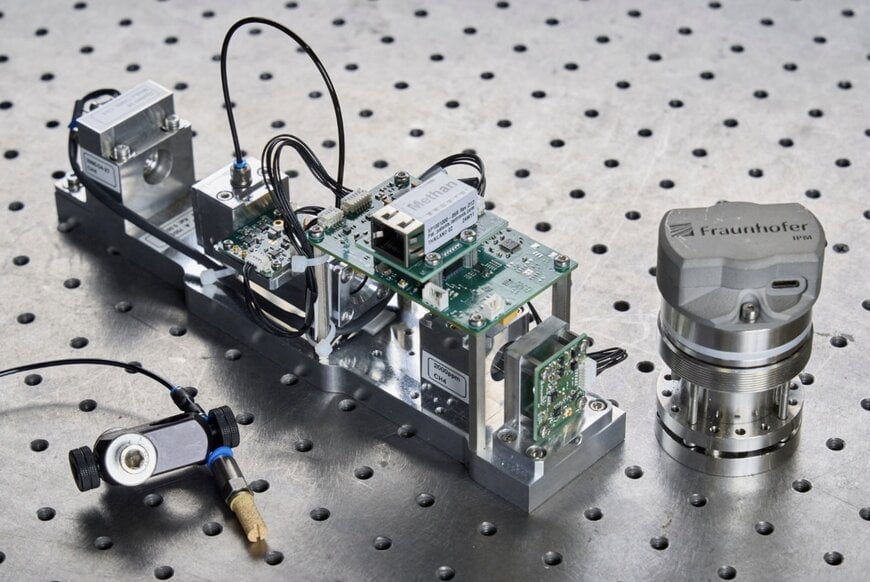
The innovative sensor principle continuously determines its own resonant frequency and automatically adjusts the optical excitation accordingly. © Fraunhofer / Piotr Banczerowski
The Fraunhofer Institute for Physical Measurement Techniques IPM has developed a highly sensitive gas sensor technology that packages precise trace gas measurement capabilities into a robust, compact hardware format. By adapting a resonant photoacoustic measurement method for industrial environments, the development team has lowered operational hardware costs to a fraction of conventional devices. This achievement has earned the researchers the Joseph von Fraunhofer Prize for 2026.
Resonance Stabilization and Sensor Wall Utilization
The underlying mechanism relies on the photoacoustic effect, where gases exposed to light absorb energy, heat up, and expand. Pulsing the light source generates periodic pressure fluctuations that translate into sound waves, the unique frequencies of which can be mapped directly to individual molecular gas species. This photoacoustic effect provides a measurement methodology that remains precise even when tracking low trace gas concentrations.
Despite its native sensitivity, the process was previously constrained to a market niche because it relies on a physical resonator cavity for acoustic signal amplification. These resonators are sensitive to minor environmental variations in air pressure, temperature, or external mechanical stress, requiring the system to hit the correct resonant frequency to preserve measurement fidelity.
The research team—led by Christian Weber, Katrin Schmitt, and Johannes Herbst—resolved this constraint by engineering a sensor principle that integrates a small secondary light-emitting diode (LED) to continuously determine the internal cavity's own resonant frequency and automatically adjust the optical excitation source. The system takes advantage of a known physical property where the internal sensor wall absorbs radiation and generates a strong baseline photoacoustic signal.
The platform uses this sensor wall in combination with the secondary light source to rapidly map the live resonant frequency. This real-time correction allows the resonant amplification to remain stable under fluctuating ambient conditions. Concurrently, the reduced hardware dependencies minimize production requirements, enabling sensor prices approximately one-tenth of those for conventional devices.
Network Inspection and Infrastructure Monitoring
The initial commercial implementation of the platform has been executed by Schütz Messtechnik for the automated inspection of natural gas distribution networks. The system isolates minute fractions of methane gas in ambient air to identify infrastructure leaks at an early stage.
Johannes Herbst, project manager in the Spectroscopy and Process Analytics group at Fraunhofer IPM, noted that the inspection process achieves high speeds and precision by reducing the measurement chamber volume down to roughly four milliliters, a significant reduction from the four liters required by conventional hardware. This structural downscaling lowers the physical weight of the assembly, enhancing portability and field versatility.
Beyond pipeline inspection, the sensor platform is deployed within gas-insulated high-voltage electrical systems. In this application, the compact sensor size permits continuous, integrated monitoring of the insulation gas quality inside active electrical enclosures to enhance operational grid safety.
Interdisciplinary Development and Technology Transfer
The rapid time-to-market of the platform was driven by a collaborative engineering effort within Fraunhofer IPM. Christian Weber, who received the 2025 Hugo Geiger Prize for his doctoral thesis on photoacoustics, coordinated the core integrated sensor workflows alongside Katrin Schmitt, Head of the Thermal Measurement Techniques and Systems group, and Johannes Herbst, who managed the laser spectroscopy technology transfer.
The award-winning platform serves as a benchmark for translating applied physics into commercial field instruments. The methane detection systems establish the baseline for future iterations of resonant photoacoustic hardware, with anticipated applications spanning industrial process monitoring and automated environmental emissions tracking along high-traffic roadways.
Additional Context
This section details technical specifications not included in the original news release.
Resonant photoacoustic spectroscopy (PAS) sensors rely on the interaction between molecular absorption lines and acoustic wave physics. When a target gas molecule absorbs a photon from a modulated light source, it undergoes a transition to an excited vibrational-rotational energy state. This energy is subsequently released through non-radiative relaxation, where intermolecular collisions convert the internal molecular excitation into kinetic energy. This localized heating generates a periodic pressure wave within an acoustic resonator cavity.
To maximize the signal-to-noise ratio, the light source modulation frequency must match one of the acoustic eigenmodes of the resonator, which is typically a cylindrical or H-shaped longitudinal cavity. The quality factor of the cavity determines the total resonant amplification, often scaling the acoustic signal by a factor of 10 to 100. However, because the speed of sound fluctuates with temperature, the exact resonant frequency of a small 4 mL cavity shifts dynamically during field operations. If the optical modulation frequency deviates from the acoustic peak by even a fraction of a hertz, the signal amplitude drops sharply, inducing severe measurement drift.
By integrating a secondary tracking LED focused on the cavity boundaries, the system establishes a secondary dither or phase-locked loop (PLL) control circuit. This tracking mechanism monitors the phase shift between the optical modulation and the resulting microphone response—which passes exactly through zero at the center of the resonant peak. This real-time correction allows the system to maintain a stable, amplified acoustic signal without requiring thick thermal insulation or bulky temperature-controlled ovens. The acoustic waves are captured using low-cost Micro-Electro-Mechanical Systems (MEMS) condenser microphones or piezoelectric quartz tuning forks, providing parts-per-million (ppm) or parts-per-billion (ppb) gas selectivity within a compact, vibration-resistant solid-state enclosure.
Edited by Romila DSilva, Induportals Editor, with AI assistance.
The Fraunhofer Institute for Physical Measurement Techniques IPM has developed a highly sensitive gas sensor technology that packages precise trace gas measurement capabilities into a robust, compact hardware format. By adapting a resonant photoacoustic measurement method for industrial environments, the development team has lowered operational hardware costs to a fraction of conventional devices. This achievement has earned the researchers the Joseph von Fraunhofer Prize for 2026.
Resonance Stabilization and Sensor Wall Utilization
The underlying mechanism relies on the photoacoustic effect, where gases exposed to light absorb energy, heat up, and expand. Pulsing the light source generates periodic pressure fluctuations that translate into sound waves, the unique frequencies of which can be mapped directly to individual molecular gas species. This photoacoustic effect provides a measurement methodology that remains precise even when tracking low trace gas concentrations.
Despite its native sensitivity, the process was previously constrained to a market niche because it relies on a physical resonator cavity for acoustic signal amplification. These resonators are sensitive to minor environmental variations in air pressure, temperature, or external mechanical stress, requiring the system to hit the correct resonant frequency to preserve measurement fidelity.
The research team—led by Christian Weber, Katrin Schmitt, and Johannes Herbst—resolved this constraint by engineering a sensor principle that integrates a small secondary light-emitting diode (LED) to continuously determine the internal cavity's own resonant frequency and automatically adjust the optical excitation source. The system takes advantage of a known physical property where the internal sensor wall absorbs radiation and generates a strong baseline photoacoustic signal.
The platform uses this sensor wall in combination with the secondary light source to rapidly map the live resonant frequency. This real-time correction allows the resonant amplification to remain stable under fluctuating ambient conditions. Concurrently, the reduced hardware dependencies minimize production requirements, enabling sensor prices approximately one-tenth of those for conventional devices.
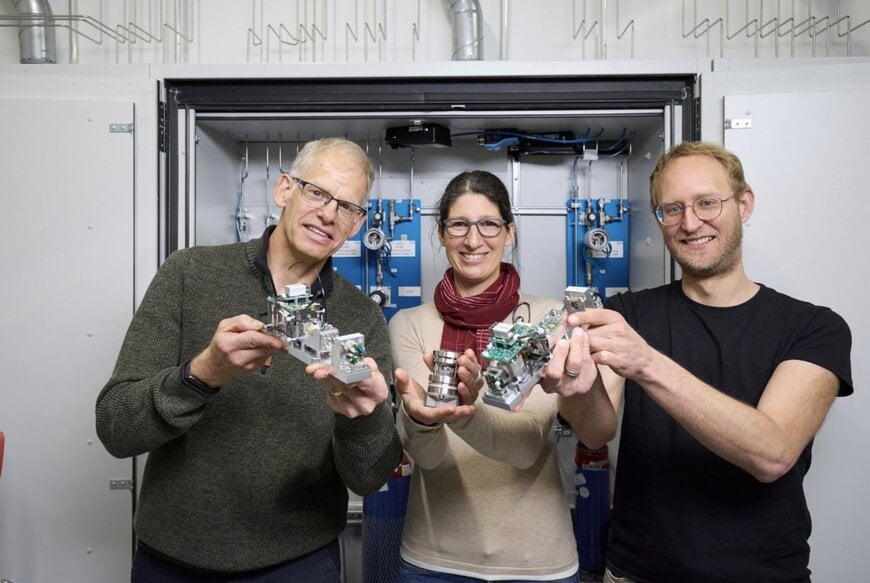
By further developing the measurement method to be suitable for industrial use, Johannes Herbst, Katrin Schmitt and Christian Weber (from left) have succeeded in implementing highly sensitive gas sensor technology in a robust and compact format. © Fraunhofer / Piotr Banczerowski
The initial commercial implementation of the platform has been executed by Schütz Messtechnik for the automated inspection of natural gas distribution networks. The system isolates minute fractions of methane gas in ambient air to identify infrastructure leaks at an early stage.
Johannes Herbst, project manager in the Spectroscopy and Process Analytics group at Fraunhofer IPM, noted that the inspection process achieves high speeds and precision by reducing the measurement chamber volume down to roughly four milliliters, a significant reduction from the four liters required by conventional hardware. This structural downscaling lowers the physical weight of the assembly, enhancing portability and field versatility.
Beyond pipeline inspection, the sensor platform is deployed within gas-insulated high-voltage electrical systems. In this application, the compact sensor size permits continuous, integrated monitoring of the insulation gas quality inside active electrical enclosures to enhance operational grid safety.
Interdisciplinary Development and Technology Transfer
The rapid time-to-market of the platform was driven by a collaborative engineering effort within Fraunhofer IPM. Christian Weber, who received the 2025 Hugo Geiger Prize for his doctoral thesis on photoacoustics, coordinated the core integrated sensor workflows alongside Katrin Schmitt, Head of the Thermal Measurement Techniques and Systems group, and Johannes Herbst, who managed the laser spectroscopy technology transfer.
The award-winning platform serves as a benchmark for translating applied physics into commercial field instruments. The methane detection systems establish the baseline for future iterations of resonant photoacoustic hardware, with anticipated applications spanning industrial process monitoring and automated environmental emissions tracking along high-traffic roadways.
Additional Context
This section details technical specifications not included in the original news release.
Resonant photoacoustic spectroscopy (PAS) sensors rely on the interaction between molecular absorption lines and acoustic wave physics. When a target gas molecule absorbs a photon from a modulated light source, it undergoes a transition to an excited vibrational-rotational energy state. This energy is subsequently released through non-radiative relaxation, where intermolecular collisions convert the internal molecular excitation into kinetic energy. This localized heating generates a periodic pressure wave within an acoustic resonator cavity.
To maximize the signal-to-noise ratio, the light source modulation frequency must match one of the acoustic eigenmodes of the resonator, which is typically a cylindrical or H-shaped longitudinal cavity. The quality factor of the cavity determines the total resonant amplification, often scaling the acoustic signal by a factor of 10 to 100. However, because the speed of sound fluctuates with temperature, the exact resonant frequency of a small 4 mL cavity shifts dynamically during field operations. If the optical modulation frequency deviates from the acoustic peak by even a fraction of a hertz, the signal amplitude drops sharply, inducing severe measurement drift.
By integrating a secondary tracking LED focused on the cavity boundaries, the system establishes a secondary dither or phase-locked loop (PLL) control circuit. This tracking mechanism monitors the phase shift between the optical modulation and the resulting microphone response—which passes exactly through zero at the center of the resonant peak. This real-time correction allows the system to maintain a stable, amplified acoustic signal without requiring thick thermal insulation or bulky temperature-controlled ovens. The acoustic waves are captured using low-cost Micro-Electro-Mechanical Systems (MEMS) condenser microphones or piezoelectric quartz tuning forks, providing parts-per-million (ppm) or parts-per-billion (ppb) gas selectivity within a compact, vibration-resistant solid-state enclosure.
Edited by Romila DSilva, Induportals Editor, with AI assistance.
www.fraunhofer.de
