
www.industryemea.com
15
'26
Written on Modified on
Atlas Copco Launches ZS 4 (VSD) Oil-Free Screw Blower Series
Atlas Copco introduces the energy-efficient ZS 4 (VSD) low-pressure blower range featuring an IE4/IE5 motor platform and a smart pressure split design.
www.atlascopco.com
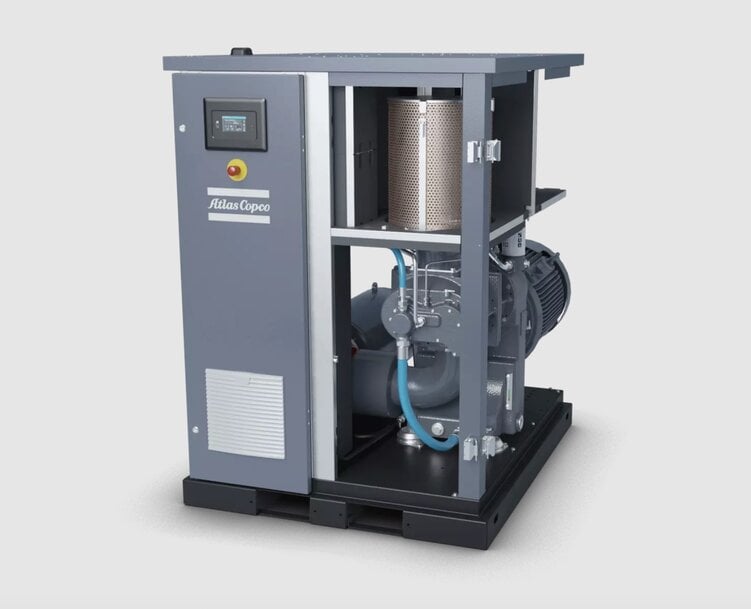
Atlas Copco has launched the ZS 4 (VSD) series of oil-free screw blowers, marking a development in its low-pressure blower portfolio. Integrating advancements from variable speed drive (VSD+) technology into the established ZS platform, the equipment delivers optimized pressure performance, lower specific energy requirements, and reduced noise levels for industrial environments.
Operational Efficiency and Mechanical Profiles
The blower is designed specifically for process environments such as municipal or industrial wastewater treatment, pneumatic conveying lines, and general manufacturing applications. The product range covers an operational power spectrum spanning from 37 kW to 90 kW.
The primary technical configuration utilizes an internal high-efficiency IE4 or IE5 motor platform. When combined with a smart pressure split design, the system matches output parameters to specific system configurations, minimizing total energy consumption while sustaining stable volumetric airflow rates.
Operating data demonstrates that the screw blower architecture achieves up to 35% greater energy efficiency compared to traditional lobe blowers. Furthermore, the updated configuration yields a 3% improvement in the blower's specific energy requirement (SER), lowering overall operating expenses and the total cost of ownership.
Performance Layout and Application Categories
The ZS 4 (VSD) series is built to maximize reliability and process cleanliness through a series of dedicated hardware features:
- Aeration Configuration: Equipped with a dedicated low-pressure screw element rated for operations below 800 mbar, making it suitable for wastewater treatment aeration basins.
- Conveying Configuration: Outfitted with an advanced high-pressure screw element optimized for material displacement in pneumatic conveying systems and adjacent high-resistance industrial networks.
- Acoustic Management: Incorporates internal structural damping and refined acoustic enclosures, lowering overall machine noise levels down to 75 dB(A) to improve the local working environment.
- Process Cleanliness: Certified under Class 0 environmental guidelines, ensuring completely oil-free air compression to prevent downstream medium contamination.
The mechanical drivetrain utilizes a precise screw design that reduces internal mechanical stress and friction points, extending the system service life. The screw elements are backed by a warranty up to 5 years or 60,000 operational hours.
Installation and Asset Management
The blower features a plug-and-play mechanical layout that minimizes field installation times and associated plant downtime during asset replacement. The physical enclosure is built with a compact footprint, allowing space-saving side-by-side positioning inside utility rooms. Internal components are structured to grant direct maintenance access to critical service points.
This technological configuration is aligned with modern utility investment requirements, such as the UK water sector's AMP8 asset management period, where long-term energy optimization, whole-life expenditure reductions, and reliable long-term operations serve as core compliance goals for wastewater plant operators.
Additional Context
This section details technical specifications not included in the original news release.
Industrial low-pressure blowers generally operate on two primary thermodynamic principles to compress air: positive displacement (isochoric compression) or internal compression (isentropic compression). Traditional lobe blowers utilize twin symmetrical rotors that trap a fixed volume of air from the inlet and transport it around the casing to the outlet without changing the internal volume of the pocket. Compression occurs only when the trapped pocket opens to the discharge piping, forcing the pressurized downstream air to backflow into the casing. This constant shock loading creates high aerodynamic pulsing, leading to major thermal generation, high pressure ripples, and severe kinetic energy losses.
Screw blowers alter this compression dynamic by introducing interlocking helical male and female rotors. As the rotors mesh, the volumetric space between the lobes decreases continuously along the axial length of the screw from the intake port toward the discharge valve. This internal compression mechanism requires significantly less input shaft torque to reach identical discharge pressures, achieving a much higher adiabatic efficiency.
Class 0 certification in accordance with standard ISO 8573-1 guarantees that no lubricant enters the compression chamber, completely eliminating the risk of introducing aerosolized hydrocarbons or vaporized compressor oils into sensitive biological wastewater processes or dry pneumatic conveying lines.
IE4 (Super Premium Efficiency) and IE5 (Ultra Premium Efficiency) motor designations conform strictly to international standard IEC 60034-30-1, tracking absolute electrical-to-mechanical power conversion efficiency under variable loads. To meet these rigorous performance thresholds, modern blower motors often replace standard squirrel-cage induction rotors with synchronous reluctance (SynRM) or permanent magnet synchronous motor (PMSM) designs. These technologies eliminate rotor current losses and subsequent heat build-up, allowing variable speed drives (VFDs) to maintain a highly stable specific energy requirement (SER)—defined as the total electrical energy consumed per unit volume of delivered air—across the blower's entire operational turndown spectrum.
Edited by Romila DSilva, Induportals Editor, with AI assistance.
Installation and Asset Management
The blower features a plug-and-play mechanical layout that minimizes field installation times and associated plant downtime during asset replacement. The physical enclosure is built with a compact footprint, allowing space-saving side-by-side positioning inside utility rooms. Internal components are structured to grant direct maintenance access to critical service points.
This technological configuration is aligned with modern utility investment requirements, such as the UK water sector's AMP8 asset management period, where long-term energy optimization, whole-life expenditure reductions, and reliable long-term operations serve as core compliance goals for wastewater plant operators.
Additional Context
This section details technical specifications not included in the original news release.
Industrial low-pressure blowers generally operate on two primary thermodynamic principles to compress air: positive displacement (isochoric compression) or internal compression (isentropic compression). Traditional lobe blowers utilize twin symmetrical rotors that trap a fixed volume of air from the inlet and transport it around the casing to the outlet without changing the internal volume of the pocket. Compression occurs only when the trapped pocket opens to the discharge piping, forcing the pressurized downstream air to backflow into the casing. This constant shock loading creates high aerodynamic pulsing, leading to major thermal generation, high pressure ripples, and severe kinetic energy losses.
Screw blowers alter this compression dynamic by introducing interlocking helical male and female rotors. As the rotors mesh, the volumetric space between the lobes decreases continuously along the axial length of the screw from the intake port toward the discharge valve. This internal compression mechanism requires significantly less input shaft torque to reach identical discharge pressures, achieving a much higher adiabatic efficiency.
Class 0 certification in accordance with standard ISO 8573-1 guarantees that no lubricant enters the compression chamber, completely eliminating the risk of introducing aerosolized hydrocarbons or vaporized compressor oils into sensitive biological wastewater processes or dry pneumatic conveying lines.
IE4 (Super Premium Efficiency) and IE5 (Ultra Premium Efficiency) motor designations conform strictly to international standard IEC 60034-30-1, tracking absolute electrical-to-mechanical power conversion efficiency under variable loads. To meet these rigorous performance thresholds, modern blower motors often replace standard squirrel-cage induction rotors with synchronous reluctance (SynRM) or permanent magnet synchronous motor (PMSM) designs. These technologies eliminate rotor current losses and subsequent heat build-up, allowing variable speed drives (VFDs) to maintain a highly stable specific energy requirement (SER)—defined as the total electrical energy consumed per unit volume of delivered air—across the blower's entire operational turndown spectrum.
Edited by Romila DSilva, Induportals Editor, with AI assistance.
