
www.industryemea.com
26
'26
Written on Modified on
Single-Chip Ultra-Wideband Transceivers for Secure Positioning and Sensing
Infineon introduces the AIROC UWB TSL100 chip family for secure automotive and industrial access applications.
www.infineon.com
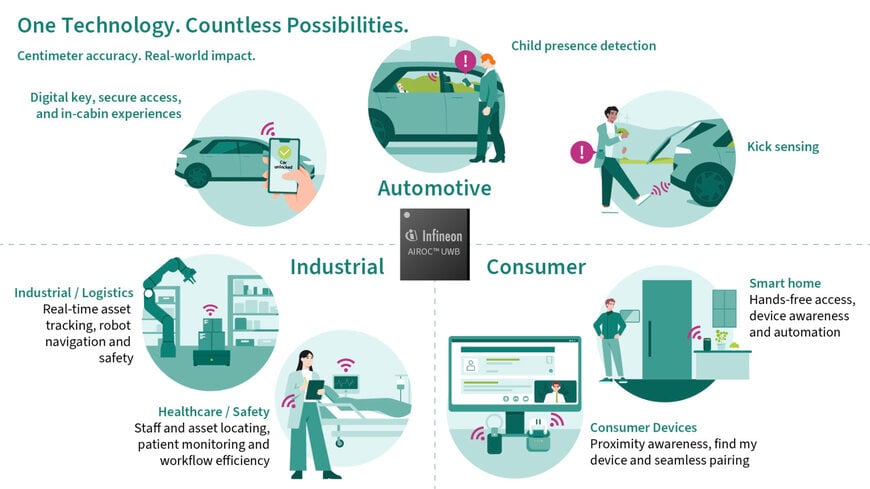
AIROC™ UWB TSL100 is Infineon’s first-generation ultra-wideband product family for precise positioning and smart presence detection.
Infineon Technologies has introduced the AIROC UWB TSL100, a first-generation ultra-wideband (UWB) semiconductor family that integrates precise spatial positioning and smart presence detection onto a single chip. Designed for automotive, consumer, and industrial ecosystems, the System-on-Chip (SoC) provides a scalable hardware platform compliant with FiRa, Car Connectivity Consortium (CCC), and Aliro standards, eliminating the need for independent RF sensing subsystems in connected environments.
Cryptographic Security and RF Performance
The TSL100 architecture is engineered to mitigate severe multipath interference and non-line-of-sight (NLOS) conditions, such as key fobs located in a user's back pocket. The physical layer (PHY) incorporates 48-bit security protocols to prevent man-in-the-middle relay attacks. The highly sensitive RF receiver can accurately isolate and verify direct signal paths that are up to 100,000 times weaker than surrounding reflected signals. Furthermore, the chip features proprietary AIROC intent-detection technology to create configurable spatial boundaries, ensuring that smart locks and secure access points trigger reliably based on highly specific inside/outside spatial parameters.
Hardware Variants and Power Efficiency
The product family is divided into two specific hardware variants: the AEC-Q100 qualified TSL111A for automotive OEMs targeting digital keys, kick sensors, and NCAP-compliant in-cabin presence detection; and the TSL111C for industrial asset tracking, smart access, and indoor navigation. Both variants prioritize extreme energy efficiency for battery-powered edge devices. The low-power RF design extends the operational lifespan of standard coin-cell batteries beyond two years during continuous CCC ranging operations. This efficiency is augmented by a dedicated sleep mode that reduces ambient current consumption by more than 50 percent compared to legacy transceiver solutions.
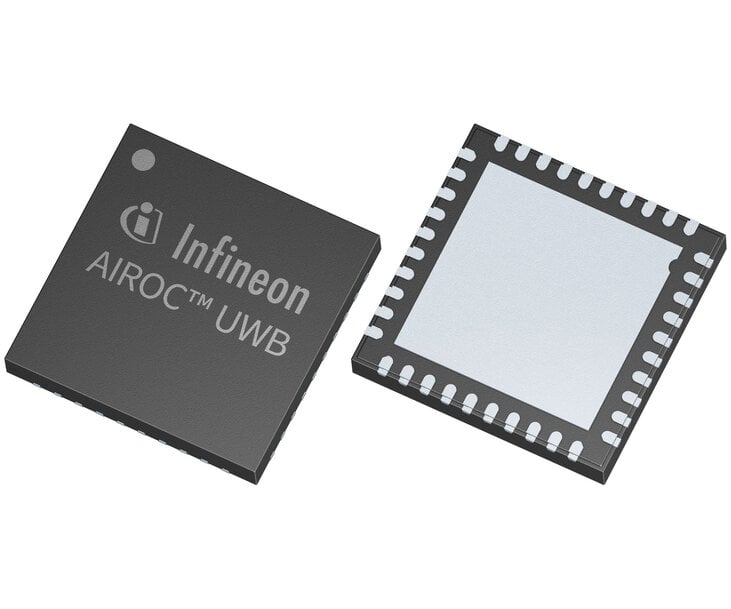
AIROC™ UWB TSL100 is Infineon’s first-generation ultra-wideband product family for precise positioning and smart presence detection.
Additional Context: This section details technical specifications not included in the original announcement
In wireless telecommunications, Ultra-Wideband (UWB) differs fundamentally from narrowband protocols like Bluetooth Low Energy (BLE) or Wi-Fi. Instead of continuously modulating a carrier wave, UWB transmits data via extremely short, nanosecond-duration RF pulses across a very wide frequency spectrum (typically exceeding 500 MHz of bandwidth). This impulse radio technique allows UWB receivers to calculate distance using Time-of-Flight (ToF) metrics with centimeter-level precision. In environments with heavy multipath interference—where signal pulses reflect off metal surfaces and arrive at the receiver at slightly different times—the ultra-short duration of UWB pulses allows the PHY layer to easily distinguish the true, direct-path "first pulse" from subsequent delayed echoes. To thwart relay attacks (where unauthorized interceptors amplify a signal to unlock a vehicle or door), modern UWB standards utilize Scrambled Timestamp Sequences (STS). This cryptographic layer ensures the time-of-flight pulses are completely randomized and cannot be predicted, spoofed, or artificially delayed by malicious hardware.
Edited by Lekshman Ramdas, Induportals editor – adapted by AI.
www.infineon.com
Infineon Technologies has introduced the AIROC UWB TSL100, a first-generation ultra-wideband (UWB) semiconductor family that integrates precise spatial positioning and smart presence detection onto a single chip. Designed for automotive, consumer, and industrial ecosystems, the System-on-Chip (SoC) provides a scalable hardware platform compliant with FiRa, Car Connectivity Consortium (CCC), and Aliro standards, eliminating the need for independent RF sensing subsystems in connected environments.
Cryptographic Security and RF Performance
The TSL100 architecture is engineered to mitigate severe multipath interference and non-line-of-sight (NLOS) conditions, such as key fobs located in a user's back pocket. The physical layer (PHY) incorporates 48-bit security protocols to prevent man-in-the-middle relay attacks. The highly sensitive RF receiver can accurately isolate and verify direct signal paths that are up to 100,000 times weaker than surrounding reflected signals. Furthermore, the chip features proprietary AIROC intent-detection technology to create configurable spatial boundaries, ensuring that smart locks and secure access points trigger reliably based on highly specific inside/outside spatial parameters.
Hardware Variants and Power Efficiency
The product family is divided into two specific hardware variants: the AEC-Q100 qualified TSL111A for automotive OEMs targeting digital keys, kick sensors, and NCAP-compliant in-cabin presence detection; and the TSL111C for industrial asset tracking, smart access, and indoor navigation. Both variants prioritize extreme energy efficiency for battery-powered edge devices. The low-power RF design extends the operational lifespan of standard coin-cell batteries beyond two years during continuous CCC ranging operations. This efficiency is augmented by a dedicated sleep mode that reduces ambient current consumption by more than 50 percent compared to legacy transceiver solutions.
AIROC™ UWB TSL100 is Infineon’s first-generation ultra-wideband product family for precise positioning and smart presence detection.
Additional Context: This section details technical specifications not included in the original announcement
In wireless telecommunications, Ultra-Wideband (UWB) differs fundamentally from narrowband protocols like Bluetooth Low Energy (BLE) or Wi-Fi. Instead of continuously modulating a carrier wave, UWB transmits data via extremely short, nanosecond-duration RF pulses across a very wide frequency spectrum (typically exceeding 500 MHz of bandwidth). This impulse radio technique allows UWB receivers to calculate distance using Time-of-Flight (ToF) metrics with centimeter-level precision. In environments with heavy multipath interference—where signal pulses reflect off metal surfaces and arrive at the receiver at slightly different times—the ultra-short duration of UWB pulses allows the PHY layer to easily distinguish the true, direct-path "first pulse" from subsequent delayed echoes. To thwart relay attacks (where unauthorized interceptors amplify a signal to unlock a vehicle or door), modern UWB standards utilize Scrambled Timestamp Sequences (STS). This cryptographic layer ensures the time-of-flight pulses are completely randomized and cannot be predicted, spoofed, or artificially delayed by malicious hardware.
Edited by Lekshman Ramdas, Induportals editor – adapted by AI.
www.infineon.com
