
www.industryemea.com
07
'26
Written on Modified on
KROHNE introduces AI‑enhanced pipeline monitoring
The system combines artificial intelligence with proven physical models, providing an effective way to manage the complex risks of modern pipelines.
uk.krohne.com
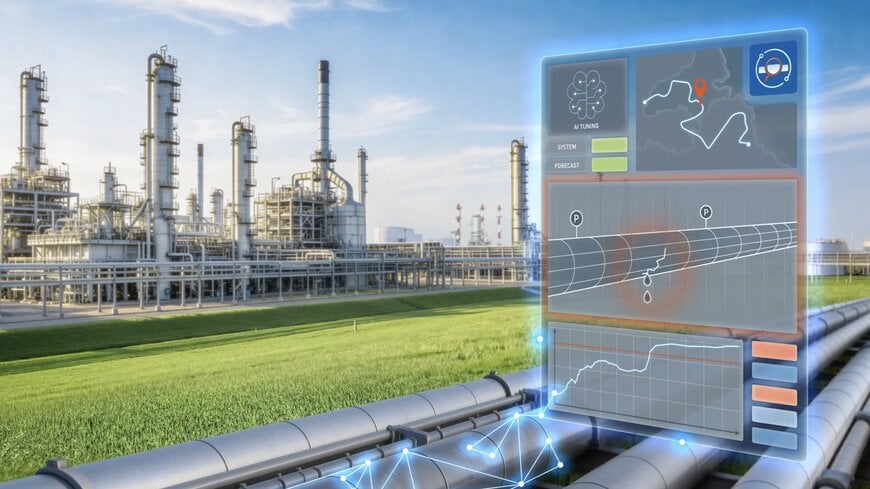
KROHNE has announced the commercial launch of PipePatrol NEO, a comprehensive software and instrumentation platform developed for internal leak detection, theft mitigation, and multi-parameter pipeline monitoring. The system applies artificial intelligence alongside deterministic physics-based algorithms to manage operational risks across complex midstream assets and industrial utility networks.
Integrated Neural Monitoring and Adaptive Models
At the core of the system is the Neural Engine Pipeline Monitoring (NEPM) subsystem, which serves as KROHNE's next-generation framework for continuous internal fluid tracking. NEPM marks an evolutionary shift from conventional Real-Time Transient Models (RTTM) and Extended RTTM (E-RTTM) platforms, which historically relied on rigid, non-adaptive mathematical models.
The system unifies a multi-method analytical loop by executing several diagnostics in parallel:
- Dynamic Digital Twins: A calibrated hydraulic model continuously runs a "virtual pipeline" simulation in parallel with active operations to establish baseline thermodynamic and fluid-mechanical profiles along the entire pipeline length.
- Real-Time Instrumentation Feeds: The software ingests physical telemetry data, including high-frequency flow, pressure, temperature, and fluid density measurements extracted from localized block valves, pump manifolds, and terminal stations.
- AI Pattern Recognition: When anomalies materialize between the virtual model and empirical telemetry, an AI-powered neural engine cross-references the deviations against characteristic leak signatures and unauthorized withdrawal profiles to isolate true faults from sensor drift.
The underlying algorithms continuously learn from historical operational data, automatically optimizing system sensitivity thresholds without requiring manual instrumentation hardware tuning. This adaptive capacity minimizes false alarm triggers during dynamic, non-steady-state events—such as rapid valve closures, pump start-up/shutdown sequences, product batch transitions, or sudden communication network outages.
Modular Application Tiers and Retrofit Engineering
The monitoring suite utilizes a modular software architecture, allowing pipeline operators to customize the functional profile of the installation based on specific asset configurations and regulatory demands.
Modular Application Tiers and Retrofit Engineering
The monitoring suite utilizes a modular software architecture, allowing pipeline operators to customize the functional profile of the installation based on specific asset configurations and regulatory demands.
- Leak & Rupture Alarming: Provides localized leak coordinates and volume metrics within minutes, while featuring localized PLC-level execution for instant line break isolation during major ruptures.
- Theft Identification: Employs specialized pattern recognition to identify and locate illegal, small-volume tapping or product siphoning operations.
- Tightness Testing: Delivers fully automated hydrostatic tightness monitoring for high-consequence areas, including fuel hydrant networks, capable of resolving slow leaks down to 0.02 liters per cubic meter per hour.
- Stress Monitoring: Automatically logs and counts structural load cycles and transient pressure spikes in accordance with the DIN 45667 standard, generating data to evaluate mechanical fatigue and estimate remaining asset service life.
- Predictive Modelling: Simulates operator-defined hydraulic scenarios to forecast throughput trends, anticipate delivery limits, and support proactive operational scheduling.
The platform is designed to be retrofitted onto existing, brownfield pipeline networks using pre-existing field instrumentation, interfacing with centralized SCADA and Distributed Control System (DCS) architectures. Structurally, the solution supports compliance protocols required by international pipeline regulations, including API RP 1130, API 1175, TRFL, and CSA Z662. The platform is engineered to monitor varied fluid profiles, spanning crude oil and refined hydrocarbons, natural gas, complex chemical processes, wastewater networks, regional district heating systems, and high-pressure hydrogen distribution infrastructure.
Additional Context
This section details technical specifications not included in the original news release.
The transient hydraulic calculations driving the digital twin are governed by the fundamental equations for conservation of mass, momentum, and energy in one-dimensional fluid flow. The mathematical model resolves the partial differential equations describing fluid continuity and momentum, factoring in internal line pressure, fluid mass flow rate, fluid density, structural internal diameter, pipe roughness friction, and the localized angle of pipeline inclination. By resolving these equations across discretized spatial steps along the pipeline mesh, the software continuously estimates the expected pressure and flow profiles at any point in time.
When a leak occurs, it produces an immediate drop in localized pressure that propagates outward in both directions as a negative acoustic wave at the speed of sound. The NEPM framework identifies this transient phenomenon by pairing the mathematical model with a convolutional neural network (CNN) trained on time-series wave attenuation data.
The system computes the exact longitudinal position of the fluid escape relative to two bounding sensor points using a time-of-arrival algorithm based on the total known installation distance between sensors and the fine-resolution difference in time when the negative pressure wave front registers across the respective high-speed pressure transmitters. The neural layer enhances this calculation by assessing secondary variables—such as localized boundary layer turbulence and thermal conductivity changes—to refine positional accuracy down to ten meters over extended multi-kilometer pipeline segments.
Edited by Romila DSilva, Induportals Editor, with AI assistance.
Additional Context
This section details technical specifications not included in the original news release.
The transient hydraulic calculations driving the digital twin are governed by the fundamental equations for conservation of mass, momentum, and energy in one-dimensional fluid flow. The mathematical model resolves the partial differential equations describing fluid continuity and momentum, factoring in internal line pressure, fluid mass flow rate, fluid density, structural internal diameter, pipe roughness friction, and the localized angle of pipeline inclination. By resolving these equations across discretized spatial steps along the pipeline mesh, the software continuously estimates the expected pressure and flow profiles at any point in time.
When a leak occurs, it produces an immediate drop in localized pressure that propagates outward in both directions as a negative acoustic wave at the speed of sound. The NEPM framework identifies this transient phenomenon by pairing the mathematical model with a convolutional neural network (CNN) trained on time-series wave attenuation data.
The system computes the exact longitudinal position of the fluid escape relative to two bounding sensor points using a time-of-arrival algorithm based on the total known installation distance between sensors and the fine-resolution difference in time when the negative pressure wave front registers across the respective high-speed pressure transmitters. The neural layer enhances this calculation by assessing secondary variables—such as localized boundary layer turbulence and thermal conductivity changes—to refine positional accuracy down to ten meters over extended multi-kilometer pipeline segments.
Edited by Romila DSilva, Induportals Editor, with AI assistance.
