
www.industryemea.com
22
'26
Written on Modified on
AI orchestration platform deployment in automotive manufacturing
KUKA deploys an open orchestration platform at KUKA Toledo Production Operations to integrate artificial intelligence with existing automotive production infrastructure.
www.kuka.com

In the automotive manufacturing industry, facilities are integrating artificial intelligence with established industrial automation to optimize production data and coordinate robotic workflows.
Activity and operational challenges
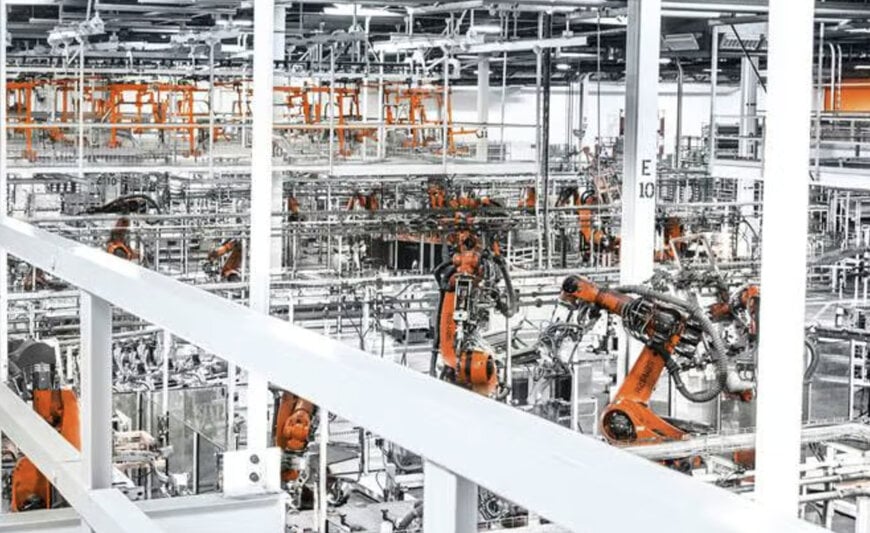
KUKA Toledo Production Operations (KTPO), located in Ohio, manufactures vehicle bodies for the automotive industry. The 335,000-square-foot facility produces the body-in-white for Jeep Wrangler and Gladiator vehicles, outputting over 300 vehicle bodies per day—approximately one every two minutes. The highly automated plant utilizes 285 robots and more than 60,000 connected devices across its production environment. This scale of operation generates vast amounts of production data, much of which typically remains dormant in isolated systems.
Improvement objectives
The facility sought to scale intelligent automation by moving artificial intelligence out of pilot environments and into real-world manufacturing. Management aimed to increase operational flexibility, automate complex processes, and reduce changeover times without replacing existing automation assets. The primary goal was to transform isolated factory data into actionable insights, allowing automation systems to better understand production processes and continuously improve performance.
Selected technical solution
To connect existing automation infrastructure with AI-driven systems, the facility implemented the KUKA Automation Management Platform (AMP). This open orchestration platform was selected to create a scalable foundation for Physical AI. The system allows the integration of custom AI models within a shared context layer. By continuously collecting and analyzing operational data, the platform forms a closed-loop system designed to inform decision-making in real time. The initial operational deployment specifically focuses on the coordination of autonomous mobile robots (AMR) within the facility.
Deployment and support
The platform's alpha version was deployed directly into the active production environment at KTPO. Testing within this established infrastructure allows engineers to evaluate the system under realistic manufacturing conditions. "KTPO is a familiar environment for us, so we can focus on evaluating the platform under realistic conditions and accelerate improvements that will help deliver the best possible experience for our users," explains Marc Fleischmann, Chief Software and AI Officer.
Objective benefits and results
The integration connects mobile robots, production machines, and software systems to maximize the utility of existing factory data. The system enables machines to process environmental variables, learn from operational data, and coordinate activities across workflows. By combining established industrial automation with AI-driven decision-making, the facility establishes a practical path to augment existing workflows and drive higher efficiency throughout the automotive production cycle.
Edited by Maria Brueva, Induportals editor – adapted by AI.
www.kuka.com
