
www.industryemea.com
04
'26
Written on Modified on
SUPERPAN Project Develops Ultralight Recyclable Panels for Transport
BIRKA COMPOSITES, AIMPLAS, and IDEKO collaborate to create sustainable, lightweight composite components using automated manufacturing.
www.aimplas.net
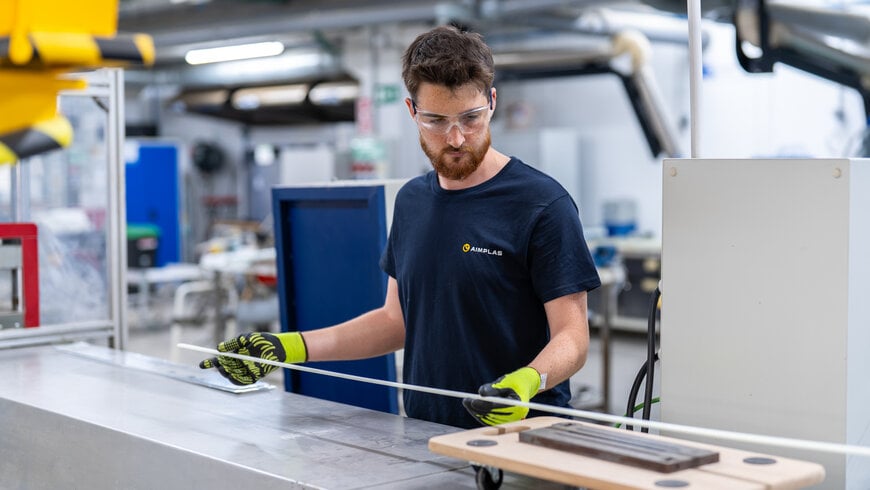
The SUPERPAN research project—a joint initiative led by BIRKA COMPOSITES alongside technology centers AIMPLAS and IDEKO—has been launched to develop a new generation of multidirectionally reinforced, ultralight panels for the transport sector. The project addresses critical industry challenges by focusing on reducing structural weight, improving energy efficiency, and shifting composite production towards highly sustainable, automated models.
Sustainable Materials and Circular Economy
A central advancement of the SUPERPAN project is the transition toward materials that can be easily recovered at the end of their operational lifecycle. By substituting traditional thermosetting resins with thermoplastic matrices, the initiative significantly enhances the recyclability of structural composites. This approach aligns with circular-economy principles, ensuring components are designed with their entire service life and end-of-life recovery in mind. According to Manuel Guerrero of BIRKA, the goal is to advance efficient materials that reduce weight without compromising structural safety or performance.
Automated Manufacturing Processes
To overcome the high costs, complexity, and manual dependence of current composite manufacturing, SUPERPAN integrates advanced, automated production techniques. The project utilizes dual pullbraiding (DPB)—a technology patented by BIRKA—combined with ultraviolet (UV)-assisted curing of prepregs. Furthermore, the integration of real-time data controllers into the manufacturing line minimizes process variability, reduces energy consumption, and limits defect rates, thereby increasing overall productivity and industrial scalability.
Additional Context
This section provides technical background not explicitly detailed in the original release.
The shift from thermoset to thermoplastic composites represents a critical evolution in structural manufacturing. While traditional thermosets (such as epoxies) offer high strength, their cross-linked chemical structures prevent them from being melted down and reformed, often resulting in landfill waste or low-value downcycling. Thermoplastics can be reheated, reshaped, and reprocessed, offering a viable pathway for closed-loop recycling in heavy industries. Funded by the Spanish State Research Agency (AEI) and co-funded by the European Union under the 2023 Public-Private Partnership program, the SUPERPAN project exemplifies the accelerating European push to decarbonize commercial and heavy transport vehicles through advanced, scalable lightweighting strategies.
Edited by Lekshman Ramdas, Induportals editor – adapted by AI.
www.aimplas.com
