
www.industryemea.com
28
'26
Written on Modified on
High-Voltage Gas-Insulated Circuit Breakers for Transmission Networks
GE Vernova developed a 420 kV circuit breaker using alternative gas mixtures to modernize high-voltage electrical substations without sulfur hexafluoride.
www.gevernova.com
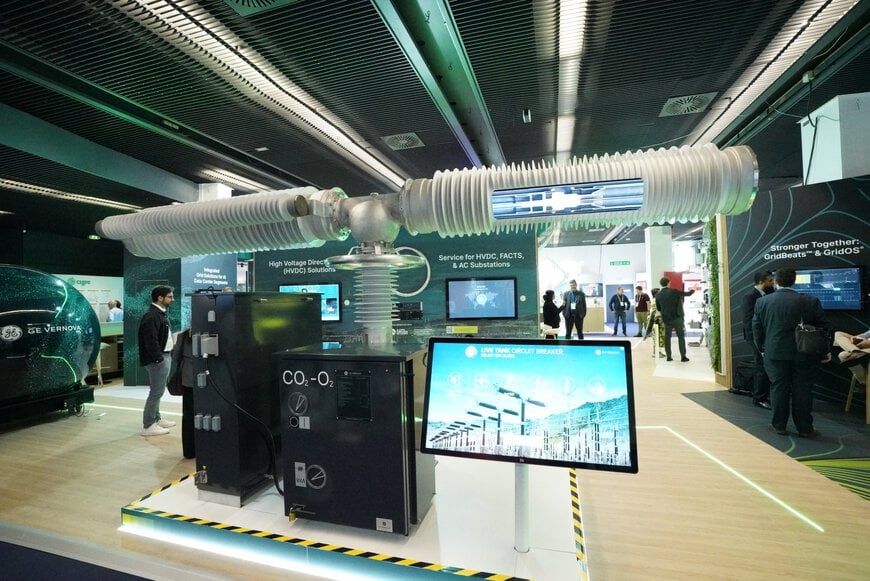
High-voltage electrical transmission systems require rapid fault-current interruption to protect critical substation assets and maintain grid stability. The deployment of non-fluorinated switching equipment addresses operational continuity at high electrical ratings while phasing out greenhouse gas alternatives across primary transmission networks.
Technical Capabilities and Gas Mixture Integration
Substation equipment operating at the transmission level must withstand high dielectric stress while interrupting substantial fault currents. The GL316c live tank circuit breaker operates at a rated voltage of 420 kV and handles short-circuit breaking currents up to 63 kA. Rather than utilizing sulfur hexafluoride (SF₆), which has historically served as the primary arc-quenching and insulating medium in high-voltage switchgear, the unit employs a gas mixture consisting of carbon dioxide and oxygen (CO₂-O₂). This medium provides the necessary arc-extinction properties during contact separation under full fault load conditions.
The technology evolved from an initial 420 kV, 50 kA configuration developed under the European Union LIFE Programme co-funded initiative titled "LIFE SF6-free HV Breaker." Subsequent engineering modifications and test sequences validated switching performance up to 63 kA, extending the design to higher fault-current environments.
Manufacturing and Infrastructure Applications
Transmission system operators integrate live tank circuit breakers at outdoor substations where overhead transmission lines interface with transformers and busbar systems. The equipment performs routine load switching alongside emergency disconnection under short-circuit events. Production of the 420 kV, 63 kA variant is assigned to the manufacturing plant in Villeurbanne, France, where it integrates into the manufacturer's GRiDEA technology portfolio aimed at reducing fluorinated gas dependency across high-voltage portfolios.
According to Eric Chaussin, VP and CEO of the Power Transmission Business, advancing CO₂-O₂ technology to 420 kV and 63 kA extends non-SF₆ interrupting capability into network nodes characterized by peak fault-current levels.
Additional Context
This section details technical specifications and competitive benchmarking not included in the original product announcement.
Alternative transmission-level switchgear development focuses primarily on two competing dielectric and interrupting media: synthetic air mixtures combined with vacuum interrupters, and fluoronitrile-based gas mixtures (such as C4-FN blended with CO₂ and O₂).
In the 420 kV transmission class, equipment relying on vacuum interrupters generally requires multiple interrupter units in series to achieve dielectric recovery at high voltages, often limiting single-break designs to lower voltage classes (such as 72.5 kV to 145 kV) or requiring complex mechanical linkages for 420 kV operation. In contrast, gas-mixture breakers utilize thermal puffer or self-blast arc-quenching mechanisms similar to traditional SF₆ architectures. Fluoronitrile-based gas mixtures (C4-FN/CO₂/O₂) provide dielectric strength comparable to SF₆ with a Global Warming Potential (GWP) reduction of approximately 98% to 99%, while natural gas mixtures like CO₂-O₂ eliminate fluorinated compounds entirely, yielding a GWP reduction close to 100% relative to pure SF₆ (which has a GWP of 24,300 over a 100-year horizon). Operating at 63 kA short-circuit interruption aligns the GL316c with standard maximum fault ratings for 420 kV transmission substations under IEC 62271-100 standards.
Edited by Evgeny Churilov, Induportals Media - Adapted by AI.
www.gevernova.com
