
Emitech expands EMC testing expertise for emerging wireless frequencies
New methodology enables medical device immunity testing beyond 6 GHz, supporting FDA compliance for 5G and Wi-Fi.
www.emitech.fr
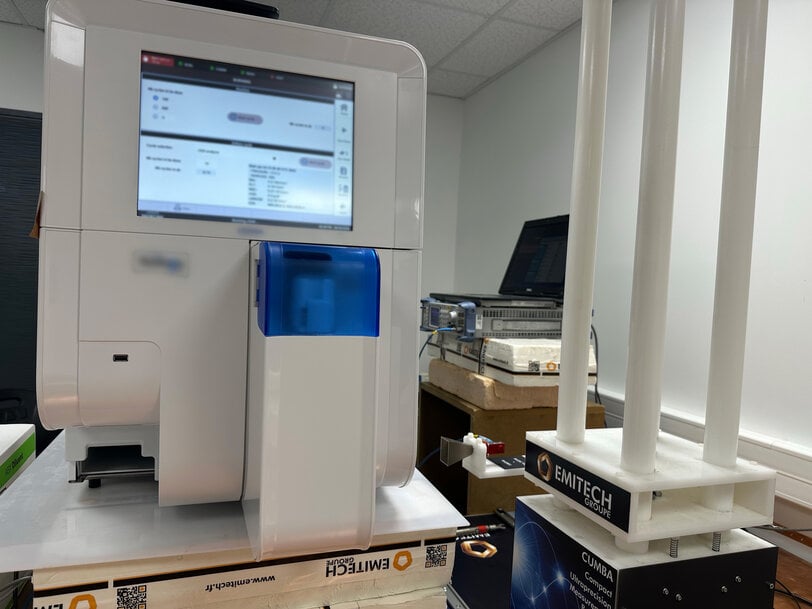
The Emitech Group is a major player in equipment testing. In the medical sector, it supports manufacturers, importers, and distributors in bringing their products to the U.S. market via the FDA 510(k) pathway. Their technical dossier must demonstrate the product’s electromagnetic compatibility, particularly with regard to the collateral standard IEC 60601-1-2 and its FDA-recognized version (ANSI/AAMI/IEC 60601-1-2). However, this standard—like all current EMC standards—covers radiated immunity testing only up to 6 GHz, whereas medical devices now incorporate wireless functions that operate in higher frequency bands: 5G FR2, Wi-Fi 6E, and Wi-Fi 7.
The FDA’s June 2022 guidance on the electromagnetic compatibility of medical devices explicitly requires manufacturers to identify and technically justify the electromagnetic risks associated with their product’s real-world usage environment, even when no standard yet covers them. For devices incorporating these new wireless technologies, this creates a methodological gap: how can a product’s robustness be demonstrated at frequencies that the standard does not test?
It is in this context that the Emitech Group, with the approval of its innovation department, has developed a radiated immunity testing methodology applicable beyond 6 GHz. Its approach mirrors the one Emitech previously applied when the FDA required immunity to RFID readers even though no standardized method yet existed: the same type of modulation, field levels derived from the reference radiated immunity level in IEC 60601-1-2 (ranging from 10 V/m to 28 V/m depending on the severity of the target environment), this time applied to the frequencies of 5G FR2, Wi-Fi 6E, and Wi-Fi 7. “We cannot wait for a standard to be established to meet the FDA’s requirements: our role is to work with our clients to build a well-founded and traceable technical dossier,” emphasizes David Montaulon, EMC & Radio Expert at the Emitech Group.
Technical resources dedicated to high frequencies
To implement this methodology, the Emitech Group relies on testing resources that are uncommon among players in the medical market. It utilizes resources originally developed for its defense-related activities; its antennas and radio-frequency generators cover frequencies up to approximately 40 GHz, enabling radiated immunity testing on bands not covered by current standards (5G FR2, Wi-Fi 6E/7).
For near-field testing above 18 GHz, the laboratory repurposes a high-precision motorized mast, originally developed for radio frequency measurements up to 140 GHz. This device enables automatic scanning at a distance of approximately 5 cm from the product under test, ensuring uniform exposure and excellent reproducibility. All tests are conducted in an anechoic chamber, covering the entire surface of the equipment.
An approach based on foresight, not on waiting for a standard
The RFID case study illustrates this philosophy. When a client—a manufacturer of enteral feeding pumps—was faced with an FDA recommendation regarding immunity to RFID frequencies, even though no standardized test bench existed, the Emitech Group developed its own in-house solution. As a result, its teams enabled the client to secure market authorization in the U.S. even before the FDA formally recognized AIM Standard 7351731, which addresses this immunity. Today, the Emitech Group applies the same approach to emerging 5G and Wi-Fi frequencies, convinced that part of this methodology will eventually be incorporated into future regulatory standards as well.
A Philosophy Rooted in the FDA’s Risk Management Approach
The FDA does not systematically require additional testing; rather, it seeks to verify that the risk has been identified, analyzed, and technically justified. This is the crux of this methodology: it enables the Emitech Group’s clients to compile a traceable technical dossier that aligns with the spirit of the FDA guidance, rather than encountering a roadblock during the review of the 510(k) application.
For manufacturers, the benefit is clear: by incorporating these tests from the product design phase, they reduce the risk of delays caused by a Request for Additional Information (AFI) during the 510(k) review process.
A Longer-Term Goal
Beyond this new methodology, the Emitech Group intends to remain a leading player in anticipating electromagnetic risks associated with emerging wireless technologies—whether they involve the next generations of Wi-Fi or future mobile networks. This ability to anticipate risks—already proven in the RFID sector—is a key differentiator that enables the Group to support its clients as soon as new frequency bands emerge, even before they are covered by a standard.
With this new methodology, the Emitech Group—which employs 680 people across 18 locations and forecasts revenue of 78.1 million euros in 2026—is strengthening its position in the medical sector and confirming its ability to support its clients in the most demanding markets in terms of electromagnetic compatibility.
www.emitech.com
