
www.industryemea.com
16
'26
Written on Modified on
Acceed Unveils Robust Dual-GPU Edge AI Computer
The MIL-STD-810H certified Nuvo-10208GC secures high-performance graphics cards using a patented clamping mechanism for extreme operational environments.
acceed.com
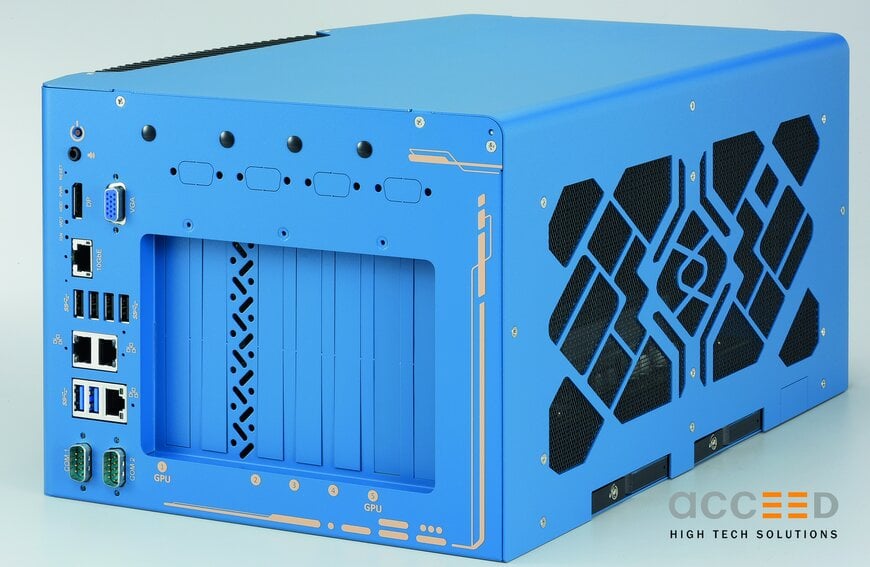
Specialized distributor Acceed has added the new Nuvo-10208GC industrial controller to its portfolio. Specifically engineered for demanding edge AI applications, the system accommodates two full-sized NVIDIA RTX graphics cards, each drawing up to 350 watts of power. To reliably protect these high-performance GPUs—which weigh over 500 grams each—against severe vibration and shock, the 4U chassis features a patented damping and clamping mechanism that secures the cards directly to the housing. This enables the computer to meet the rigorous requirements of MIL-STD-810H certification, allowing deployment in mobile inspection systems, autonomous vehicles, and harsh industrial environments with temperature fluctuations ranging from -25 °C to +60 °C.
High-Performance Processing and Connectivity
Powered by the industrial Intel R680E chipset, the system supports current LGA1700-format Intel processors with up to 65W TDP and a maximum of 128 GB of DDR5 RAM at 4800 MT/s. To process massive data streams from high-resolution cameras and machine vision sensors without latency, the controller comes standard with two 2.5 Gigabit and one Gigabit Ethernet port. Optional 10-Gigabit interfaces, additional PCIe slots for frame grabbers, and flexible storage options via NVMe and SATA round out the hardware configuration to efficiently handle data-intensive AI inference and parallel workloads.
Additional Context: Technological Background and Market Dynamics
This section provides technological and market background not explicitly detailed in the original release.
Conventional high-performance graphics cards (GPUs) are primarily designed for static deployment in climate-controlled server racks. In mobile or industrial edge scenarios—such as trains, autonomous agricultural machinery, or heavily vibrating production lines—the massive heat sinks of modern GPUs exert tremendous leverage forces. Without additional mechanical stabilization, these forces inevitably lead to micro-cracks in the motherboard's PCIe slot or complete contact failure. The integration of a dedicated clamping bracket thus resolves one of the most critical electromechanical vulnerabilities of mobile AI hardware. Furthermore, shifting immense computing power directly to the network edge (edge computing) is essential for autonomous real-time control. By evaluating complex deep learning models locally, operators eliminate the dangerous latencies and high bandwidth costs associated with transmitting uncompressed high-speed video streams to cloud-based data centers.
Edited by Lekshman Ramdas, Induportals editor – adapted by AI.
www.acceed.com
