
www.industryemea.com
22
'26
Written on Modified on
Digital Twins for Physical AI in Industrial Automation
Festo, NVIDIA, and ABB Robotics integrate NVIDIA Isaac Sim, Omniverse libraries, and ABB RobotStudio to resolve machine integration errors through physics-based virtual commissioning.
www.festo.com
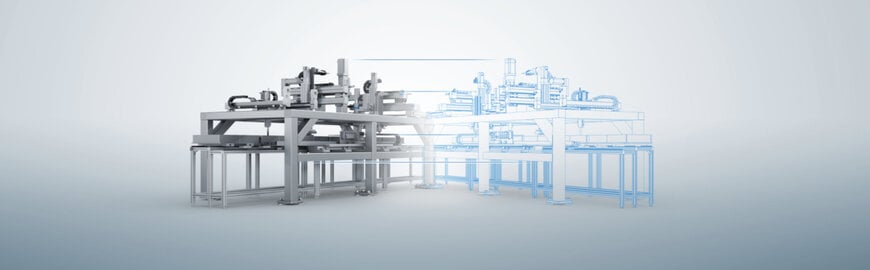
Deploying complex multi-axis handling systems and robotic cells in factory and process automation requires extensive validation to prevent mechanical collisions and control logic bottlenecks during physical installation. To address the simulation-to-reality gap that typically delays machine commissioning, Festo is collaborating with NVIDIA and ABB Robotics to develop physics-validated digital twins utilizing NVIDIA Isaac Sim, NVIDIA Omniverse libraries, and ABB RobotStudio.
Solving the Simulation-to-Reality Gap in Virtual Commissioning
When industrial machines combine multiple kinematic, pneumatic, and electrical functions, engineering teams must verify how these subsystems interact before hardware installation begins. Traditional computer-aided engineering models often capture static 3D geometry without accurately reflecting dynamic motion profiles, friction, or real-world mechanical compliance. Consequently, machine builders encounter integration mismatches during physical assembly that require manual reprogramming on the shop floor.
Virtual commissioning resolves these integration bottlenecks during the design phase, provided the underlying digital product models behave identically to physical hardware. As noted by Jan R. Seyler, Head of Physical AI and Digital Thread at Festo, digital product models must match the reliability standards of physical hardware so engineers can validate automation systems under realistic operating conditions. Prof. Dr. Tomas Smetana, Chief Technology Officer at Festo, states that combining NVIDIA Omniverse libraries with industrial automation engineering establishes a virtual environment designed to support autonomous production systems.
Physics-Based Simulation Architecture and OpenUSD Integration
The technical foundation of Festo's simulation architecture relies on extending existing Universal Scene Description (USD) data exports with dynamic motion behaviour and application-relevant physical properties. While standard CAD files define spatial boundaries, USD-based models within the NVIDIA Omniverse ecosystem incorporate kinematic chains, mass properties, and dynamic response characteristics.
Festo utilizes NVIDIA Isaac Sim, an open robotics simulation framework built on NVIDIA Omniverse libraries, alongside synthetic data generation to train and validate robotic perception and autonomous control algorithms. To ensure the fidelity of these virtual components, Festo is implementing a closed-loop verification workflow that benchmarks simulated outputs against empirical test data. Under defined operating conditions in Festo laboratories, physical components undergo motion and dynamic behaviour measurements. Engineers compare these physical telemetry datasets directly against simulation runs in NVIDIA Isaac Sim, iteratively calibrating the digital twin parameters until the virtual model accurately reproduces real-world component physics.
Multi-Vendor Co-Simulation with Three-Axis Handling and Robotics
A primary industrial application of this architecture is a joint virtual handling cell developed by Festo, ABB Robotics, and NVIDIA. In factory automation, integrating linear gantry or cartesian handling units with articulated industrial robots frequently introduces timing, workspace interference, and controller synchronization challenges.
To validate these multi-vendor workflows prior to hardware procurement, the partners linked the digital twin of a three-axis Festo handling system with an articulated robot inside ABB RobotStudio. The system architecture utilizes the RobotStudio HyperReality extension, which bridges ABB's offline programming environment with NVIDIA Omniverse libraries to render photorealistic, physics-based simulations. Concurrently, the ABB Virtual Controller executes the exact control software and robot programs that run on physical ABB controllers.
By running the Festo three-axis handling kinematics and the ABB Virtual Controller within a unified simulation environment, machine builders can optimize cycle times, verify collision-free trajectories, and debug PLC-to-robot communication protocols virtually. According to Boris Fiedler, Head of Operations and Portfolio, Software and Digital at ABB Robotics, this joint engineering approach advances virtual commissioning for machine builders and supports the deployment of industrial-grade Physical AI. In the long term, narrowing the divergence between virtual validation and physical operation enables control code and AI policies trained in simulation to transfer directly to factory floor machinery with minimal manual adaptation.
Enterprise Scale and Industrial Application Scope
Festo develops these digital models to support its global customer base across more than 35 factory and process automation industries, including emerging LifeTech applications in medical technology and laboratory automation. Headquartered in Esslingen am Neckar, Germany, Festo supplies pneumatic and electrical automation technology to 300,000 customers across 176 countries. The company employs approximately 20,600 people across more than 250 branch offices in around 60 countries, generating a turnover of approximately €3.33 billion in 2025. To sustain its hardware and digital engineering developments, Festo invests more than 8% of its annual turnover into research and development, alongside 1.5% allocated to basic and further technical training supported by Festo Didactic SE.
Additional Context:
This section details technical specifications and competitive benchmarking not included in the original product announcement.
In industrial automation engineering, the transition from kinematic digital twins to physics-informed digital twins for Physical AI is governed by emerging interoperability standards. Beyond the OpenUSD (Universal Scene Description) framework spearheaded by the Alliance for OpenUSD (AOUSD) for 3D scene composition and physical attributes, multi-vendor co-simulation typically relies on the Functional Mock-up Interface (FMI) standard and the Asset Administration Shell (AAS) defined by the Industrial Digital Twin Association (IDTA), of which Festo is a founding member. While AAS standardizes static and dynamic asset metadata across the digital thread, OpenUSD and NVIDIA Omniverse provide the real-time GPU-accelerated ray tracing and PhysX solver execution required to train reinforcement learning policies and synthetic vision models.
Across the broader industrial automation and robotics sector, major manufacturers are establishing comparable pathways to integrate physics simulation with native controller software:
Siemens integrates its Process Simulate and NX Mechatronics Concept Designer (MCD) platforms with NVIDIA Omniverse, pairing them with SIMATIC S7-PLCSIM Advanced to execute virtual PLC code against physics-based 3D models.
Rockwell Automation utilizes its Emulate3D software—which incorporates volumetric physics and CAD kinematics—alongside NVIDIA Omniverse APIs to simulate material handling and robotic workcells driven by ControlLogix virtual controllers.
KUKA and Fanuc offer native offline programming and virtual controller environments (KUKA.Sim and FANUC ROBOGUIDE, respectively) that utilize exact robot controller kernels (such as KUKA.OfficeLite) to guarantee cycle-time accuracy, though traditional OEM simulators historically prioritized proprietary kinematic validation over open, multi-vendor photorealistic synthetic data generation.
Compared to standalone vendor-specific simulators that evaluate either linear motion axes or articulated robots in isolation, the Festo, ABB Robotics, and NVIDIA integration specifically addresses heterogeneous workcells. By combining Festo's laboratory-calibrated component models with ABB's Virtual Controller kernel inside an OpenUSD-compliant Omniverse environment, the architecture enables simultaneous validation of pneumatic/electric linear actuators and 6-axis robotics under a single physics engine.
Edited by Sucithra Mani, Induportals editor – adapted by AI.
www.festo.com
