
www.industryemea.com
16
'26
Written on Modified on
Wastewater Heat Recovery for Urban District Heating
Hounslow Borough Council and Thames Water collaborate to recover heat from treated wastewater at Mogden Sewage Treatment Works to supply a low-carbon district heating network.
www.thameswater.co.uk
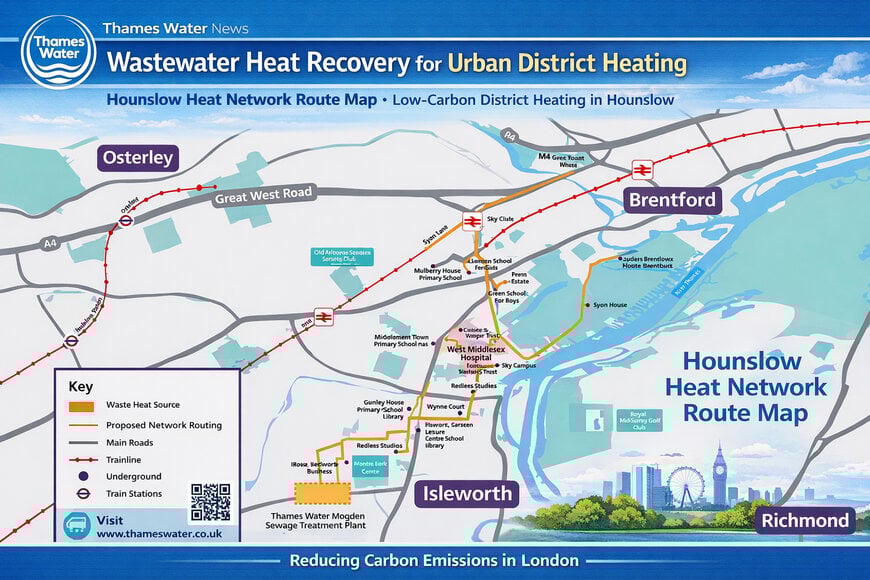
Hounslow Borough Council and Thames Water are working together to deploy a wastewater heat-recovery system that will supply renewable heat to a district heating network serving homes and public buildings in the London Borough of Hounslow. The system uses treated wastewater as a stable thermal source for a centralised heat network designed to reduce carbon emissions from building heating.
Context of the Cooperation
Urban heating remains a major source of greenhouse gas emissions, particularly where buildings rely on individual gas boilers. The Hounslow project addresses this challenge by capturing thermal energy from wastewater flows at the Mogden Sewage Treatment Works, one of the largest treatment facilities in the UK.
The facility processes wastewater from approximately two million people each day, providing a continuous low-grade heat source. Hounslow Borough Council leads the development of the borough-wide heat network, while Thames Water provides access to the wastewater infrastructure and supports the integration of heat-recovery systems at the treatment works.
The project has received £10.55 million from the UK Government’s Green Heat Network Fund (GHNF), which supports the development of low-carbon district heating infrastructure.
Technical Solution and Responsibilities
The system captures heat from treated wastewater using heat exchangers installed within the treatment works. Thermal energy is transferred to a heat-pump system that upgrades the temperature to levels suitable for building heating networks.
Thames Water is responsible for enabling the extraction of thermal energy from wastewater streams and supporting the installation of heat-recovery infrastructure within the treatment facility. Hounslow Borough Council manages the design and development of the district heating network, including energy distribution infrastructure and integration with buildings.
Heat is transported through insulated underground pipes carrying hot water, forming a centralised heat network. Such networks can replace individual building heating systems and allow multiple energy sources to be integrated into the same thermal infrastructure.
Deployment and Infrastructure
The first phase of the Hounslow Heat Network is planned to include approximately 8.8 km of underground distribution pipework connecting the heat source at Mogden to residential, public and commercial buildings.
Construction of the network infrastructure is expected to begin in 2028. Once operational, the system is projected to deliver around 50 GWh of low-carbon heat annually.
The network is designed to serve up to 3,000 homes in its initial phase, alongside hospitals, NHS buildings, schools, libraries and other municipal facilities. Integration with existing building heating systems will allow properties to receive heat without individual boilers or electric heaters.
Applications and Use Cases
The project demonstrates the application of district heating infrastructure using wastewater as a renewable thermal source. Target users include residential developments, healthcare facilities, education buildings and public infrastructure requiring continuous heating demand.
Wastewater heat recovery is already deployed at more than 500 locations globally, particularly in Northern Europe and Scandinavia, where district heating systems are widely used.
Expected Impact
When operational, the system is projected to reduce emissions by approximately 6,690 tonnes of CO₂ equivalent annually, compared with conventional heating systems. The recovered heat represents part of a wider potential resource: across London and the Thames Valley, wastewater could theoretically supply up to 10 TWh of low-carbon heat, equivalent to heating more than 800,000 homes.
The Hounslow Heat Network illustrates how water infrastructure can support urban decarbonisation strategies by integrating wastewater energy recovery with sustainable urban energy systems.
Edited by an industrial journalist, Sucithra Mani — AI-powered.
www.thameswater.com
