
www.industryemea.com
16
'26
Written on Modified on
Edge AI Computing Platforms for Real-Time Airport Baggage Monitoring
ARBOR Technology Corp. integrates specialized AI acceleration and computer vision to automate detection of conveyor disruptions through decentralized edge computing.
www.arbor-technology.com
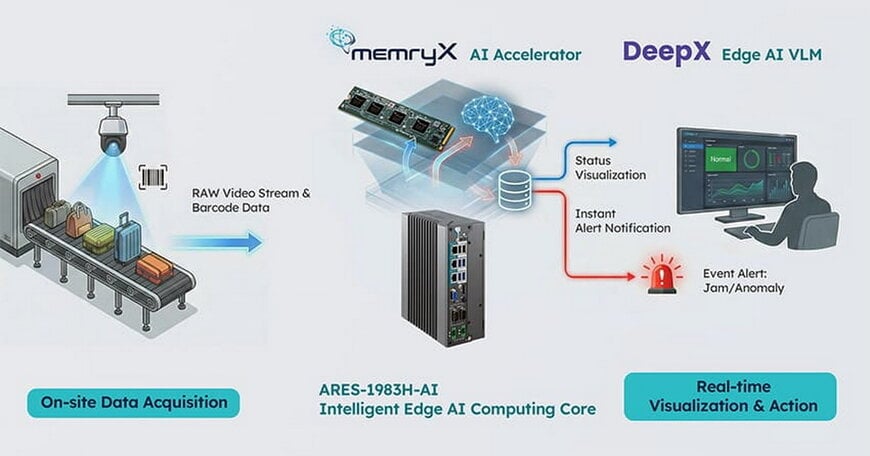
The ARES-1983H-AI is an industrial-grade edge AI platform designed for continuous operation in airport logistics, utilizing high-performance inference to monitor baggage flow and detect mechanical jams. By processing visual data at the point of origin, the system enables immediate intervention in high-volume transport environments, reducing reliance on centralized data centers or manual oversight.
Hardware Architecture and Environmental Durability
The core of the system is the ARBOR Technology Corp. ARES-1983H-AI, which features a fanless or dual fan-sink thermal design to maintain operational stability in space-constrained airport infrastructure. The hardware is engineered to withstand the dust, vibration, and temperature fluctuations inherent to baggage handling areas. For connectivity and security, the platform includes three LAN ports and eight USB ports, including two internal USB 2.0 ports dedicated to hardware license keys and security dongles.
Scalable Inference via M.2 Acceleration
To manage the computational load of real-time video analytics within the digital supply chain, the solution incorporates MemryX MX3 M.2 AI Accelerator Modules. The architecture allows for the installation of one, two, or four modules, providing a scalable performance range from 24 TFLOPS to 96 TFLOPS. A technical distinction of this acceleration is the use of Group-BF16 activations, which provides higher mathematical accuracy for computer vision models compared to standard INT8 quantization. This precision is critical for distinguishing between standard baggage flow and overlapping items or pile-ups.
Computer Vision and Flow Analytics
The software layer, provided by DeepX, utilizes computer vision to monitor the automotive data ecosystem of moving parts and luggage. The algorithms are trained to identify specific operational disruptions, such as conveyor congestion or baggage jams, without the latency associated with cloud-based processing. By utilizing a public SDK with open-source model support, the system allows for the integration of new neural networks as operational requirements evolve.
Operational Impact on Infrastructure
The integration of these technologies provides end-to-end visibility across terminal conveyor systems. By shifting from reactive to proactive monitoring, airport operators receive real-time alerts via intuitive dashboards. This localized processing ensures that even if network connectivity to a central server is interrupted, the edge device continues to monitor and log critical flow data. The platform supports future expansion through further AI upgrades and hybrid cloud integration, facilitating the development of resilient, automated airport infrastructure.
Edited by Evgeny Churilov, Induportals Media - Adapted by AI.
www.arbor-technology.com
