
www.industryemea.com
27
'26
Written on Modified on
Crane Service Agreement Supports Shipyard Operations
Konecranes and Meyer Turku Oy collaborate on large-scale crane maintenance and optimization program for shipbuilding infrastructure.
www.konecranes.com
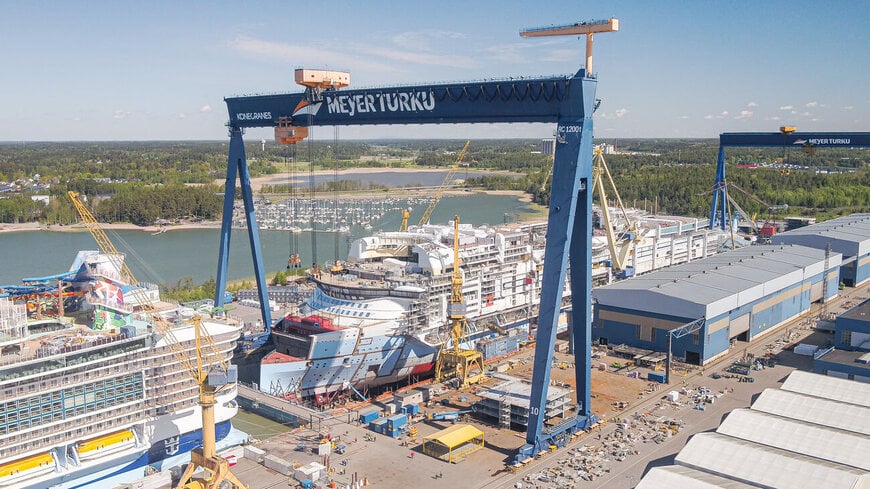
Konecranes and Meyer Turku Oy have entered a four-year service agreement covering the maintenance and operational optimization of approximately 200 cranes at the Turku shipyard, supporting continuous shipbuilding operations and asset reliability.
Context of the Cooperation
Meyer Turku operates one of Finland’s most significant shipyards, with a long industrial history and complex lifting infrastructure required for cruise ship construction. The facility relies on a wide range of cranes, from light-duty units handling 63 kg loads to heavy-duty systems such as a 1,200-tonne Goliath gantry crane.
Given increasing production volumes and full order books, maintaining high equipment availability and minimizing downtime has become a critical operational requirement. The cooperation with Konecranes builds on a long-standing relationship dating back to the shipyard’s establishment in 1976, combining operator requirements with OEM-level service expertise.
Technical Solution and Responsibilities
The agreement includes a comprehensive service framework covering preventive maintenance, corrective repairs, and operational readiness across the crane fleet. Konecranes is responsible for delivering structured maintenance programs based on equipment condition, usage cycles, and safety requirements.
The service model integrates inspection routines, lifecycle assessments, and predictive maintenance approaches supported by digital diagnostics. This enables early identification of wear, load-related stress, and component fatigue, particularly important for high-capacity lifting systems such as gantry cranes.
Meyer Turku retains operational control of production processes while relying on Konecranes for technical service execution, spare parts management, and system optimization. The cooperation reflects a typical industrial automation service architecture where asset performance is managed through a combination of field service and data-driven maintenance planning.
Deployment and Implementation
The agreement, booked in mid-2025, is already under execution at the Turku shipyard. Implementation involves phased servicing aligned with production schedules to avoid disruption to vessel assembly operations.
Integration with existing infrastructure includes compatibility with legacy crane systems as well as newer digitally enabled equipment. Maintenance activities are coordinated to ensure compliance with safety standards and lifting regulations applicable to shipyard operations.
Applications and Use Cases
The crane systems support core shipbuilding processes, including hull assembly, block handling, and heavy component installation. Reliable crane operation is essential for maintaining workflow continuity in large-scale modular construction environments.
Typical use cases include synchronized lifting operations, high-load positioning, and repetitive material handling tasks requiring precision and uptime. The service agreement targets improved process stability, reduced unplanned stoppages, and enhanced equipment lifecycle management.
Results and Expected Impact
While no quantitative performance metrics are disclosed, the structured maintenance approach is expected to improve equipment availability and reduce failure rates through predictive interventions. For high-capacity assets, even minor reliability improvements can translate into significant operational gains by preventing production delays.
The cooperation demonstrates how long-term service agreements can support complex industrial environments by aligning maintenance strategies with production demands and asset criticality.
Edited by an industrial journalist Sucithra Mani with AI assistance.
www.konecranes.com
